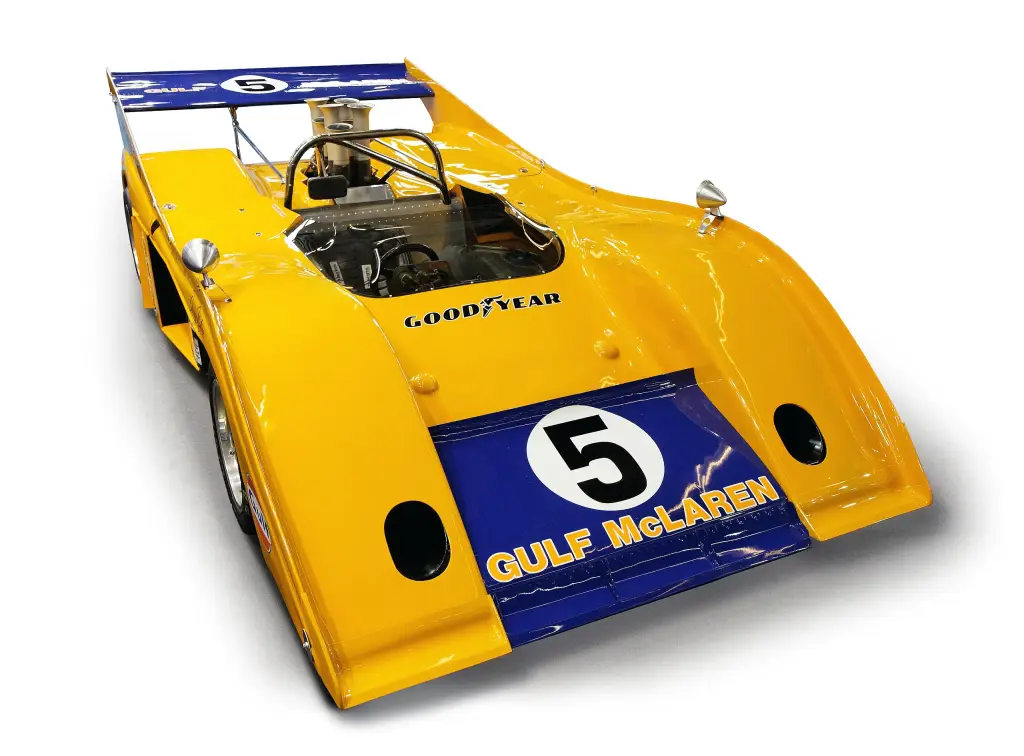
The McLaren M20 was the sports prototype McLaren developed for the 1972 Can-Am season as a replacement for the M8F. It was the last Can-Am design the team created before leaving the series, and only three were built.
McLaren M20 at a glance
| Type | Can-Am sports prototype |
|---|---|
| Season | 1972 |
| Replaced | McLaren M8F |
| Designers | Gordon Coppuck and Tyler Alexander |
| Engine | Chevrolet V8, 509 cu in (8,340 cc), about 750 hp |
| Gearbox | Hewland Mk II behind a Lola-type spacer |
| Chassis | aluminium with fibreglass bodywork |
| Cooling | two radiators beside the cockpit instead of one in the nose |
| Aerodynamics | adjustable airfoil between the front wheel arches |
| Brakes | Lockheed discs with machined grooves |
| Built | three |
| Main results | two wins for Denny Hulme in 1972; one for Scooter Patrick in 1974 |
based on one source (English Wikipedia).
History of the McLaren M20
When McLaren designed the replacement for the 1971 M8F, one of the team’s main aims was to improve cooling so that Denny Hulme and Peter Revson would be more comfortable during races. On the M8F, as on earlier McLaren sports cars, a large radiator sat in the nose and the air left it upwards over the open cockpit. Gordon Coppuck and Tyler Alexander solved the problem with two radiators, one on each side of the cockpit, fed from the flanks of the bodywork, so the hot air no longer passed over the driver.
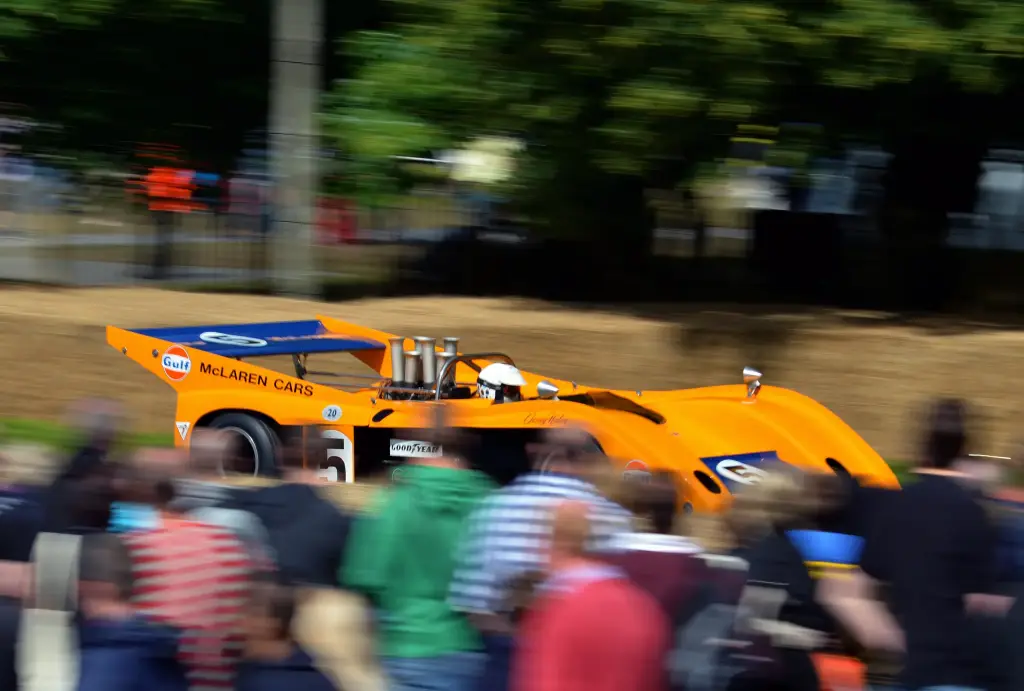
Without a radiator in the nose, the designers could reshape the front for better aerodynamics, adding an adjustable airfoil between the front wheel arches to increase downforce and grip in corners. The fuel tanks had to be redesigned too: they were compacted around the cockpit and arranged to flow from the outer tanks into a central one, so that weight distribution did not change as fuel was burned off.
The engine was again a Chevrolet V8, enlarged to 509 cubic inches (8,340 cc) and giving about 750 hp, with a Hewland Mk II gearbox behind a Lola-type spacer that moved the engine forward. The fibreglass body on the aluminium chassis kept the M8F’s coke-bottle shape but gained side ducting for the radiators, and the Lockheed brakes used grooved discs to prevent outgassing. Three cars were built in 1972, and all were eventually sold to private teams.
Two cars debuted at Mosport Park, the opening round of 1972, and Hulme won after some tyre trouble, beating Porsche’s new turbocharged 917/10. At Road Atlanta his M20 became airborne and flipped while following a Porsche over the hump, and the destroyed car was replaced by the third chassis. Hulme then won at Watkins Glen with Revson second, but a string of engine failures cost McLaren the title for the first time since 1966, and the team turned to Formula One and Indy cars. The three cars went to private teams; one was fitted with a turbocharger to take on Porsche, and Scooter Patrick won with another at Road America in 1974, shortly before the series was cancelled.
Design and features
- Side radiators: cooler cockpits and a free nose for aerodynamics.
- Adjustable front airfoil: more front-end downforce and grip than the M8F.
- Eight-litre Chevrolet: 509 cubic inches and about 750 hp, the biggest engine of the M8 line.
- Fuel tanks around the cockpit: arranged to keep the weight distribution stable during a race.
- Grooved brake discs: developed with Lockheed to clear gas from the pads.
McLaren M20 versions
- Works M20 (1972): two cars for Hulme and Revson, plus a third spare that replaced Hulme’s after his flip at Road Atlanta.
- Private entries (1973–1974): cars sold to Roy Woods Racing, Commander Motor Homes and Felder Racing, one later turbocharged.
- 1974 winner: Scooter Patrick’s U.S. Racing M20 won the last race of the season at Road America.
The M20 replaced the M8 and was the end of McLaren’s Can-Am line; its Indy car of the same years was the M16. More cars are in the McLaren collection.
Video: ROFGO Collection – McLaren M20 – Prep and fire up
Video by YouTube on YouTube.
Sources
- McLaren M20, English Wikipedia: development, engine, racing history