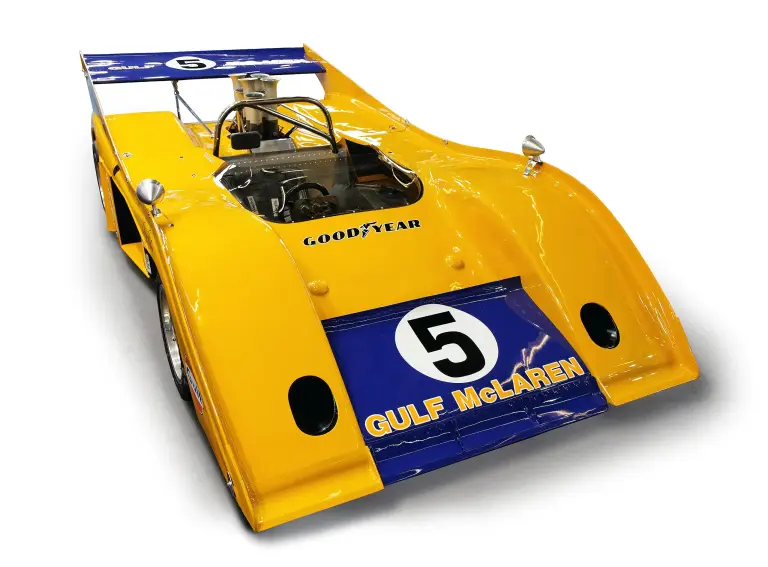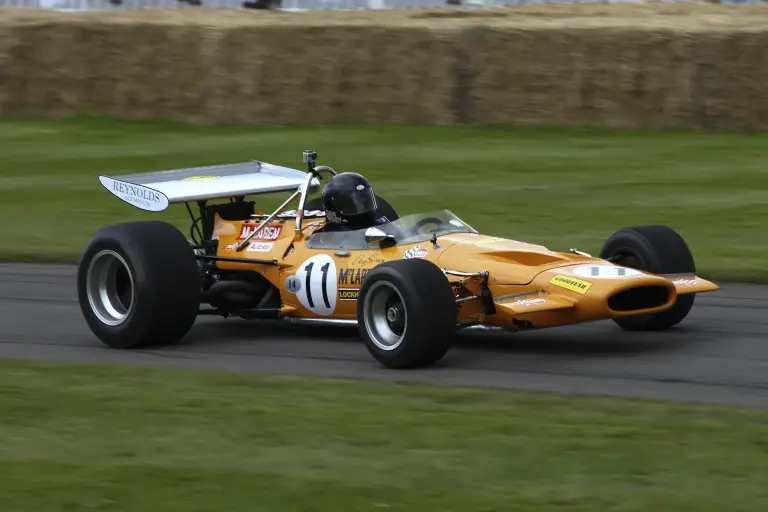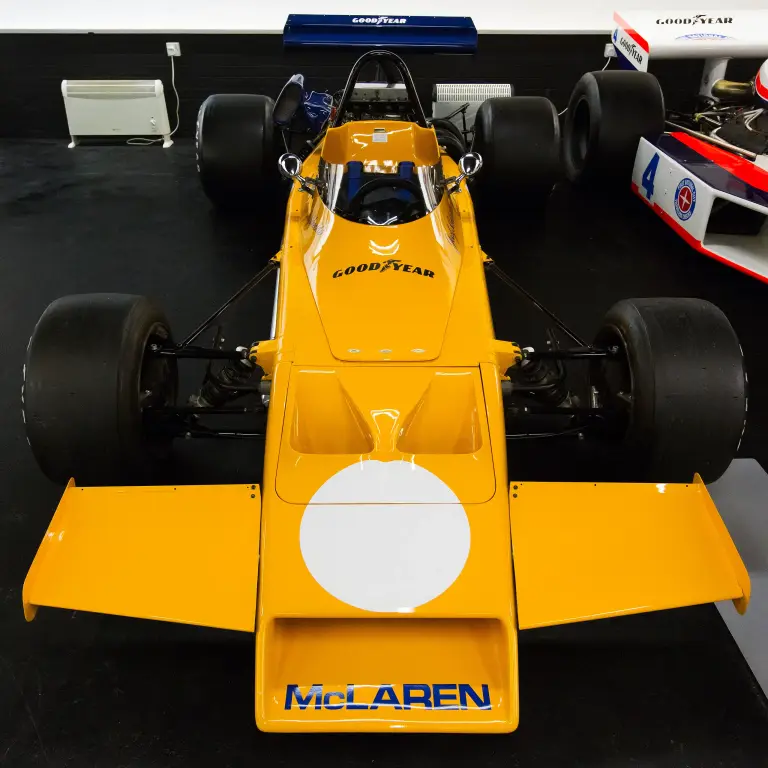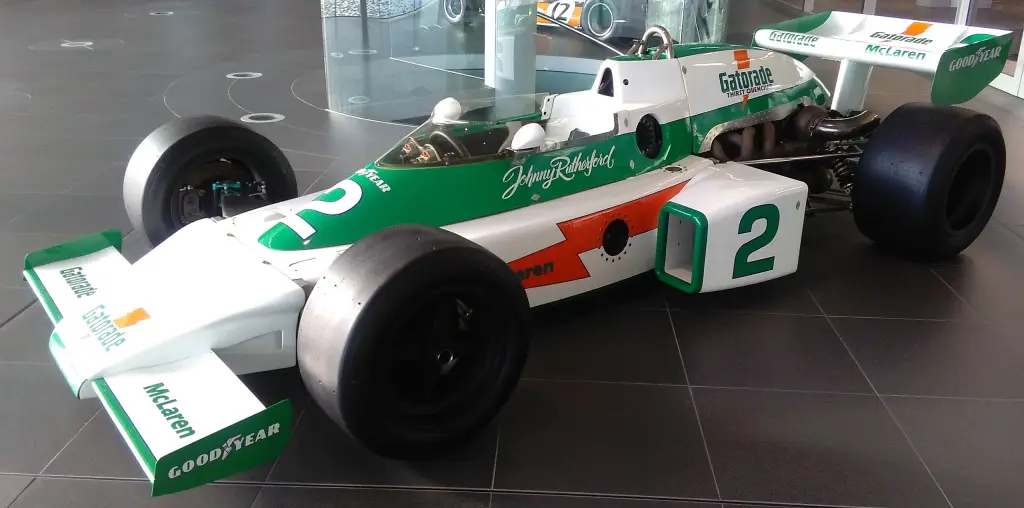
The McLaren M16 was a race car designed and built by McLaren between 1971 and 1976 for American open-wheel racing. It was the most successful car of the 1970s at the Indianapolis 500, with wins in 1972, 1974 and 1976, and the last car to win the race with the Offenhauser engine.
McLaren M16 at a glance
| Type | American open-wheel (USAC) racing car |
|---|---|
| Years | 1971–1976 |
| Engine | Offenhauser 2.61-litre turbocharged straight-four |
| Power | over 700 hp with 24.6 psi boost |
| Chassis | aluminium monocoque |
| Body | wedge shape with side-mounted radiators |
| First appearance | January 1971, replacing the M15 |
| Indy 500 wins | 1972 (Mark Donohue), 1974 and 1976 (Johnny Rutherford) |
| Replaced by | M24 |
based on one source (English Wikipedia).
History of the McLaren M16
The car was unveiled in January 1971 to replace the M15. The first version is now known as the M16A because of the updates that followed. Its aluminium monocoque carried the Offenhauser straight-four that was then standard at Indianapolis: 159 cubic inches (2.61 litres), turbocharged by Garrett and limited to 24.6 psi (1.7 bar), it produced more than 700 hp. Following the example of the Lotus 72 in Formula One a year earlier, the radiators were moved into the sidepods, which gave the car its wedge shape.
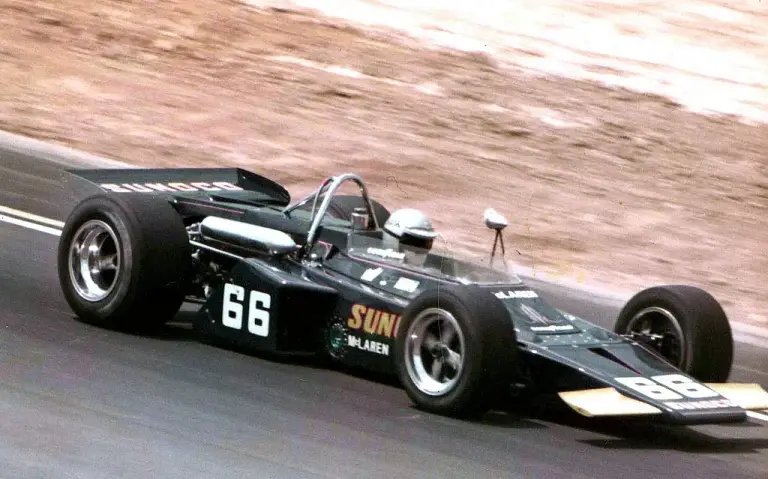
Two works cars were entered for Denny Hulme and Peter Revson in the 1971 Indianapolis 500, with a third run by Penske for Mark Donohue. All three qualified in the top four, but only Revson finished, in second place. For 1972 the updated M16B was entered by the works team for Gordon Johncock (who replaced Hulme) and Penske added a second car for Gary Bettenhausen; none of those three finished, but Donohue won, giving McLaren its first victory at Indianapolis and Penske the first of its many wins there.
Johnny Rutherford joined the works team with the M16C in 1973. In 1974 he won both the Indianapolis 500 and the Pocono 500 and finished second in the USAC championship. McLaren fielded two new M16E cars in 1975, while Penske stayed with the previous year’s cars, and Rutherford finished second at Indy and second in the championship. He won his second Indianapolis 500 with the M16E in 1976, the last year of the M16 as a works entry, as McLaren introduced the M24; other teams kept racing M16s until 1981.
Design and features
- Offenhauser turbo: the classic Indianapolis engine in its most developed form, giving more than 700 hp.
- Sidepod radiators: a wedge-shaped body borrowed from the Lotus 72 idea, cleaner aerodynamically than nose-mounted radiators.
- Aluminium monocoque: light and stiff, typical of American open-wheel design of the period.
- Long competition life: five developments in six seasons and customer cars racing until 1981.
McLaren M16 versions
- M16A (1971): the original car, second at Indianapolis with Peter Revson.
- M16B (1972): the car Mark Donohue drove to McLaren’s first Indy win.
- M16C (1973): the version with which Johnny Rutherford joined the team.
- M16E (1975–1976): the final works car, winner at Indianapolis in 1976.
The M16 brought McLaren’s Formula One thinking to Indianapolis, where the team also raced the M14A in Europe; its successor was the M24, and the works Formula One car of the period was the M23. More cars are in the McLaren collection.
Sources
- McLaren M16, English Wikipedia: design, seasons, Indianapolis results