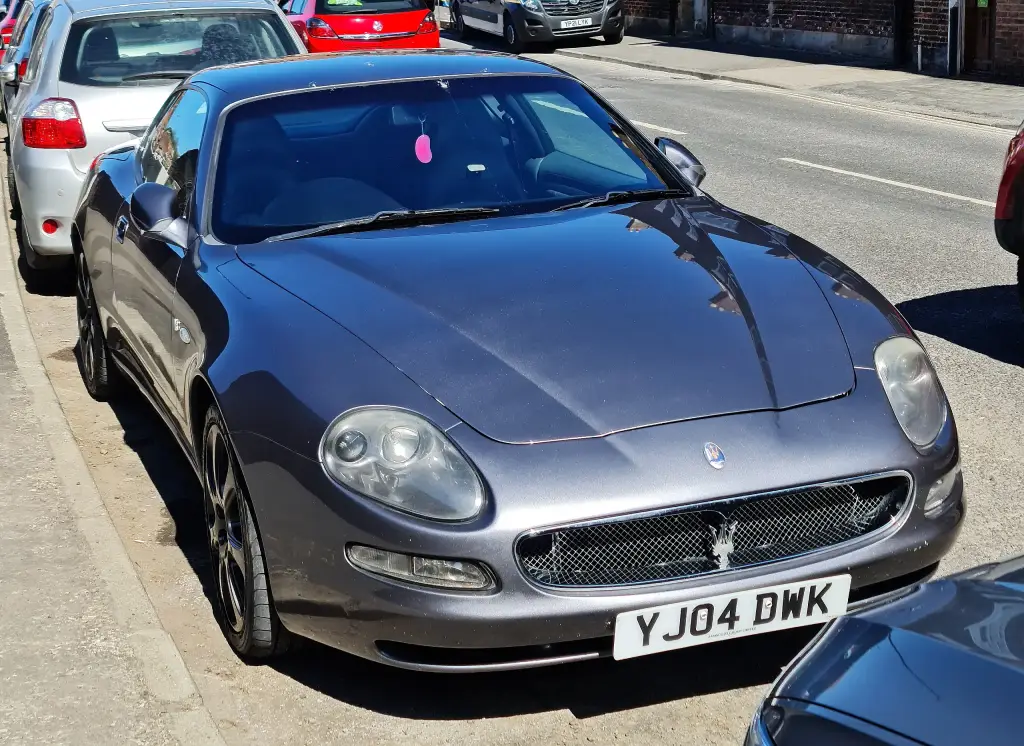
The Maserati Coupé and Spyder, internally Tipo M138, are grand tourers produced from 2001 to 2008: a four-seater coupé and a two-seater convertible. Their design was based on the preceding 3200 GT, which was not sold in the United States, and because the names Coupé and Spyder could refer to any Maserati of those types, both are commonly called the 4200 GT after the increase in engine displacement from 3.2 to 4.2 litres.
Maserati Coupé at a glance
| Maker | Maserati, Modena |
|---|---|
| Project code | Tipo M138 |
| Production | 2001–2008 |
| Design | Giorgetto Giugiaro, Italdesign; interior by Enrico Fumia |
| Body | four-seat coupé and two-seat soft-top Spyder |
| Engine | 4,244 cc V8, 92 mm × 80 mm, 390 PS at 7,000 rpm |
| Torque | 450 N·m at 4,500 rpm |
| Transmission | six-speed manual GT or Cambiocorsa automated manual |
| Coupé wheelbase | 2,660 mm |
| Spyder wheelbase | 2,440 mm |
| Kerb weight | 1,670–1,680 kg coupé, 1,720–1,730 kg Spyder |
| Built | 13,423 |
Based on one source: the English Wikipedia article on the Coupé and Spyder.
History of the Maserati Coupé
The Spyder was unveiled at the 2001 Frankfurt Auto Show and the Coupé followed shortly afterwards at the 2002 Detroit Auto Show. Sales in the United States began in March 2002 for the Spyder and in May for the Coupé, and the Spyder’s introduction marked Maserati’s return to North America after an eleven-year absence; almost as soon as it appeared, the Spyder was selected by Forbes as the Best GT for 2001. Both cars were designed by Giorgetto Giugiaro of Italdesign, who had also designed the Ghibli, Bora, Quattroporte III and 3200 GT, while the interior was commissioned to Enrico Fumia and based heavily on the restyled 1999 interior of the 3200 GT. The cars were built at the Viale Ciro Menotti plant in Modena, and 13,423 were produced before the GranTurismo replaced them.
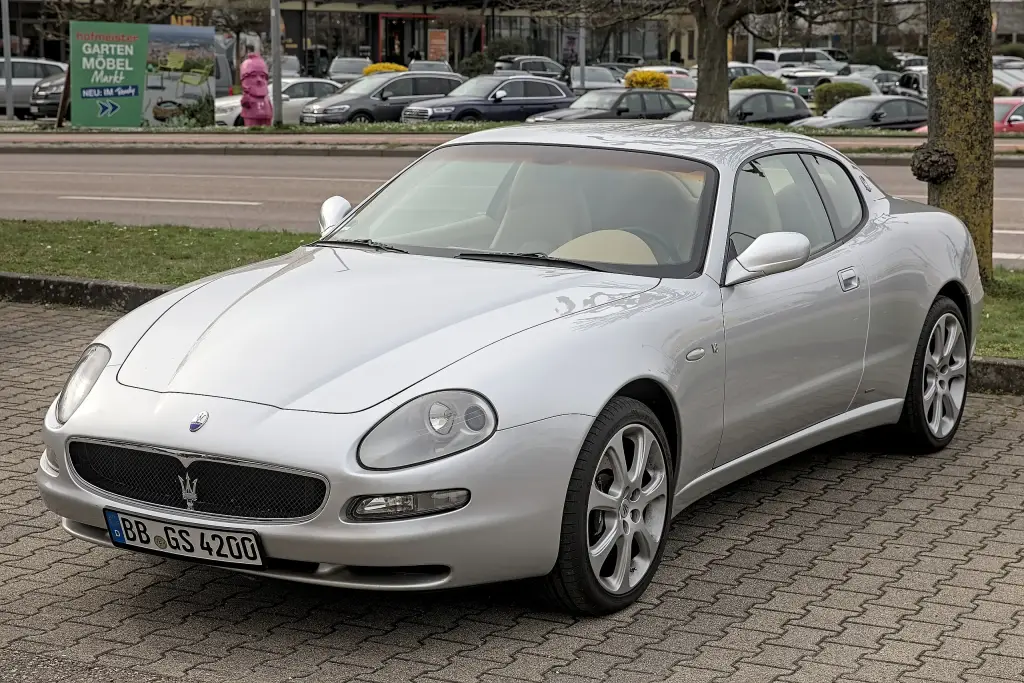
Coupé and Spyder bodies
The Coupé is a true four-seater that can seat two adults in the rear. Its wheelbase of 2,660 mm is about 76 mm longer than that of the Jaguar XK8 and 305 mm longer than a Porsche 911 (996), and the car measures 4,523 mm long, 1,822 mm wide and 1,305 mm high. The design follows the 3200 GT but replaces the boomerang tail lights with more conventional units. The Spyder is a soft-top whose roof is operated by a button on the centre console and stows beneath a hard cover flush with the body in front of the boot, taking about 30 seconds to deploy or stow; arch-type roll bars sit behind each seat. Its wheelbase of 2,440 mm is 220 mm shorter than the Coupé’s, its length is 4,303 mm and its kerb weight is 1,720–1,730 kg against 1,670–1,680 kg for the Coupé. In late 2004 both cars received a minor facelift with a larger grille whose lower edge reached further into the bumper, horizontal bars, the 1963-style oval Saetta logo on the C-pillars and a new air outlet and rear bumper; the Spyder also gained a glass rear window in 2003 in place of plastic.
Engine and transmission
Both models used the F136 R V8 from the Ferrari-Maserati F136 engine family, displacing 4,244 cc and rated at 390 PS at 7,000 rpm with 450 N·m of torque at 4,500 rpm. Compared with the 3200 GT engine, the main changes were the larger displacement from a bigger bore and a move to natural aspiration, which replaced the twin-turbocharging Maserati had used for 20 years because the powertrain was now Ferrari-based. The crankshaft is of crossplane design, the compression ratio is 11.1:1, the eight cylinders are arranged in a 90-degree V and the bore and stroke are 92 × 80 mm. The engine shares racing-engine features such as dry-sump lubrication, a pump assembly outside the crankcase and four valves per cylinder; the 32-valve double-overhead-camshaft layout uses chain-driven camshafts with variable valve timing on the intake side, and the aluminium-silicon crankcase and heads keep weight to 184 kg.
The manual transmission was a six-speed unit available either as the GT with a foot-operated clutch or as the Cambiocorsa, an automated manual with paddle shifters. The Cambiocorsa used a Formula One-type gearbox built by Graziano Trasmissioni with hydraulic operation and electronic management, operated by paddles behind the steering wheel similar to those of Ferrari road cars, and offered four operating modes including Normal, Sport and Auto. Both models came with 18-inch alloy wheels, originally a 15-spoke design, although after 2003 most buyers chose the optional seven-spoke sport wheels that became standard by 2005. Maserati offered sixteen exterior colours, ten shades of leather and five colours for the Spyder’s roof.
Design and features
- Ferrari-based V8: a naturally aspirated 4.2-litre F136 with 390 PS and a 7,000 rpm redline.
- Two body styles: a genuine four-seat coupé and a two-seat soft-top Spyder.
- Cambiocorsa: a paddle-shift automated manual derived from Formula One practice.
- US return: the Spyder brought Maserati back to North America after eleven years.
- Practical GT: a long wheelbase and a usable rear seat in the coupé.
Maserati Coupé versions
- Coupé (2001–2008): the four-seater with a 2,660 mm wheelbase.
- Spyder (2001–2008): the two-seater convertible with a 2,440 mm wheelbase.
- GT and Cambiocorsa: manual and paddle-shift automated manual versions of both.
- GranSport: the sportier coupé version of the range.
- 2004 facelift: larger grille, new bumpers and Saetta logos on the C-pillars.
The Coupé and Spyder replaced the Maserati 3200 GT and were replaced by the Maserati GranTurismo. Their interior and styling owed much to the Ghibli tradition. More cars are in the Maserati collection.
Sources
- Maserati Coupé, English Wikipedia: history, dimensions, engine, transmission