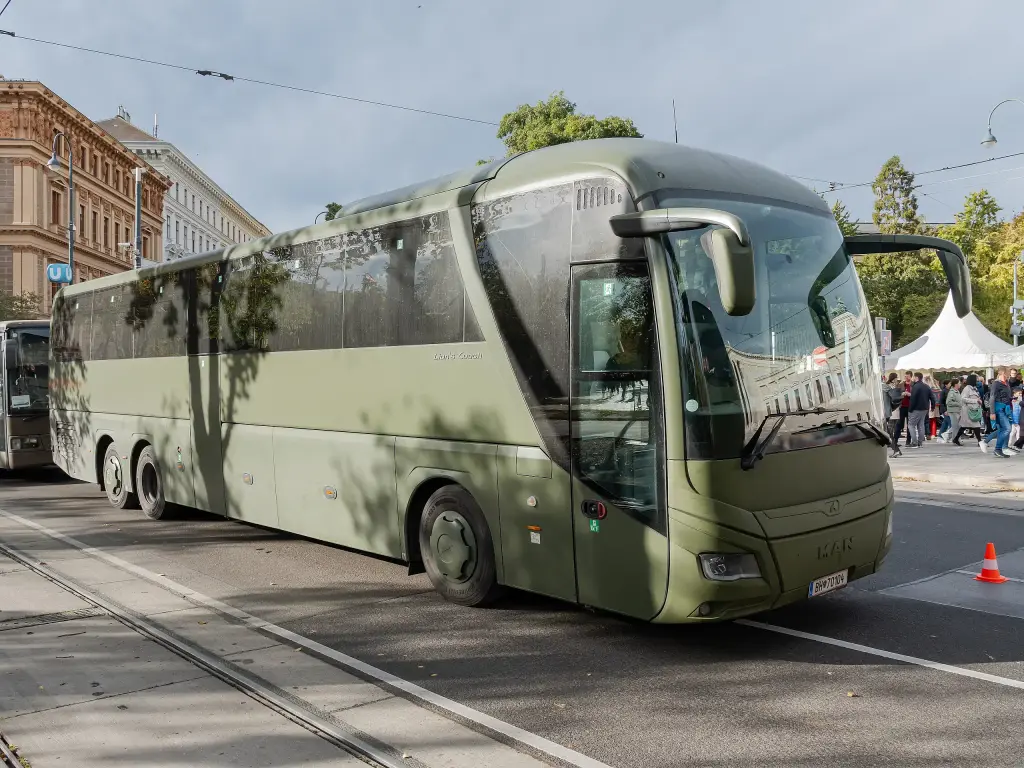
The MAN Lion’s Coach is MAN’s integral touring coach, introduced in 1996 as a cheaper alternative to the Lion’s Star. It has been through three generations and in 2020 was named Coach of the Year.
MAN Lion’s Coach at a glance
| Production | 1996–present |
|---|---|
| Class | integral touring coach |
| Assembly | MANAŞ, Turkey |
| First generation | 1996–2002, 12 m with 49 seats |
| First engines | D2866 LOH, 294 kW (400 hp) and 309 kW (420 hp) |
| Second generation | 2002–2017, 12 to 13.8 m, D20 engines 420–500 hp |
| Third generation | since 2017, four lengths from 12.1 to 13.9 m, up to 63 seats |
| Award | Coach of the Year 2020 |
| Electric | Lion’s Coach E, shown in 2025, production from 2026 |
English and German Wikipedia describe the same coach; the German article has the details of the 2024 update and the electric Lion’s Coach E.
History of the MAN Lion’s Coach
In 1992 MAN introduced the Lion’s Star coach, which influenced the naming of later MAN coaches; in 1994 the Lion’s Star RH 403 was voted Coach of the Year. In 1996, besides the Lion’s Star, a cheaper coach called Lion’s Coach was introduced, produced in Turkey. It also included a three-axle version, the Lion’s Top Coach, for the first time. The visual difference from the Lion’s Star was a redesigned front, especially the triangular grooves under the windscreen wipers. The 12-metre FRH version carried 49 passengers, a guide and a driver, and used the D2866 LOH 23 six-cylinder diesel of 294 kW (400 hp) or the D2866 LOH 20 of 309 kW (420 hp), with an eight-speed manual gearbox as standard.
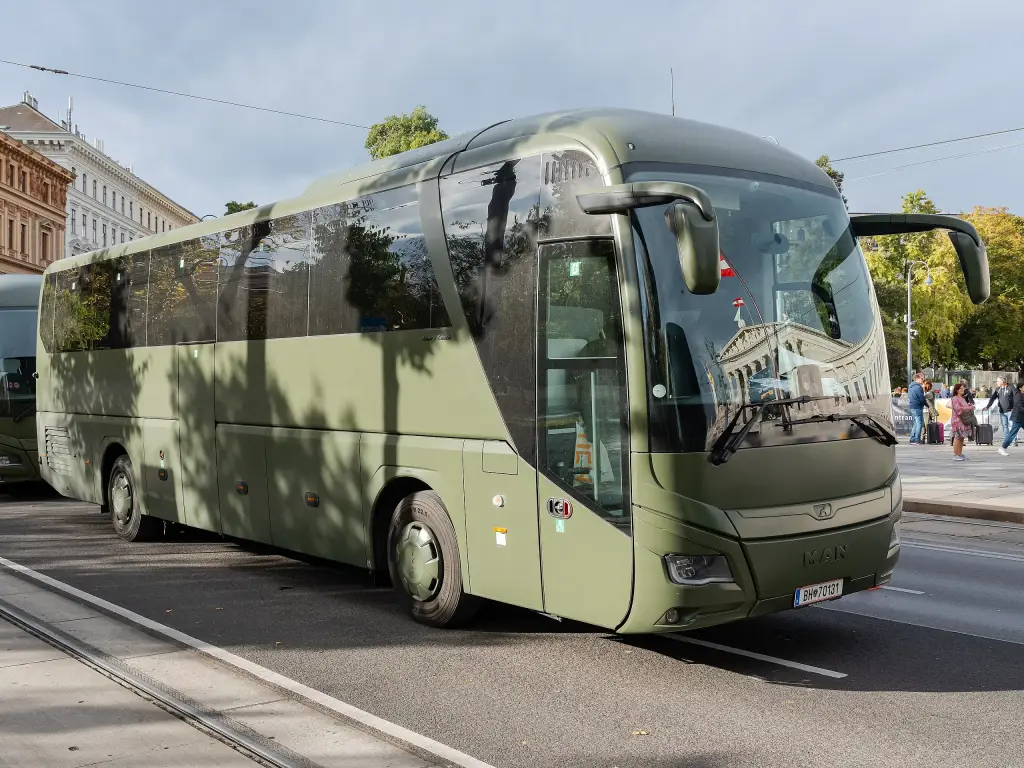
Second generation
The second generation was introduced in 2002 and built until 2017 as the R07 and R09, also known as RHC 414, 464 and 444. It ran alongside a new Lion’s Star. In 2003 the Lion’s Coach won the Red Dot award and in 2004 the iF Product Design Award. It came in three lengths — 12,000 mm with two axles and 13,260 and 13,800 mm with three — and with two MAN Common Rail engines from the D20 series: the 10.5-litre D2066LOH and the 12.4-litre D2676LOH, rated from 309 kW (420 hp) to 368 kW (500 hp). Over its life the coach went through facelifts in 2008 and 2015 and its engines progressed from Euro 3 to Euro 6c.
Third generation
The third-generation Lion’s Coach was unveiled at Busworld 2017 in Kortrijk on 24 October 2017. It is available in four lengths: 12,101 and 13,091 mm with two axles, and 13,361 and 13,901 mm with three; the 13-metre version has six more seats than the 12-metre one, an optional wheelchair lift is offered, and the four variants carry up to 53, 57, 59 or 63 passengers. The D26 engine and driveline were uprated, with 30 hp and 300 Nm more than before. It won the Grand Coach Award at Busworld 2017, the Busplaner Innovation Prize 2018, the iF Design Award 2018 and Coach of the Year 2020. For model year 2024 MAN added a new electronics platform, a digital driver workplace and the Euro 6e D26 engine. The electric Lion’s Coach E was shown at Busworld Europe in October 2025 as the first fully electric coach from a major European maker, with a 13.9-metre three-axle body, 356 to 534 kWh of batteries, up to 650 km of range and a 330 kW motor; production is due to start in Ankara in 2026.
Design and features
- Cheaper Lion: created in 1996 as a lower-cost alternative to the Lion’s Star and produced in Turkey.
- Three generations: 1996–2002, 2002–2017 and the current coach since 2017.
- Award winner: Red Dot 2003, iF Design Award 2004 and 2018, Coach of the Year 2020.
- Electric version: the Lion’s Coach E with up to 650 km of range.
MAN Lion’s Coach versions
- Lion’s Coach (1996–2002): first generation, 12 m and the three-axle Lion’s Top Coach.
- Lion’s Coach R07/R09 (2002–2017): second generation with facelifts in 2008 and 2015.
- Lion’s Coach (since 2017): third generation in four lengths.
- MAN Fortuna: the name used for the Lion’s Coach in Turkey in 2004–2006.
- Lion’s Coach Midi: 10-metre version developed with Caetanobus in 2014.
- Lion’s Coach E: battery-electric coach, production from 2026.
MAN’s city bus range is described in the MAN Lion’s City article, and the older standard bus in the MAN SL200 article. More MAN vehicles are in the MAN collection.
Sources
- MAN Lion’s Coach, English Wikipedia: generations, engines, awards
- MAN Lion’s Coach, German Wikipedia: third generation updates, Lion’s Coach E