The Malaguti Spidermax is a maxiscooter produced by the Italian company Malaguti from 2004 to 2011 at the historic factory in Castel San Pietro Terme. It was the largest model of the range, developed over three years at a cost of about six million euros to compete with the Japanese maxi scooters.
Malaguti Spidermax at a glance
| Maker | Malaguti, Castel San Pietro Terme (Bologna) |
|---|---|
| Production | 2004–2011 |
| Development | Engines Engineering, project B2, from 2000 |
| Development cost | about €6 million over three years |
| Frame | die-cast aluminium perimeter frame |
| Engine | Piaggio Master 500, 460 cm³ at launch |
| Power | 40 hp at 7,250 rpm and 42 Nm at 6,000 rpm |
| Brakes | two 270 mm front discs, 260 mm rear |
| Underseat space | 38 litres, two full-face helmets |
| Weight | 204 kg |
| RS 500 engine | 493 cm³, 41 hp at 7,250 rpm |
Based on one source: the English Wikipedia article on the Malaguti Spidermax.
History of the Malaguti Spidermax
The design of a Malaguti maxi scooter positioned higher than the Madison was entrusted in 2000 to Engines Engineering, led by engineer Alberto Strazzari. Known by the code name project B2, the development cost the manufacturer about six million euros and lasted three years. The model was intended to compete with the Japanese maxi scooters, which in Europe were gaining ever greater market shares. Among its main features were a single-cylinder engine combined with an innovative die-cast aluminium perimeter frame inspired by motorcycles, made of two shells joined by through screws and integrated with tubular steel frames to support the platform and the rear structure. The style was the work of the Malaguti style centre and the aerodynamics were studied in a wind tunnel. The engine was the Piaggio Master 500, with an effective displacement of 460 cm³.
Spidermax GT 500 (2004–2010)
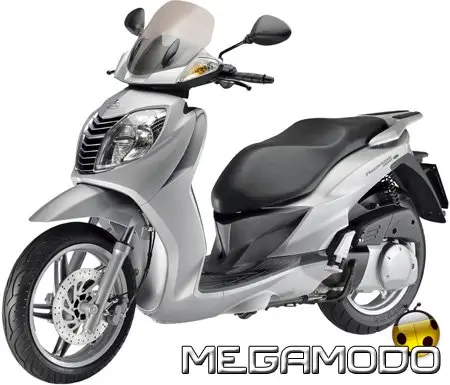
The Spidermax GT 500 was presented at the end of 2003; the GT 500 designation underlined the intention to offer sportier versions of the model in the future. It went into production in the spring of 2004 and on sale in Italy and the rest of Europe from the autumn. Aesthetically it had a large front with two V-shaped lights joined by a small grille with chrome edges, very large side air intakes, and a very large rear volume housing a 38-litre compartment able to take two full-face helmets; the central part of the scooter was painted in a contrasting aluminium colour. The front Paioli fork was of the telehydraulic type with 41 mm stanchions and 120 mm of travel, while the rear used an oscillating engine with an articulated attachment to the frame and two telehydraulic shock absorbers adjustable in spring preload with 75 mm of travel. The braking system, made by Grimeca, was of the integral type with two 270 mm front discs and a 260 mm rear disc, all with two-piston floating calipers.
The engine was the Piaggio Master 500 of 460 cm³, a liquid-cooled four-stroke single with four valves, delivering 40 hp at 7,250 rpm and 42 Nm of torque at 6,000 rpm, fed by electronic injection and combined with a continuously variable transmission with automatic centrifugal clutch. At its debut the engine was approved to Euro 2. The declared weight was 204 kg and the front and rear tyres were 16-inch. In January 2007 the Euro 3-approved GT 500 was presented, and it remained in production until 2010 with the 460 cm³ Master engine.
Spidermax RS 500 (2007–2011)
A slight restyling was presented at EICMA in November 2007 and went on sale from December; on that occasion a second variant, the RS 500, was introduced with a sportier character alongside the GT 500. The renewed Spidermax had a new front shield with a new grille, new graphics for the instrument cluster and the new 493 cm³ Euro 3-approved Piaggio Master engine delivering 30.5 kW (41 hp) at 7,250 rpm and 45 Nm of torque at 6,000 rpm. The lateral chrome plating that characterised the GT version was absent on the RS. A weakened variant with 24.5 kW (33 hp) at 6,500 rpm was offered for holders of an A1 licence, who could ride it from the age of 18. Production of the Spidermax RS 500 ended in April 2011 following the closure of the company.
Design and features
- Aluminium perimeter frame: two die-cast shells joined by through screws, a motorcycle-style solution.
- Piaggio Master engine: 460 cm³ at launch, 493 cm³ in the RS 500.
- Integral braking: two 270 mm front discs and a 260 mm rear disc by Grimeca.
- Underseat storage: a 38-litre compartment for two full-face helmets.
- A1 version: a 33 hp variant of the RS 500 for riders from 18.
Malaguti Spidermax versions
- Spidermax GT 500 (2004): the original Euro 2 model with 460 cm³ engine.
- Spidermax GT 500 Euro 3 (2007): updated emissions, produced until 2010.
- Spidermax RS 500 (2007): sportier restyling with the 493 cm³ engine.
- RS 500 A1 version: 33 hp at 6,500 rpm for A1 licence holders.
The Spidermax was the largest Malaguti, positioned above the Madison and eventually replacing its 400 cc version. The smaller Phantom and Firefox covered the 50 cc class. More models are in the Malaguti collection.
Sources
- Malaguti Spidermax, English Wikipedia: development, frame, engines, specifications