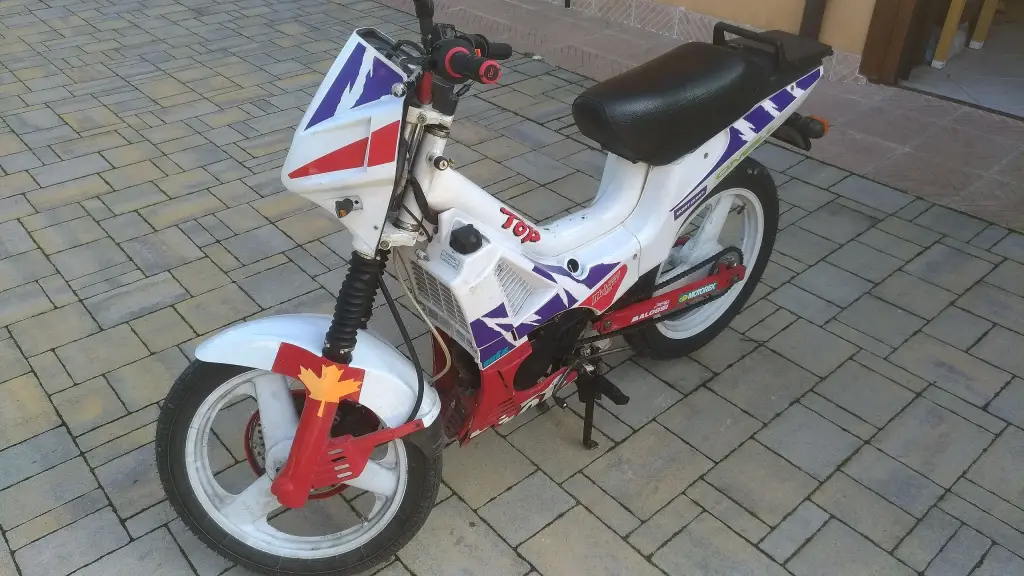
The Malaguti Fifty is a 50 cc moped produced from 1974 to 1997 by Malaguti of San Lazzaro di Savena, near Bologna. It belonged to the group of Italian mopeds known as “tuboni”, and was among the longest-lived and most successful of them.
Malaguti Fifty at a glance
| Maker | Malaguti, San Lazzaro di Savena (Bologna) |
|---|---|
| Production | 1974–1997 |
| Type | 50 cc moped, “tubone” tube frame |
| Engine | mostly Franco Morini G series, two-stroke |
| Gearbox | four speeds from 1994; three before |
| Fuel tank | formed by the frame tube, 3.25 to 6.5 litres |
| Brakes | Grimeca front disc, rear drum |
| Fifty Top update | 1994, new bodywork, instruments and four-speed gearbox |
| Legal limit | 1.5 hp and 45 km/h when restricted |
| Top speed | just over 80 km/h derestricted |
| Prototype | a new Fifty shown at EICMA 2003 was never produced |
Based on one source: the Italian Wikipedia article on the Malaguti Fifty; there is no English article.
History of the Malaguti Fifty
The Fifty was part of the so-called “tuboni”, mopeds whose large-diameter central tube formed the main frame; among them it was one of the most long-lived and successful models. Over the years the Bologna firm listed many versions: Fifty 50, AS, Black Special, Premium, RV, UP, HF, HF mix, HF colors, Full CX, Full CX mix, Full CX Colors, Mistral, Evolution, Top, Top Colors and Top Mix. During the 2003 EICMA show a prototype of a new Fifty was presented, but it never entered production.
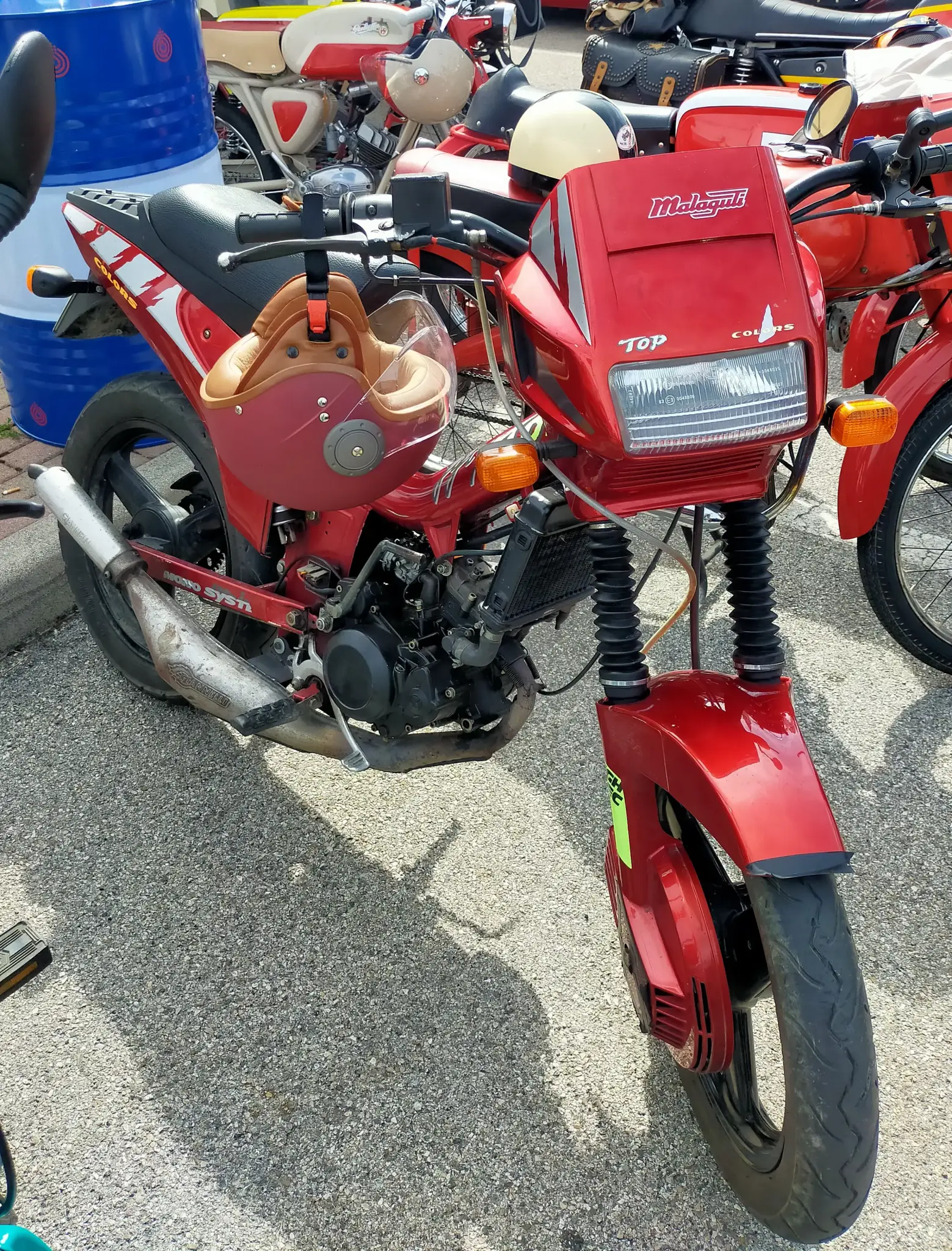
The Fifty Top of 1994
The Fifty Top 50 had its last evolution in 1994, offered in bordeaux with grey and shocking-yellow trim, black with purple trim and grey with pastel-yellow trim. The new model differed from its predecessor both in appearance and in mechanicals. The restyling involved the whole bodywork, now more modern and softer in shape, the small screen, which became much slimmer, and the instrumentation, which was reduced to a single smaller but clearer instrument combining rev counter, speedometer, odometer, indicator lights, neutral light, fuel reserve warning (not present before), water temperature warning and a clock. The fairing over the front disc disappeared and the disc itself was no longer drilled but slotted longitudinally. Mechanically the new model was distinguished by a four-speed gearbox instead of three, made possible by the end of the rule that had limited mopeds to three gears in 1993.
The “tubone” also served as the fuel tank, holding between 3.25 and 6.5 litres depending on the version; its rigidity and uniformity gave the Fifty excellent road behaviour and an optimal weight distribution that made it one of the most manageable mopeds, on a par with machines such as the Piaggio Ciao. The rear monoshock absorbed bumps well and gave a feeling of stability, while the very rigid front fork improved stability on smooth roads but made the moped slightly nervous on broken surfaces. The narrow tyres gave surprising agility in changes of direction at the cost of a lean angle smaller than modern standards. Braking was by a Grimeca front disc and a rear drum.
The engine was for most versions the Franco Morini G series with a four-speed gearbox, a unit that found no application on the modern mopeds that mostly used Minarelli engines. Only the Evolution version and the later “color” restyling carried refinements that went largely unappreciated: the plastic fuel tank was moved under the seat and the tube frame became the oil tank for automatic mixing, while the engine was a Minarelli AM3 with reed-valve induction directly in the crankcase, fixed advance, variable exhaust and electric ignition only. The front fork was similar to the Vespa’s much-discussed layout but mounted upside down, which gave great manageability even on rough roads; under hard braking the moped tended to rise instead of diving, letting the rider modulate the braking and steer away from an impact.
The light-alloy cylinder had four transfer ports and a chromed bore for low friction, and the two-ring piston had thin, low-friction rings. Induction was by a simple Dell’Orto SHA 14/12 carburettor and a mixer of the same make, and the exhaust was a generously sized expansion chamber with an integrated silencer, except on the Evolution, where it could be removed and dismantled to replace the anti-drumming material, commonly called glass wool. By law the Fifty was sold restricted to 1.5 hp (1.2 kW) and 45 km/h; derestricted, and therefore no longer covered by warranty and restricted to track use, the engine delivered more power between 6,000 and 10,500 rpm and greater torque. On the Evolution the maximum was estimated at about 8 hp at 10,500 rpm. The power-to-weight ratio was high, and top speed was just over 80 km/h. The Fifty Top 50 of the 1994 model year represented the most modern technical and stylistic expression of a moped-building philosophy that scooters and motorcycles had by then replaced.
Design and features
- Tube frame as fuel tank: the “tubone” held the petrol and kept the moped light and rigid.
- Four-speed gearbox: from 1994 the Fifty gained a fourth gear after the three-gear limit for mopeds ended.
- Franco Morini engine: the G series unit, unusual among later mopeds that used Minarelli engines.
- Single instrument: the 1994 Top combined rev counter, speedometer, odometer, warning lights and a clock.
- Evolution refinements: under-seat fuel tank, separate oil tank and an upside-down front fork.
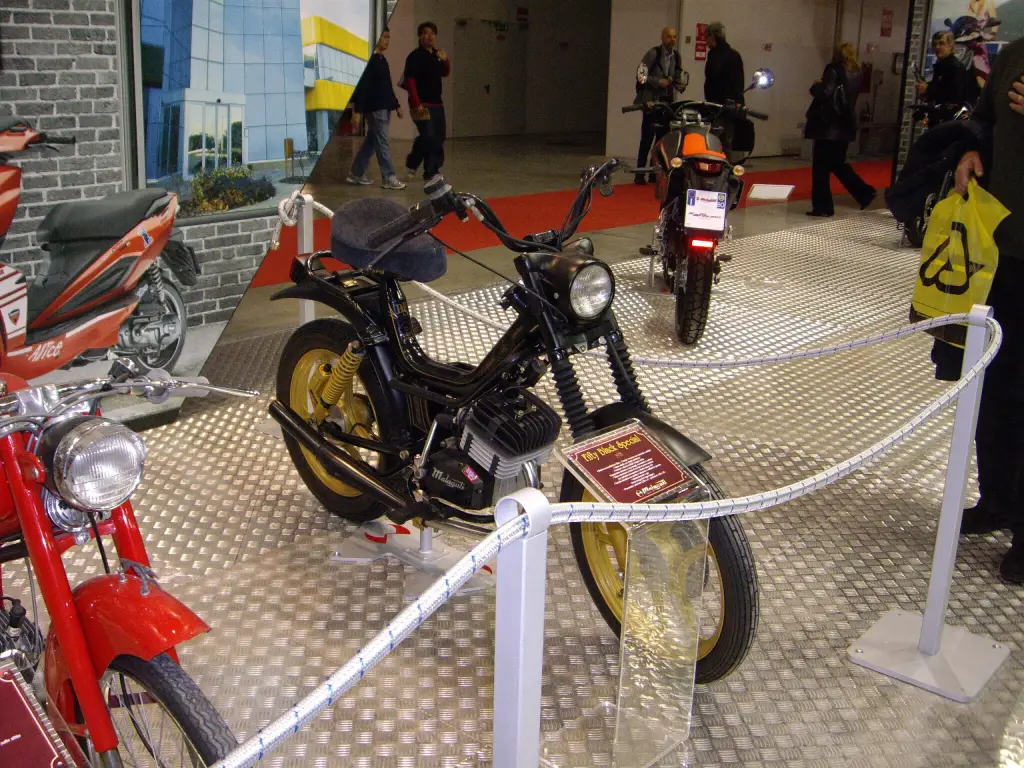
Malaguti Fifty versions
- Fifty 50: the standard model of the range.
- Black Special, Premium and HF: trim and equipment versions listed through the years.
- Full CX and Mistral: further versions in the long price lists.
- Evolution: Minarelli AM3 engine, under-seat fuel tank and inverted fork.
- Fifty Top (1994): the final evolution, with four-speed gearbox and new bodywork.
- Top Colors and Top Mix: colour variants of the Top.
The Fifty was the small moped of the range before Malaguti turned to scooters such as the Firefox and the Phantom. More models are in the Malaguti collection.
Sources
- Malaguti Fifty, Italian Wikipedia: history, versions, Fifty Top, engine, specifications