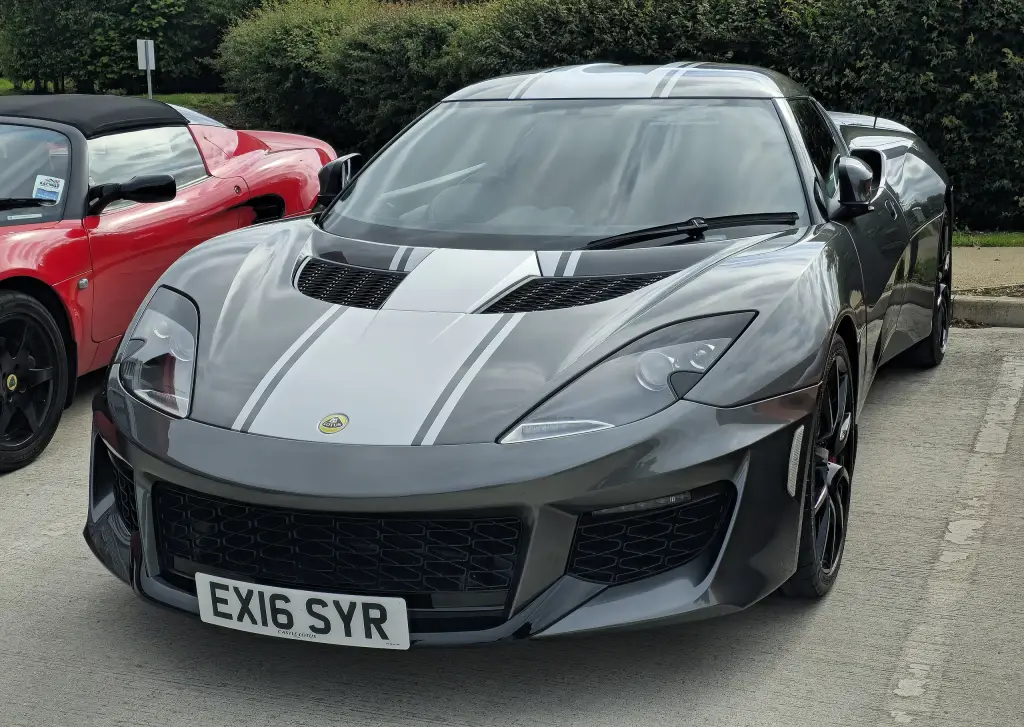
The Lotus Evora is a sports car developed under the project name Eagle and launched on 22 July 2008 at the British International Motor Show. It was based on the first all-new Lotus platform since the Elise of 1995, and was planned as the first of three cars to use it.
Lotus Evora at a glance
| Launched | 22 July 2008, British International Motor Show |
|---|---|
| Project name | Eagle |
| Platform | first all-new Lotus platform since the Elise |
| Engine | Toyota 3.5-litre 2GR-FE V6, mid-mounted and transverse |
| Gearbox | six-speed manual or Aisin automatic |
| Weight | 1,383 kg (automatic 1,442 kg) |
| Layout | 2+2 or two-seater (“Plus Zero”) |
| Drag coefficient | Cd 0.337 |
| Sales target | 2,000 cars a year |
| Price | £45,000 to just over £50,000 |
Based on one source (English Wikipedia).
History of the Lotus Evora
The Evora was the first product of a five-year plan begun in 2006 to expand Lotus beyond its track-focused cars and build a practical road car for the mainstream market. It is larger than recent Elises and their derivatives, with an unladen weight of 1,383 kg, or 1,442 kg with the automatic gearbox. It is the only Lotus with a 2+2 layout, though it could also be ordered as a two-seater under the “Plus Zero” option, and with the BMW i8 it was one of the only 2+2 mid-engine coupés on sale. The cabin was made big enough for taller passengers, and the cooled boot behind the engine can hold a set of golf clubs, though design head Russell Carr denies this was deliberate. Lotus intended the Evora to compete with cars such as the Porsche 911.
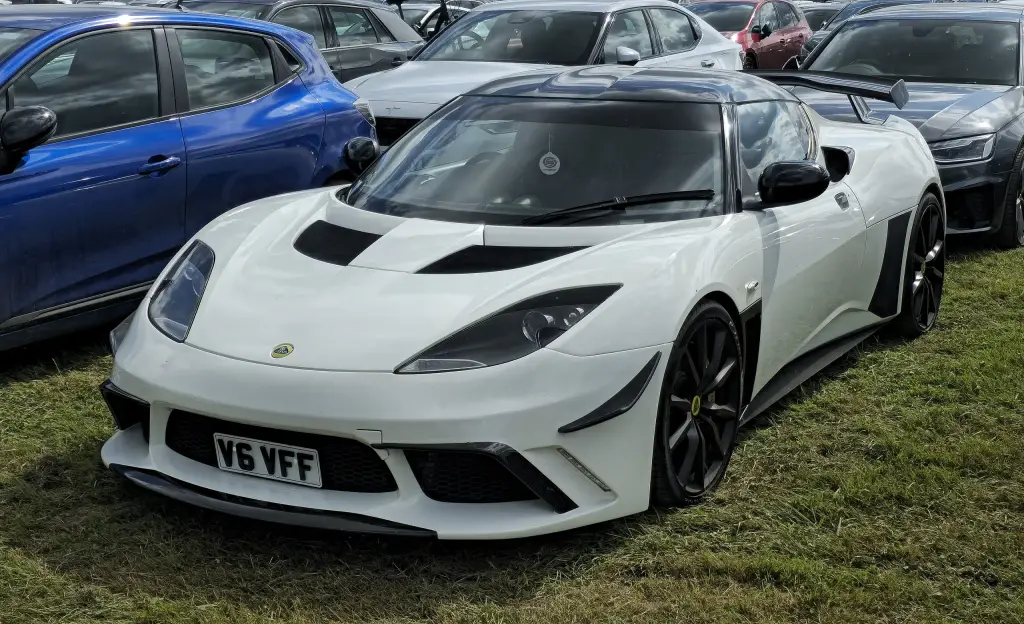
The name follows the Lotus tradition of model names beginning with E and comes from evolution, vogue and aura. Eagle, Exira and Ethos were considered, but Eagle and Ethos were rejected as hard to trademark.
The Evora uses a mid-mounted, transverse Toyota 3.5-litre 24-valve 2GR-FE V6 with a six-speed manual or an Aisin six-speed automatic. The chassis is a lightweight aluminium tub with an aluminium front crash structure and a steel rear subframe for the drivetrain, built from 6000-series alloy extrusions bonded with epoxy adhesive and riveted for torsional rigidity. Suspension is by forged aluminium double wishbones with Bilstein gas dampers and Eibach coil springs, with hydraulically assisted power steering.
The Evora S of 2010 added a Harrop supercharger, raising output to 345 hp and 400 N·m, with recalibrated dampers and steering, a single-tube exhaust, 0–60 mph in 4.6 seconds and a 172 mph top speed; production ended in 2014. The Evora 400 of 2015 replaced both the standard car and the S with 400 hp and 409 N·m from an intercooled Edelbrock supercharger, a body kit adding 23 kg of downforce, a driver-activated exhaust, narrower sills, a new dashboard and centre console, forged wheels and a split rear wing; it weighed 1,395 kg and reached 60 mph in 4.1 seconds and 186 mph. The Evora Sport 410 of 2016 raised power to 410 hp and torque to 420 N·m, with a carbon-fibre roof, tailgate and front access panel, lighter wheels, a lithium-ion battery, no rear seats and one-piece carbon bucket seats, cutting weight to 1,325 kg and giving 0–60 mph in 3.9 seconds and 190 mph. The Evora GT430 followed in 2017.
Design and features
- New platform: the first all-new Lotus architecture since the Elise.
- Toyota V6: a 3.5-litre 2GR-FE mounted transversely behind the cabin.
- 2+2 cabin: room for two small rear passengers, or the Plus Zero two-seater.
- Bonded aluminium tub: extruded alloy bonded and riveted for rigidity.
- Evora 400: 400 hp, 186 mph and 23 kg more downforce.
Lotus Evora versions
- Evora (2008): 3.5-litre V6, 2+2 or Plus Zero.
- Evora S (2010–2014): supercharged, 345 hp.
- Evora 400 (2015): 400 hp, new body kit and interior.
- Evora Sport 410 (2016): 410 hp, 1,325 kg.
- Evora GT430 (2017): the most powerful version.
The Evora was a larger stablemate of the Lotus Elise and the Lotus Exige. More cars are in the Lotus collection.
Sources
- Lotus Evora, English Wikipedia: launch, platform, engine, variants