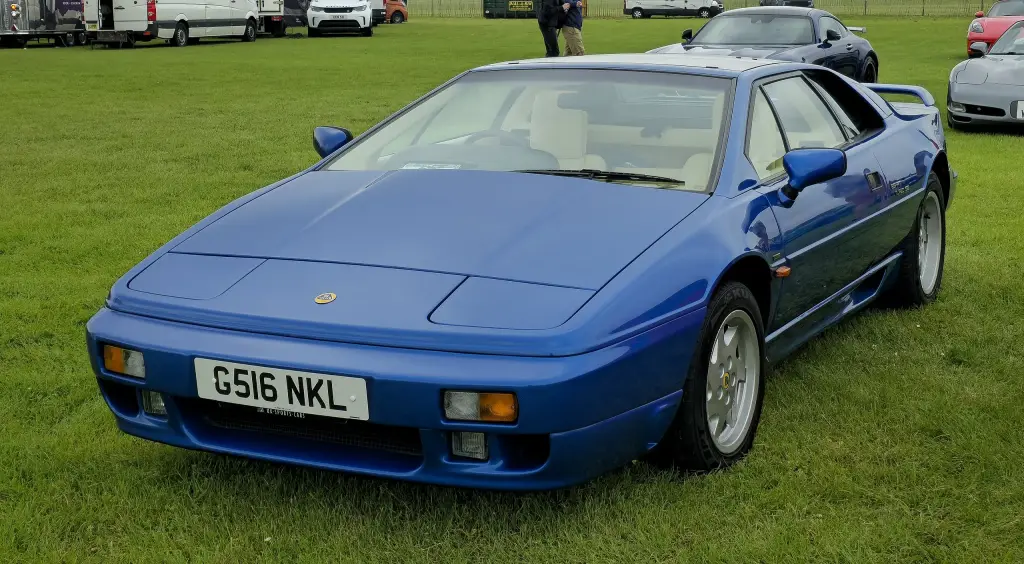
The Lotus Esprit is a sports car built at Hethel from 1976 to 2004 with a rear mid-engine, rear-wheel-drive layout. Together with the Elise and Exige it is one of Lotus’s most long-lived models, and it was among the first of Giorgetto Giugiaro’s straight-lined, hard-edge, wedge-shaped “folded paper” designs.
Lotus Esprit at a glance
| Production | 1976–2004 |
|---|---|
| Designers | Giorgetto Giugiaro, then Peter Stevens, then Julian Thomson |
| Layout | mid-engined, rear-wheel drive |
| Body | fibreglass over a steel backbone chassis |
| S1 engine | 1,973 cc Lotus 907 four, 160 hp |
| S1 weight | under 1,000 kg |
| Gearbox | Citroën C35 five-speed transaxle |
| Later engines | turbocharged fours, then a 3.5-litre V8 with 350 hp |
| Top speed | 133 mph in 1976, over 174 mph for the V8 |
| Chassis link | the backbone was later adapted for the DeLorean |
Based on one source (English Wikipedia).
History of the Lotus Esprit
In 1970 Tony Rudd, who had joined Lotus the previous year, proposed two new projects. Project M50 became the 1974 Elite, and Project M70 was meant to replace the Europa with a two-door fixed-head mid-engined coupé. A meeting between Colin Chapman and Giugiaro was arranged in 1971 by designer Oliver Winterbottom, who suggested Giugiaro use his Maserati Boomerang concept as inspiration.
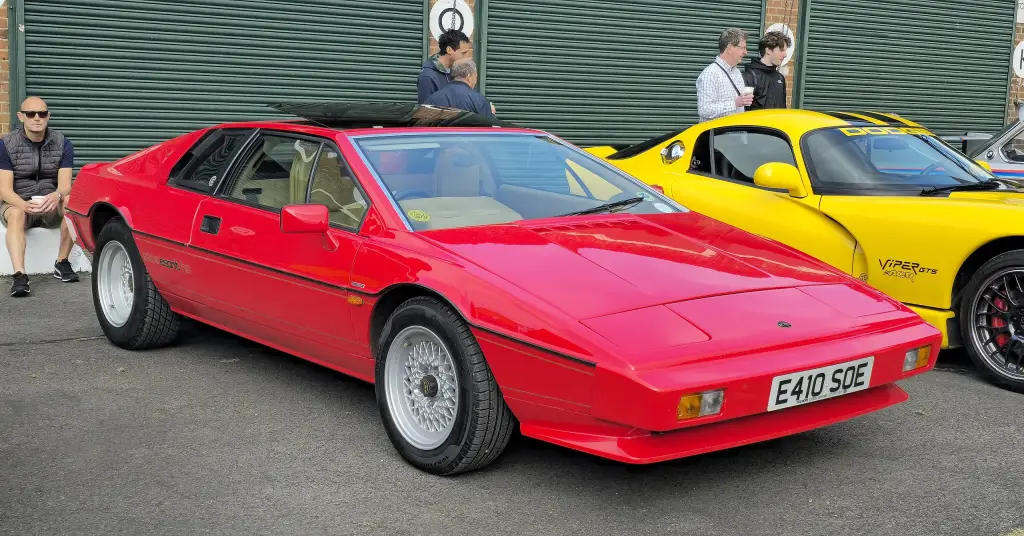
Work began in mid-1971 with a quarter-scale model. According to Italdesign, Chapman was disappointed with the wind tunnel results and halted the project, but the coachbuilder pressed on and built a full-size mock-up on a stretched Europa chassis. The nameless prototype, often called “the Silver Car”, appeared on the Italdesign stand at the 1972 Turin Auto Show, and the reception convinced Chapman to continue. A second, functional prototype, registered IDGG 01 and known as “the Red Car”, followed.
The Esprit was launched in October 1975 at the Paris Motor Show and entered production in June 1976, replacing the Europa. The first cars, the Series 1, had a wedge-shaped fibreglass body on a steel backbone chassis and the 1,973 cc Lotus 907 engine, rated at 160 hp in Europe and 140 hp in US trim. The engine sat longitudinally behind the passengers and drove through a Citroën C35 five-speed transaxle also used in the SM and Maserati Merak, with inboard rear brakes. The S1 weighed less than 1,000 kg and had upper A-arms and lower lateral links at the front and box-section trailing arms at the rear, with coil-over dampers, disc brakes all round and unassisted rack-and-pinion steering.
The S1 was praised for its handling and has been called the best-steering Esprit, but it was regarded as underpowered, especially in the United States, where emissions controls stifled the engine. Lotus claimed 0–60 mph in 6.8 seconds and 138 mph, but road tests found about 8 seconds and 133 mph. It was distinguished by its snow-shovel front air dam, Fiat X1/9 tail lights, absence of body-side ducts and Wolfrace alloy wheels, with a one-piece instrument cluster of green-faced Veglia gauges. In 1978 the Series 2 added intake and cooling ducts behind the rear quarter windows, bigger ribbed Rover SD1 tail lights and a new front spoiler.
The Esprit lived on through the 1990s and into the 2000s. Peter Stevens, who also styled the McLaren F1, softened its lines in 1988 with the X180, then Julian Thomson produced an official Series 4 in 1994 that lasted until 2004, with final changes by Russell Carr in 2002. Power roughly doubled over the years through better breathing and turbocharging, and from 1996 a Lotus-designed 3.5-litre twin-turbo V8 gave 350 hp and a top speed over 174 mph, against 133 mph in 1976. The Esprit was one of the last cars with pop-up headlights, along with the fifth-generation Chevrolet Corvette.
Design and features
- Giugiaro wedge: one of the first folded-paper designs.
- Backbone chassis: the same idea later adapted for the DeLorean.
- Lotus 907 engine: 160 hp in Europe, 140 hp in the United States.
- Mid-engine layout: longitudinally mounted behind the seats, with a Citroën transaxle.
- Long life: 28 years of production and a 350 hp V8 at the end.
Lotus Esprit versions
- S1 (1976): 2.0-litre Lotus 907, 160 hp.
- S2 (1978) and S2.2: body and cooling updates, 2.2-litre engine.
- Series 3 and Turbo Esprit (1981–1988): Giugiaro restyling and turbocharging.
- Stevens Esprit / X180 (1988–1994): softer lines by Peter Stevens.
- Series 4 (1994–2004): Julian Thomson design, final changes by Russell Carr.
- V8 (1996–2004): 3.5-litre twin-turbo V8 with 350 hp.
The Esprit replaced the Lotus Europa and sat above the Lotus Elise in the range for many years. More cars are in the Lotus collection.
Sources
- Lotus Esprit, English Wikipedia: design history, S1, later series, engines