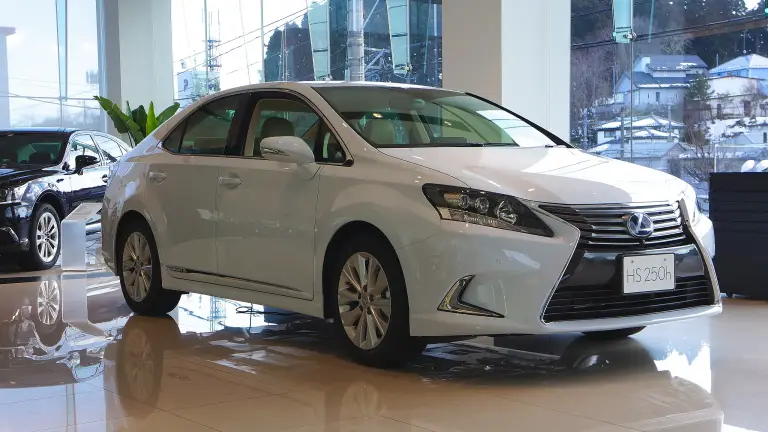
The Lexus GS is an executive sedan sold from 1993 to 2020 over four generations. It was launched in Japan in 1991 as the Toyota Aristo, carried the Lexus badge outside Japan from February 1993, and was always a rear-wheel-drive alternative to the front-wheel-drive ES.
Lexus GS at a glance
| Class | executive car (E-segment) |
|---|---|
| Launched | 1991 in Japan as the Toyota Aristo |
| As a Lexus | from February 1993, outside Japan |
| Generations | four |
| Layout | front engine, rear-wheel drive; all-wheel drive from 2005 |
| First generation | S140, styled by Italdesign Giugiaro |
| First engine | 3.0-litre 2JZ-GE straight-six, 169 kW (227 hp) |
| Aristo twin-turbo | 2JZ-GTE, 205 kW (275 hp) |
| First hybrid | GS 450h, from 2006 |
| Built at | Tahara, Japan |
| Production ended | August 2020 |
| Replaced in Europe by | the ES, from December 2018 |
based on one source (English Wikipedia)
History of the Lexus GS
The GS was developed as a performance sedan to sit between the compact IS and the flagship LS, and until 2011 it shared its chassis with the Toyota Crown. In Japan the car was sold as the Toyota Aristo from October 1991; the Lexus GS 300 went into production for export on 22 February 1993. The name stands for Grand Sedan, although some importers call it Grand Sport.
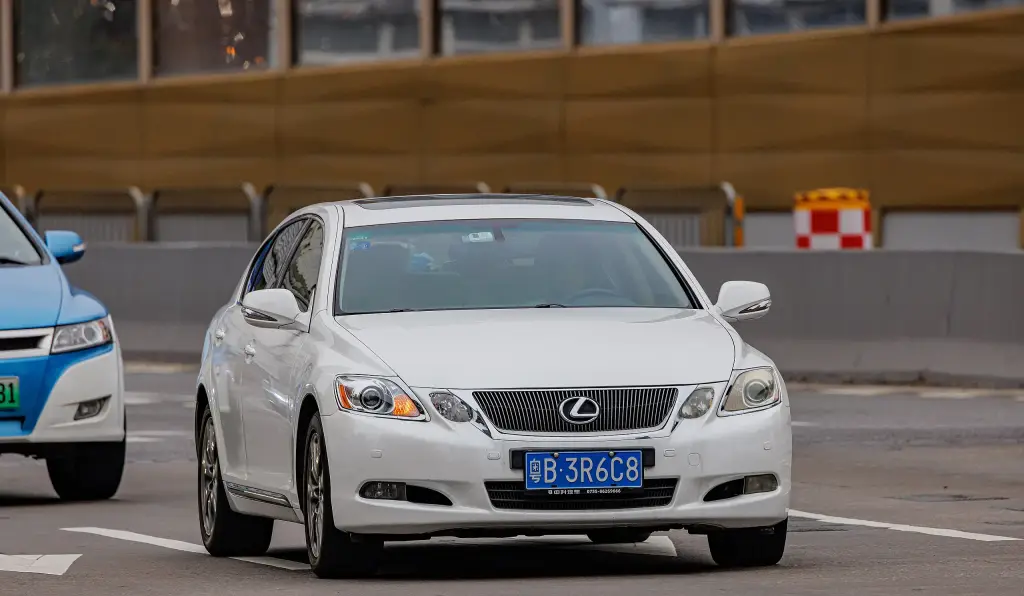
The first generation was styled by Italdesign Giugiaro, which began work in 1988 on a simpler, European-looking luxury sedan. The shape was a rounded wedge with a high rear deck and a drag coefficient of 0.31, and the suspension was double wishbone at both ends. Toyota built the Aristo at Tahara with robots performing 4,200 welds per body. Japanese buyers could have a 2JZ-GE straight-six of 169 kW (227 hp), a twin-turbo 2JZ-GTE of 205 kW (275 hp), or from 1992 a 4.0-litre V8 with all-wheel drive. The export GS 300 was offered only with the naturally aspirated 3.0-litre six and a choice of walnut trim, leather, a Nakamichi stereo and traction control.
A second generation arrived in 1997 on a new platform with in-house styling and, outside Japan, a V8 for the first time. The third generation of 2006 added V6, V8 and hybrid versions, the hybrid being the GS 450h, and was the first GS badged as a Lexus in Japan. The fourth generation premiered at Pebble Beach in August 2011 with the GS 350, GS 450h and F Sport, joined later by the GS 250. The GS was replaced in Europe by the ES from December 2018, and production ended in August 2020.
Design and features
- Rear-wheel drive: the GS was the sporting alternative to the front-wheel-drive ES.
- Giugiaro styling: the first generation was drawn by Italdesign with a low drag coefficient of 0.31.
- Straight-six and V8: engines ran from the 2JZ six to V8 units in every generation.
- Hybrid and all-wheel drive: both arrived in 2005, the hybrid as the GS 450h.
- Long life: four generations over 27 years before the model was dropped in 2020.
Lexus GS versions
- GS 300 (1993): the first export model with a 3.0-litre straight-six.
- Toyota Aristo: the Japanese version, with twin-turbo and V8 options.
- GS 430 and GS 460: V8 models of the later generations.
- GS 450h (2006): the hybrid version.
- GS 350 F Sport: the performance-tuned fourth-generation model.
- GS 250 (2011): a smaller V6 for Asia and Europe.
The GS sat between the compact IS and the flagship LS, and in Europe it was replaced by the ES. More cars are in the Lexus collection.
Sources
- Lexus GS, English Wikipedia: origins, generations, engines, production