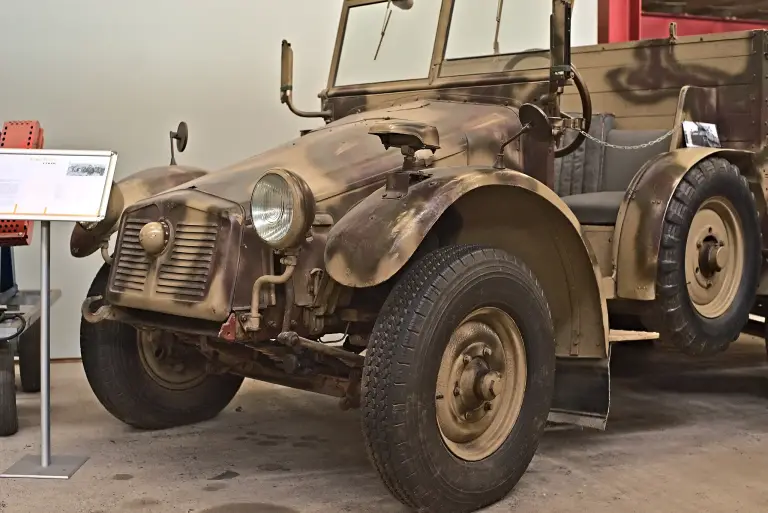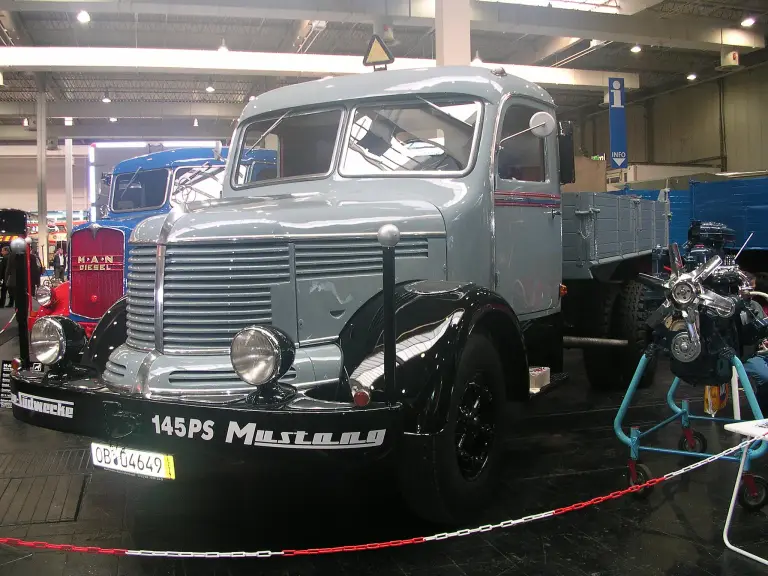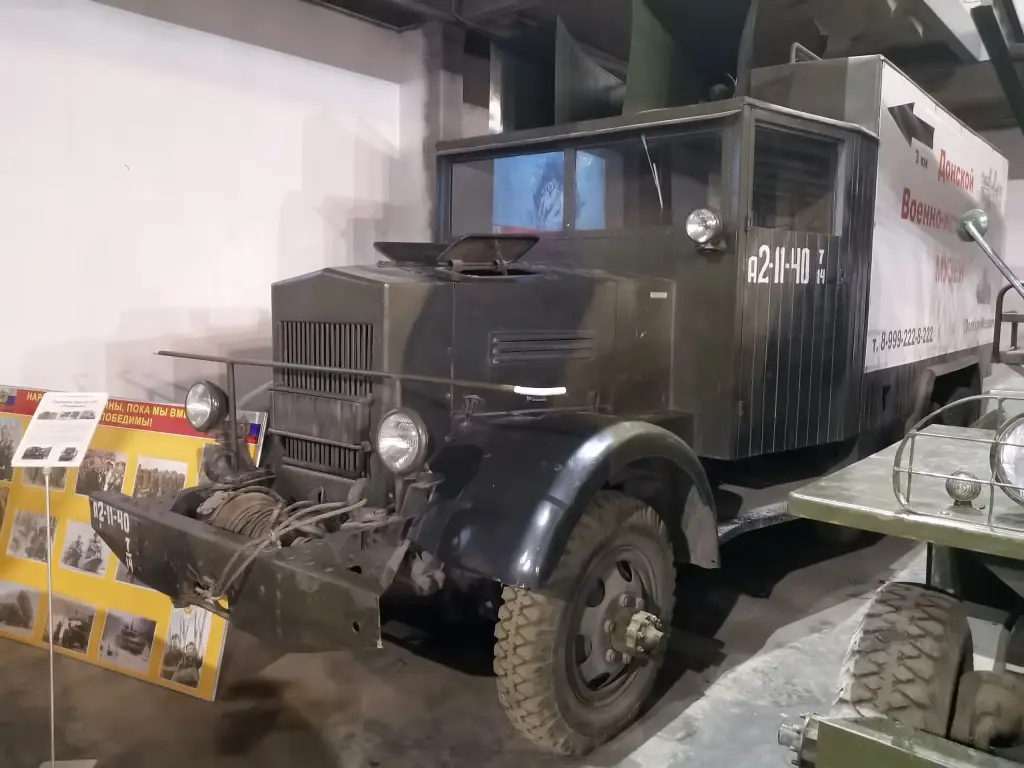
The Krupp L3 H63 was a medium cross-country lorry developed for the Reichswehr and built from 1929, with the improved L3 H163 following in 1936. It was the first military Krupp vehicle supplied to the German forces after the First World War, and it served with many Wehrmacht units during the Second World War.
Krupp L3 H63 at a glance
| Maker | F. Krupp AG, Essen |
|---|---|
| Type | medium cross-country lorry, 3-tonne class |
| Designations | L3 H63 (1929–1935), L3 H163 (1936–1938) |
| Production | 1929–1938 |
| Engine | six-cylinder Krupp M 12 / M 12a |
| Power | 90 hp (66 kW) / 110 hp (81 kW) |
| Payload | 3.5 tonnes |
| Weight | 5,700 kg empty |
| Dimensions | 7.40 × 2.50 × 3.20 m |
| Wheelbase | 3,650 + 1,100 mm |
| Speed and range | 50 km/h; 330 km on road, 250 km cross-country |
| Built | about 375 L3 H63 and 2,496 L3 H163 |
The English Wikipedia has no article on this truck; the page is based on the German one.
History of the Krupp L3 H63
The specification
In 1926 the Reichswehr began planning the equipment of a future army, and cross-country lorries able to replace large horse-drawn trains were part of it. Its specification called for a three-axle lorry with twin rear tyres, a 3,000 kg payload, high ground clearance, driven rear axles and good traction; the class was known as the “medium cross-country lorry (o)”, where “o” stood for a commercial, industry-designed vehicle. Henschel answered first in 1928 with the 33, and Krupp followed shortly afterwards with the L3 H63, developed from its L4.
Because the Krupp and Henschel designs were available early, both went through extensive trials, in which even the Deutsche Reichsbahn took part. The first L3 H63 of 1929 was revised in 1931, when the 75 hp Krupp M 11 gave way to the 90 hp M 12, and the army asked for an air-pressure brake that could also brake a towed load.
L3 H63
Early trials produced only small numbers, so series production can be dated from 1931. About 375 L3 H63 were built up to 1935. The vehicles can be recognised by a ventilation flap on the bonnet.
L3 H163
From 1936 to 1938 the L3 H163 brought a new gearbox, air brakes as standard and the Krupp M 12a engine, and the rear suspension of the twin rear axle was substantially changed. With 2,496 built it was by far the most numerous version. Although the type was available early, Krupp did not build it in the numbers reached by other makers, but a large number of body variants was created before the war for signals, survey, anti-aircraft and supply units.
Design and features
- Three axles, 6×4 drive: built to the Reichswehr’s medium cross-country specification.
- Ground clearance: 260 mm, with a wading depth of 800 mm.
- Air brakes: standard on the L3 H163 and able to brake a towed load.
- Many bodies: from open flatbed to signals, survey and fuel tanker versions.
Krupp L3 H63 versions
- Open flatbed: the standard production body.
- Kfz. 72: closed body with vertical wooden slats for radio and telephone units.
- Kfz. 74 and Kfz. 76: anti-aircraft measurement and observation vehicles.
- Sd.Kfz. 5: fuel tanker on the L3 H163 chassis.
The L3 H63 was the heavier stablemate of the Krupp L2 Protze; the same works later built the giant Bagger 288. More vehicles are in the Krupp collection.
Sources
- Krupp L3 H63, German Wikipedia: development, production, technical data, body variants
- Fried. Krupp Motoren- und Kraftwagenfabriken, German Wikipedia: production numbers, place in Krupp’s programme