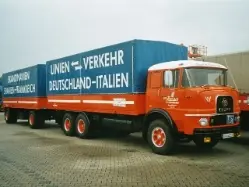
The Krupp Tiger was the heavy lorry that took over from the Titan when Krupp modernised its post-war range in 1955. It kept the two-stroke diesel principle of its predecessor, now rated at 185 hp, and it wore the flatter, squarer bonnet that marked the new generation.
Krupp Tiger at a glance
| Maker | Fried. Krupp Motoren- und Kraftwagenfabriken |
|---|---|
| Introduced | 1955 |
| Predecessor | Titan (1950; 190 hp, 210 hp from 1951) |
| Engine | two-stroke diesel |
| Power | 185 hp |
| Body | flatter, squarer bonnet than the Titan |
| Range mates | Mustang, Büffel, Widder (1955), Elch and Drache (1956) |
| Plant | Essen |
| Krupp lorry production | 1919–1968 |
Based on one source: the German Wikipedia article on the Krupp works, which describes the Tiger in its history of the post-war range. There is no separate article on the model.
History of the Krupp Tiger
The Titan before it
Krupp returned to lorry production in 1946, at first under the Südwerke brand, and in 1950 launched the heavy Titan. Its long bonnet hid a Krupp two-stroke diesel of 190 hp, raised to 210 hp in 1951, which made it the strongest German lorry of the time. The planned six-cylinder engine was not allowed under the rules of the Allied occupation, so Krupp fitted two separately running three-cylinder engines one behind the other, joined by a toothed drive. The idle beat of that engine, described by drivers as “Kropp-kropp-kropp”, gave rise to the saying that the Titan was the only lorry that could say its own name.
The range of 1955
In 1955 Krupp modernised the whole lorry programme. Bonnets became flatter and squarer, and the successor to the Titan was named Tiger, again with a two-stroke diesel, this time of 185 hp. The Mustang and the Büffel were revised at the same time but kept their names, and a new five-tonner, the Widder, joined the range.
Into the late 1950s
The Widder gave way to the Elch in 1956, and from the same year Krupp built heavy two-axle dumpers of the Drache type. Detail changes continued until 1959, including one-piece instead of split windscreens and the first forward-control cabs with fixed cabins. In 1959 a new generation of lorries with very modern cabs arrived, and the type designations were changed to three-digit numbers.
Design and features
- Two-stroke diesel: 185 hp, continuing the engine principle of the Titan.
- New bonnet: flatter and squarer than the Titan’s long, rounded hood.
- Direct successor: the Tiger took the top place in Krupp’s lorry range in 1955.
- Animal-named range: sold alongside the Mustang, Büffel, Widder, Elch and Drache.
Krupp Tiger versions
- Tiger (1955): the first version of the new heavy lorry.
- Later Tigers to 1959: detail changes such as one-piece windscreens.
- Forward-control cabs: fixed-cab versions offered towards the end of the 1950s.
The Tiger replaced the Titan at the top of the range; below it sat the Krupp Mustang and the light Krupp Büffel. More vehicles are in the Krupp collection.
Video: krupp tiger
Video by ackermann62 on YouTube.
Sources
- Fried. Krupp Motoren- und Kraftwagenfabriken, German Wikipedia: Titan background, 1955 modernisation, Tiger engine and later range