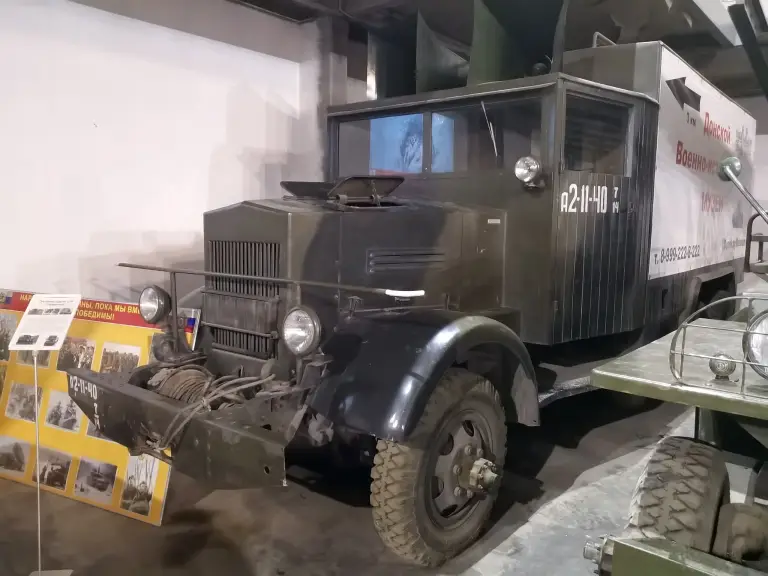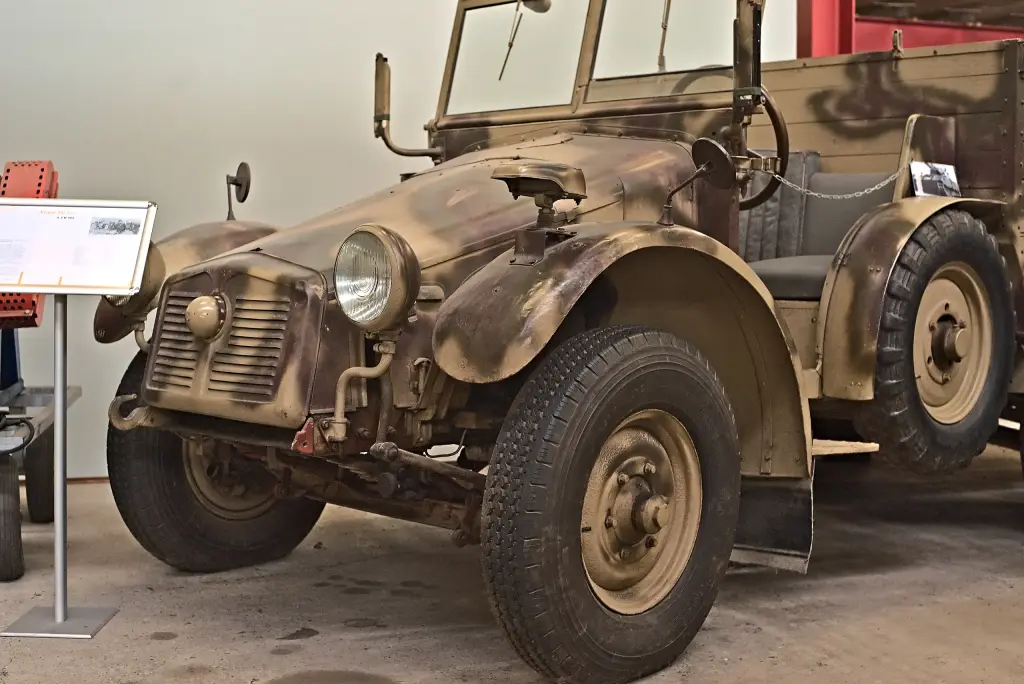
The Krupp L2, better known as the Krupp Protze, was a six-wheeled 6×4 truck and artillery tractor. Krupp supplied it to the Reichswehr and later the Wehrmacht between 1933 and 1941, first as the L 2 H 43 and from 1936 as the L 2 H 143, and about 7,000 of both types were built.
Krupp L2 Protze at a glance
| Maker | F. Krupp AG, Essen |
|---|---|
| Type | six-wheeled 6×4 truck and artillery tractor |
| Designations | L 2 H 43 (1933–1936), L 2 H 143 (1937–1941) |
| Production | 1933–1941, about 7,000 |
| Engine | air-cooled four-cylinder boxer, Krupp M 304 / M 305 |
| Capacity | 3,308 cc (M 305: 3,460 cc) |
| Power | 55 hp at 2,500 rpm; 60 hp from 1936 |
| Transmission | four-speed ZF “Aphon”, two locking differentials |
| Dimensions | 5.10 × 1.96 × 1.93 m |
| Weight | 2,450–2,825 kg empty; 3,600–3,750 kg laden |
| Speed and range | 70 km/h; 400 km on road, 275 km cross-country |
| Main role | towing the 3.7 cm Pak 36 (Kfz. 69) |
History of the Krupp L2 Protze
An unconventional chassis
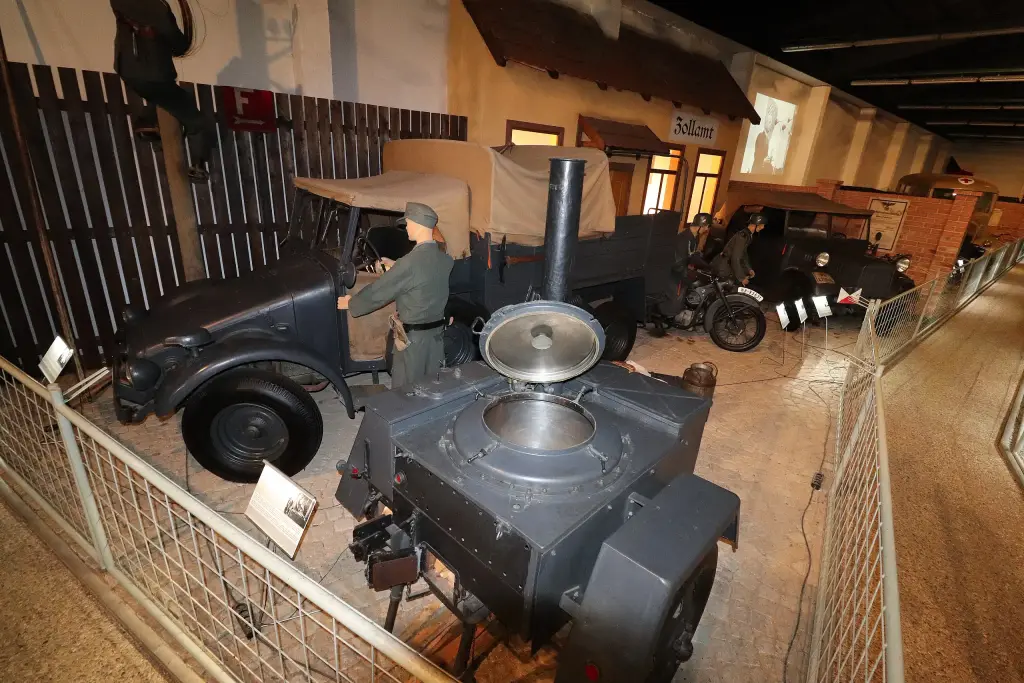
The Protze was technically unlike most military vehicles of its day. Its chassis was pressed from C-section sheet steel. The front axle was not driven and used a transverse leaf spring, while the four rear wheels were suspended individually on double wishbones. The two wheels on each side shared a horizontal coil spring above them, worked through knee levers bearing on the upper wishbone. The air-cooled four-cylinder boxer engine drove all four rear wheels through two locking differentials. Hydraulic brakes acted on all six wheels, and the handbrake acted on the transmission and so on both rear axles.
The layout gave a very low bonnet line and good visibility for the driver over rough ground. The same Krupp M 305 engine, of 3,460 cc, was also used in the Panzer I Ausf. A. The penalty was fuel consumption: about 24 litres per 100 km on the road, against 16.5 litres for the comparable Opel Blitz 1.5-tonne truck.
At war
The L 2 H 43 entered production in 1933 with a 55 hp engine; from 1936 the improved L 2 H 143 brought a 60 hp M 305 and small changes to the body and chassis. The type was used extensively on the Eastern Front, in the North African campaign and in France and Sicily. Its standard job was to tow the 3.7 cm Pak 36 anti-tank gun as the Kfz. 69, or to carry motorised infantry as the Kfz. 70, with two men in front and ten on benches in the rear.
Variants
Krupp built the Protze in a long list of specialist bodies: telephone truck (Kfz. 19), staff car (Kfz. 21), radio mast carrier (Kfz. 68), gun tractor for the 2 cm Flak (Kfz. 81) and generator carrier for anti-aircraft searchlights (Kfz. 83). In 1937 Krupp built ten lightly armoured scout cars, the Sd.Kfz. 247 Ausf. A, on the L 2 H 143 chassis. Guns were sometimes mounted directly on the truck bed as portees.
Design and features
- Six wheels, four driven: two driven rear axles with locking differentials gave the Protze its cross-country ability.
- Air-cooled boxer engine: the Krupp M 304/M 305 kept the bonnet low and avoided a radiator.
- Unusual rear suspension: independent double wishbones and a shared coil spring on each side.
- Thirsty: about 24 litres per 100 km, well above the Opel Blitz.
Krupp L2 Protze versions
- Kfz. 69: the standard gun tractor for the 3.7 cm Pak 36.
- Kfz. 70: personnel carrier with benches for ten men in the rear.
- Signals and anti-aircraft bodies: Kfz. 19, 21, 68, 81 and 83.
- Sd.Kfz. 247 Ausf. A: ten armoured scout cars on the L 2 H 143 chassis, 1937.
The Protze was the light lorry of Krupp’s military programme; the heavier Krupp L3 H63 served alongside it in the 3-tonne class. More vehicles are in the Krupp collection.
Video: Krupp L2 143
Video by SuperPyren on YouTube.
Sources
- Krupp Protze, English Wikipedia: production, variants, war service, fuel consumption
- Krupp-Protze, German Wikipedia: chassis, dimensions, technical data, designations