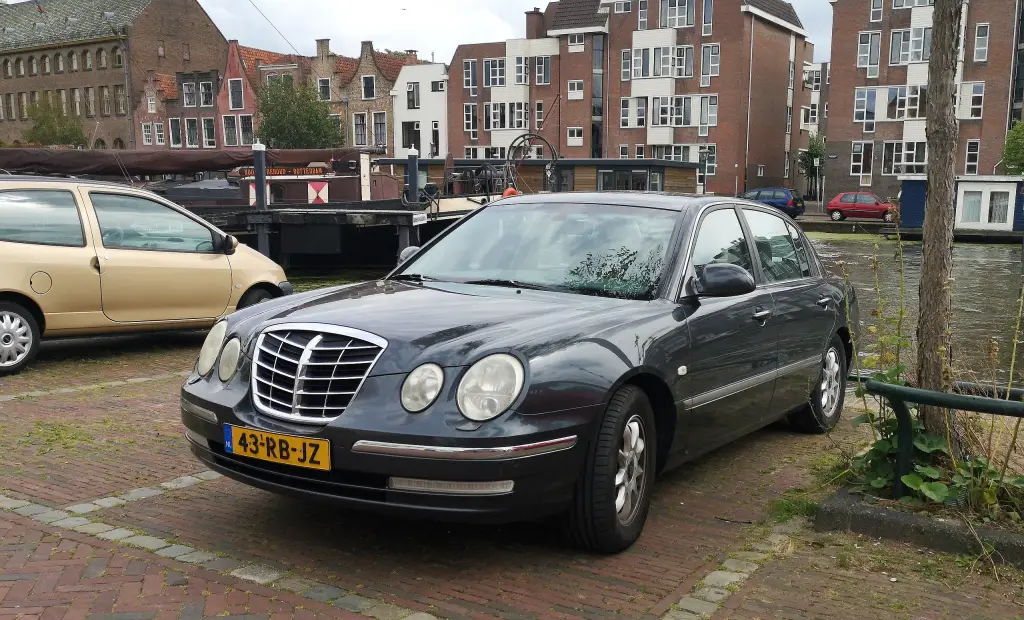
The Kia Opirus was a full-size executive saloon built from 2003 to 2012 and sold in North America as the Amanti. It was Kia’s first premium model and the first Kia to share a platform with a Hyundai, and it put comfort and equipment ahead of driver appeal.
Kia Opirus at a glance
| Maker | Kia Motors |
|---|---|
| Production | 2003–2012 globally, 2004–2009 in North America |
| Also called | Kia Amanti |
| Debut | Geneva Motor Show, 2003 |
| Development | 22 months, US$167 million |
| Platform | Hyundai Grandeur/XG Y4, lengthened 1.9 inches |
| Engines | 3.5 Sigma V6; 3.8 Lambda V6 from 2007 |
| North American power | 200 bhp and 220 lb-ft from the 3.5 |
| Gearbox | five-speed automatic |
| Built at | Hwaseong plant, near Incheon |
| Name origin | Ophir, the ancient city known for its wealth |
History of the Kia Opirus
Kia developed the Opirus over 22 months at a cost of US$167 million, with 18 per cent of the budget going to research and development and 41 per cent to production technology. It made its international debut at the 2003 Geneva Motor Show and was launched in North America at the New York International Auto Show as the Amanti. In Korea it replaced the Enterprise, a large saloon derived from the Mazda 929, and it was the first Kia to use a Hyundai platform, a lengthened version of the third-generation Grandeur/XG Y4: 1.9 inches longer in the wheelbase, 4.1 inches longer overall and 2.6 inches taller.
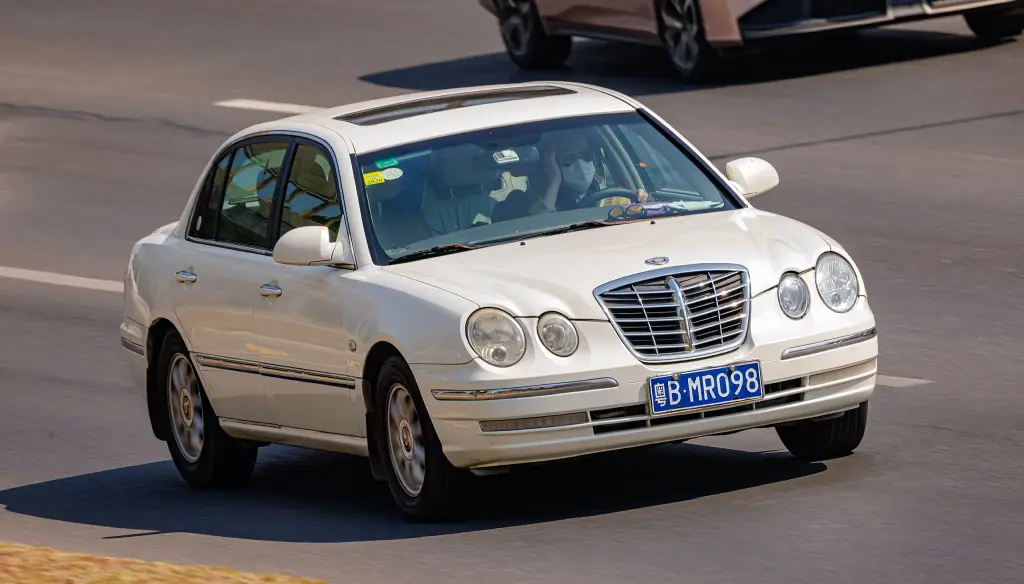
Design
The styling was described by critics as conservative, neo-classic, restrained, unoriginal and derivative, and it drew on the Mercedes-Benz E-class, Lincoln Town Car, Jaguar S-Type, Lexus GS, Chrysler 300C and Lancia Thesis. The name Opirus refers to Ophir, the ancient city famous for its wealth, and was chosen in an online survey from a shortlist of Opirus, Regent and Conzern. In 2004 the New York Times called Amanti an untranslatable latinate construction meant to suggest luxury.
Equipment
In Korea the Opirus offered heated and reclining rear seats, high-intensity discharge headlights, navigation, electro-luminescent instruments, an immobiliser, reverse parking sensors and electronically adjustable suspension settings. North American cars were sold in a single trim with faux wood trim, power everything, dual-zone climate control, front, side and curtain airbags, rain-sensing wipers, a power sunroof, 16-inch alloy wheels, a full-size spare on an alloy wheel and eight-way power front seats. Options included leather, a 270-watt Infinity stereo, heated seats, adjustable pedals and pearlescent paint. Eight airbags, anti-pinch windows, 105.6 cubic feet of passenger space and a 15.5 cubic foot boot were part of the package, and in 2005 J.D. Power named the Amanti the most appealing premium mid-size car in its APEAL study.
Drivetrain
The Opirus used the 3.5-litre Sigma and later the 3.8-litre Lambda V6. The North American Amanti’s 3.5 produced 200 bhp at 5,500 rpm and 220 lb-ft at 3,500 rpm through a five-speed automatic with a manual mode on an H-shaped gate. Suspension was by double wishbones at the front and a multi-link rear, with coil springs, anti-roll bars, gas-pressurised dampers and an electronically controlled system with automatic and sport modes. Brakes were discs of 11.9 and 11.2 inches with ABS, brake assist, EBD, traction control and stability control, and the turning circle was 5.7 metres.
2007 facelift
The facelifted car was shown at the 2006 Paris Motor Show. It lost 250 pounds, gained revised suspension and, in North America, a 3.8-litre V6 with 32 per cent more power. Outside there was a shorter, wider grille, a revised bonnet, headlamps, bumpers, alloy wheels, boot lid, tail lamps, twin exhausts and rear quarter panels, and inside a new instrument panel.
Design and features
- First premium Kia: a deliberate move upmarket in styling and price.
- Hyundai platform: a lengthened Grandeur/XG base, Kia’s first shared with Hyundai.
- Comfort first: soft suspension, heavy insulation and a long equipment list.
- 2007 facelift: lighter, quicker with the 3.8 V6 and restyled front and rear.
Kia Opirus versions
- Opirus/Amanti 3.5 (2003–2007): 200 bhp Sigma V6.
- 2007 facelift (2007–2012): 3.8 Lambda V6 in North America, 250 lb lighter.
- Korean-market cars: heated rear seats, adjustable suspension and navigation.
The Opirus was Kia’s first luxury saloon and was followed by the K8 and the K9; its badge was later borrowed by the Mohave. More Kia models are in the Kia collection.
Sources
- Kia Opirus, English Wikipedia: development, design, equipment, drivetrain, facelift