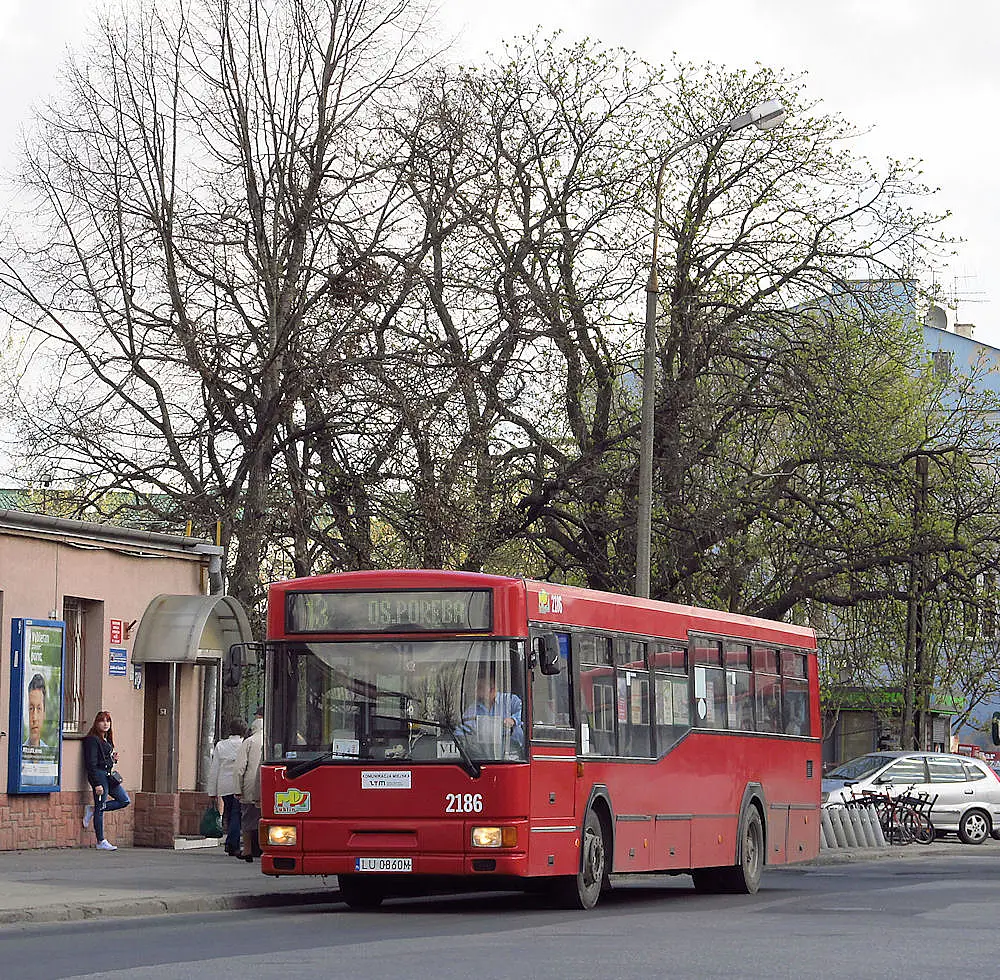
The Jelcz M121M was a low-entry city bus built at Jelcz-Laskowice from 1995 to 2004. It was the first Jelcz city bus adapted to passengers with reduced mobility, and it became one of the maker’s most popular models of the 1990s.
Jelcz M121M at a glance
| Maker | Jelcz, Jelcz-Laskowice |
|---|---|
| Type | low-entry city bus |
| Production | 1995-2004 |
| Prototype | Jelcz MN120M, 1994 |
| Floor height | 37 cm, 8 cm lower when kneeling |
| Wheelchair space | yes, with fixing points |
| Prototype engine | MAN D0826 LUH05, 230 hp |
| Prototype gearbox | ZF 4HP-500 automatic |
| Series gearbox | Voith D851.3 three-speed automatic |
| Option | ZF 4HP-500 or 5HP-500 |
| Euro 2 engine | MAN D0826 LUH12 |
| Built for Warsaw | over 100, 1995-1998 |
This page is based on a single source, the Polish Wikipedia article on the Jelcz M121M. The M120 name of the former separate entry came from the MN120M prototype described there.
History of the Jelcz M121M
In 1994 the works presented a prototype of the first Polish low-floor bus, designated Jelcz MN120M. It was in fact a low-entry version of the Jelcz 120MM/1, with a newly designed interior and a Jelcz 65N portal front axle, a German MAN D0826 LUH05 diesel of 230 hp, a four-speed ZF 4HP-500 automatic and, thanks to fully pneumatic suspension, a kneeling function. A year later the model entered series production as the M121M, the only technical change being a three-speed Voith D851.3 automatic as standard, with the ZF 4HP-500 and 5HP-500 as options.
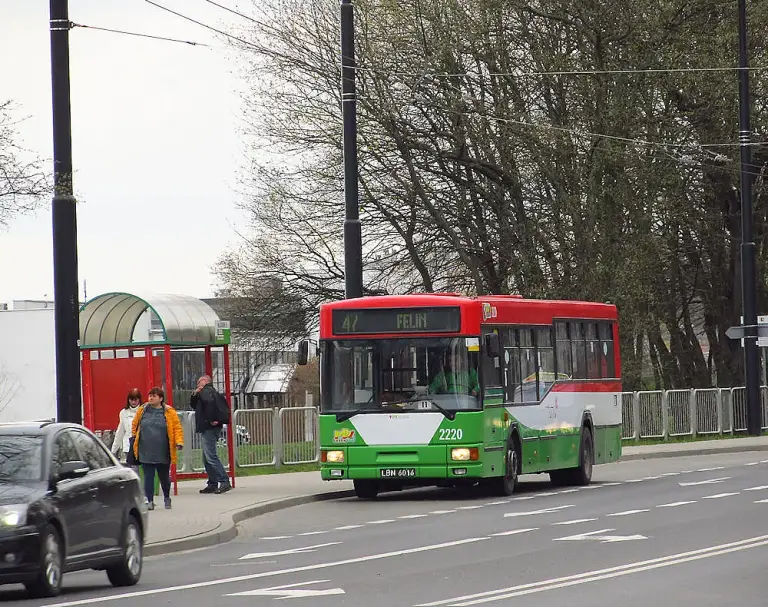
The low floor runs between the first and second doors, and a special space for a wheelchair, with fixing points, is provided in that area. The floor sits 37 cm above the road and can be lowered by a further 8 cm at stops thanks to the kneeling function; the rear part of the bus is higher and separated by steps. Because the final drive was slow, 5.86 and only later 5.125, the five-speed 5HP-500 was really the right choice, since the other gearboxes had no overdrive, which sharply limited top speed and kept fuel consumption high.
The first modernisation came at the end of 1995, with a plastic rear wall and entrance doors with bonded glass, and a much larger one followed in 1996: a new front wall with a panoramic windscreen, the removal of the steps in the low-floor front section, the fuel tank moved to the right front wheel arch with new housings incorporating a seat, and a lower window line at the front. Two years later the MAN D0826 LUH12 engine meeting Euro 2 replaced the Euro-1 unit, and from 2000 the M121M, like all Jelcz buses, used stainless steel for the frame and skin, which extended the expected service life. Production ended in 2004. The bus was popular with operators: more than 100 examples went to Warsaw alone between 1995 and 1998, because it offered comfort for disabled passengers while remaining relatively cheap against Western competition and shared its construction with other Jelcz products, which kept servicing and repair costs down.
Design and features
- Accessibility: a 37 cm low floor between the first two doors, a wheelchair space and an 8 cm kneeling function.
- Automatic transmission: Voith D851.3 as standard, with ZF 4HP-500 or 5HP-500 as options.
- 1996 facelift: panoramic windscreen, no steps in the front section and a repositioned fuel tank.
- Stainless structure: from 2000 the frame and skin were made of stainless steel.
Jelcz M121M versions
- Jelcz MN120M: the 1994 prototype with the MAN D0826 LUH05 engine and ZF automatic.
- Jelcz M121M: the series bus with the Voith D851.3 gearbox.
- Euro 2 version: from 1998 with the MAN D0826 LUH12 engine.
The M121M was developed from the Jelcz 120M and was joined in the range by the Mielec-engined Jelcz M121. More buses are in the Jelcz collection.
Sources
- Jelcz M121M, Polish Wikipedia: prototype, low-floor layout, gearboxes, modernisations and career