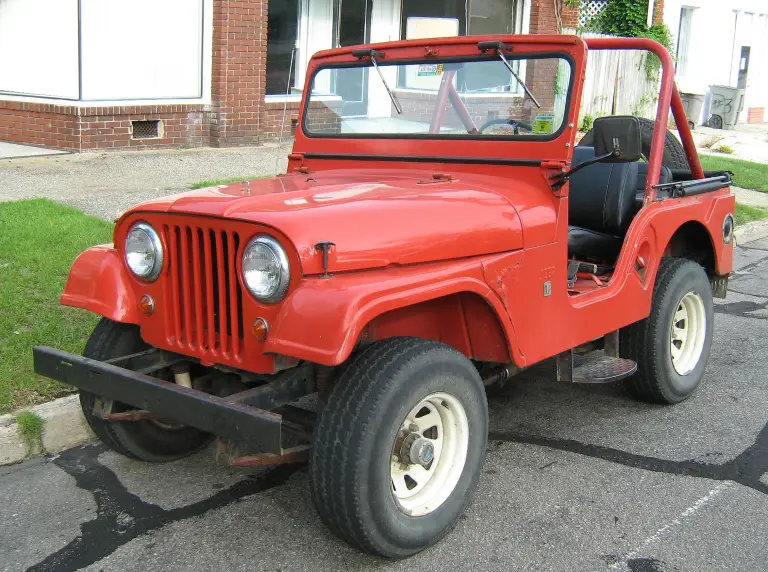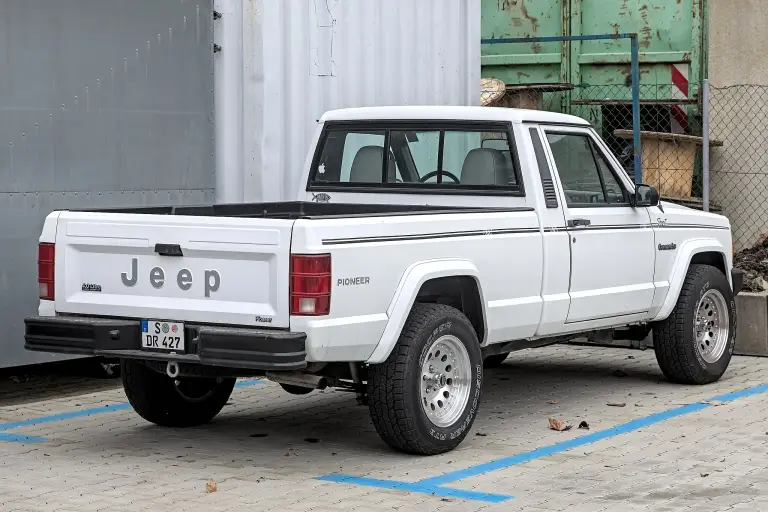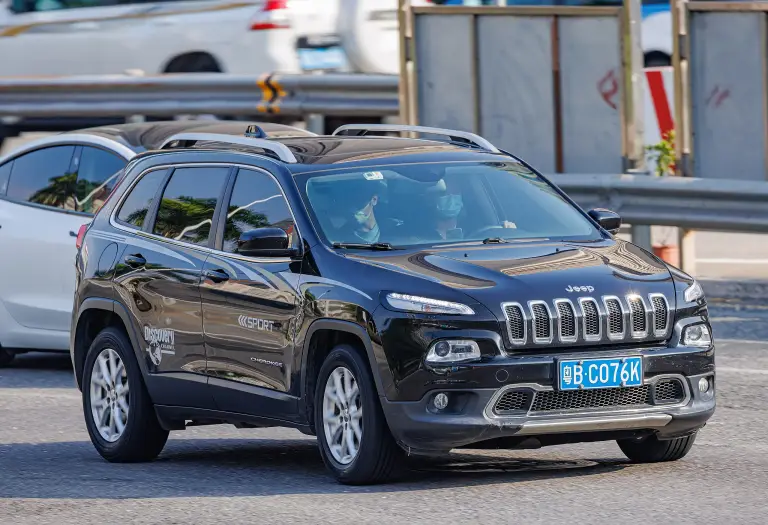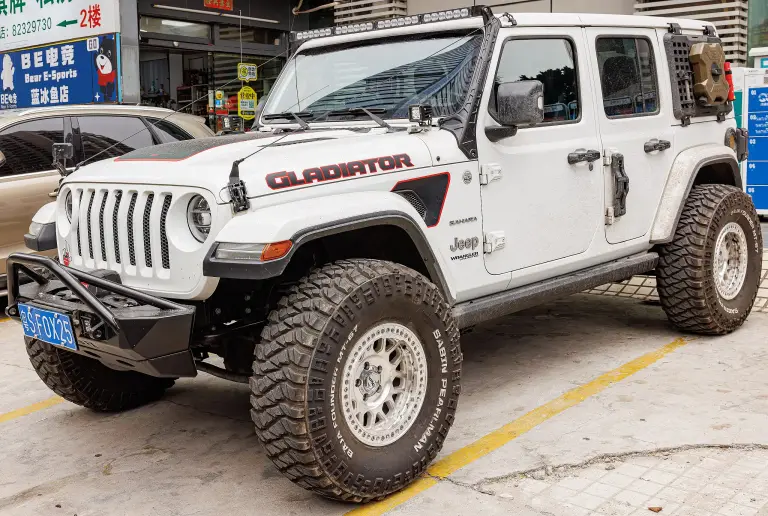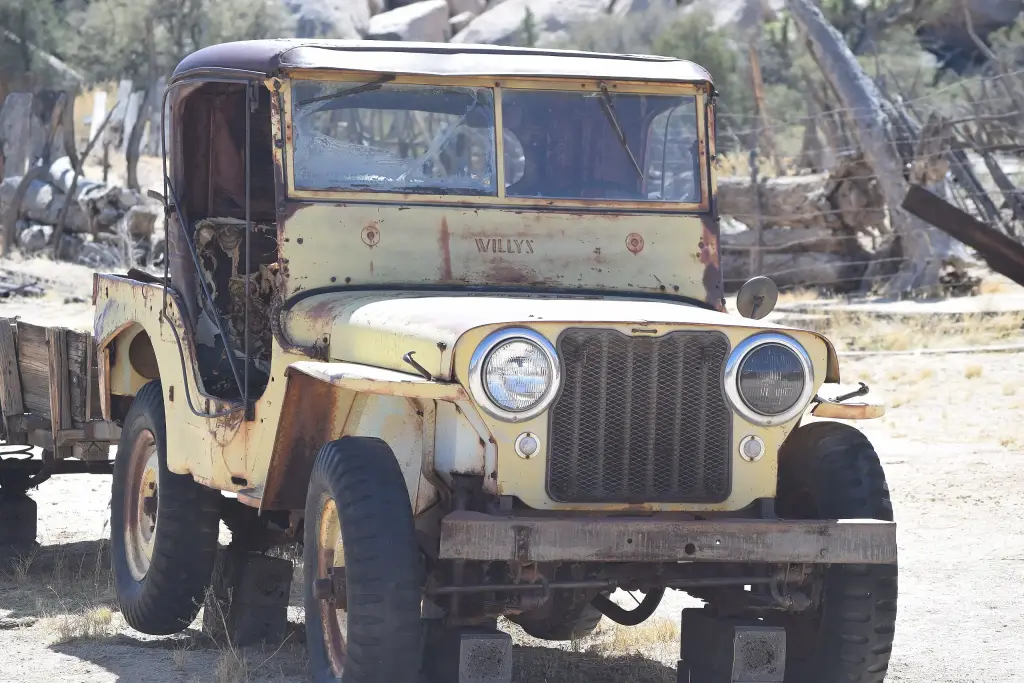
The Jeep CJ is the civilian branch of the wartime Jeep, built and sold by successive owners of the Jeep marque from 1945 until 1986. The 1945 Willys “Universal Jeep” is regarded as the world’s first mass-produced civilian four-wheel drive car. Every CJ kept a separate body on a frame, rigid live axles on leaf springs, a tapering nose with flared fenders and a fold-flat windshield, and most could be driven without doors.
Jeep CJ at a glance
| Maker | Willys-Overland, later Kaiser Jeep and American Motors |
|---|---|
| Production | 1945–1986 |
| First production model | CJ-2A (1945) |
| Body | open body on a separate frame, fold-flat windshield |
| Four-wheel drive | part-time, with high and low range |
| Early engine | Willys L-134 Go-Devil four-cylinder, 60 hp |
| Grille | seven slots on the CJ-2A against nine on the military MB |
| CJ-2A built | 214,760 (1945–1949) |
| CJ-3A built | 131,843 (1949–1953) |
| CJ-3B built | about 196,000 to 1968 |
| Total built | more than 1.5 million CJs |
| Replaced by | Jeep Wrangler, from 1987 |
The English Wikipedia article on the Jeep CJ covers the whole series; this page describes the early CJ-2A, CJ-3A and CJ-3B, and is based on one source.
History of the Jeep CJ
From the MB to the CJ-2A
In 1944, with the war turning, Willys-Overland began planning a Jeep for the civilian market. One or two prototypes called CJ, for “civilian Jeep”, were running by May 1944: they were military MBs modified with a tailgate, lower gearing, a drawbar and a canvas top. None of those first CJs survive. The CJ-2 that followed, at least 40 and probably 40 to 45 of them, was used only for testing and was never sold; known as the “AgriJeep”, it shared the MB’s Go-Devil engine but added a tailgate, power take-offs, an engine governor and a column-shift T90 gearbox. Lessons from those trials produced the CJ-2A, the first full-production CJ, built from 17 July 1945. It looked much like a civilianised MB, but its larger headlights sat flush in a seven-slot grille instead of the MB’s nine slots, and a stronger T-90 three-speed replaced the wartime T-84. It was sold mainly to farmers and industry, so only a driver’s seat and mirror were standard and the option list ran to a front power take-off, belt pulley, capstan winch, hydraulic lift, snow plough and welder.
CJ-3A and CJ-3B
The CJ-3A arrived in 1949 with a one-piece windshield, a 10-leaf suspension for farm implements and a shorter rear wheel well, and 131,843 were built before production ended in 1953. About 550 were assembled by Mitsubishi as the J1 and J2 for the Japanese police and forestry service, and the CJ-3A also served as the basis of the military Willys MC, or M38. The CJ-3B replaced it in 1953, the year Kaiser bought Willys-Overland, with a higher grille and bonnet to clear the new Willys Hurricane engine. A four-speed gearbox became an option in 1963, and about 196,000 CJ-3Bs were built up to 1968. The design was licensed widely: Mitsubishi built derivatives until 1998 and Mahindra until October 2010.
The later CJs and the end of the line
The round-fendered CJ-5 appeared in 1955 and was joined in 1976 by the longer CJ-7 with doors and a hardtop. A two-wheel-drive version, the DJ “Dispatcher”, had been added in 1956 for hotels, resorts, police and the postal service. Over 42 model years the CJ gained six-cylinder and V8 engines, automatic gearboxes and different four-wheel drive systems, but kept its basic shape. Production ended after 1986 with more than 1.5 million built; in 1987 the CJ-7 was replaced by the first-generation Wrangler, which rode on the same wheelbase and kept leaf springs. American Motors vice-president Joseph E. Cappy called the end of CJ production “an end of a very important era in Jeep history”.
Design and features
- Seven-slot grille: the CJ-2A’s flush headlights and seven slots replaced the MB’s recessed lights and nine slots.
- Farm equipment: power take-offs, a belt pulley, capstan winch and hydraulic lift turned the CJ into a tractor substitute.
- Sturdy drivetrain: the T-90 gearbox and stronger rear axles were chosen for years of rural use, not weeks of war.
- One-piece windshield: introduced on the CJ-3A, with a vent and bottom-mounted wipers.
- Raised bonnet: the CJ-3B’s higher grille and hood made room for the Hurricane engine.
- Worldwide licences: Mitsubishi and Mahindra built CJ-3B derivatives for decades.
Jeep CJ versions
- CJ-1 (1944): one or two prototypes, none surviving.
- CJ-2 AgriJeep (1944–1945): about 40–45 test vehicles, never sold.
- CJ-2A (1945–1949): the first production civilian Jeep, 214,760 built.
- CJ-3A (1949–1953): 131,843 built; the military M38 was derived from it.
- CJ-3B (1953–1968): higher bonnet for the Hurricane engine; the military version was the M606.
- Later CJs: the CJ-5 from 1955 and the CJ-7 from 1976.
The CJ line continued with the CJ-5 and the CJ-7, and its wartime ancestor is described in the article on the Willys MB. More models are in the Jeep collection.
Sources
- Jeep CJ, English Wikipedia: history, the CJ-2A, CJ-3A and CJ-3B, production figures