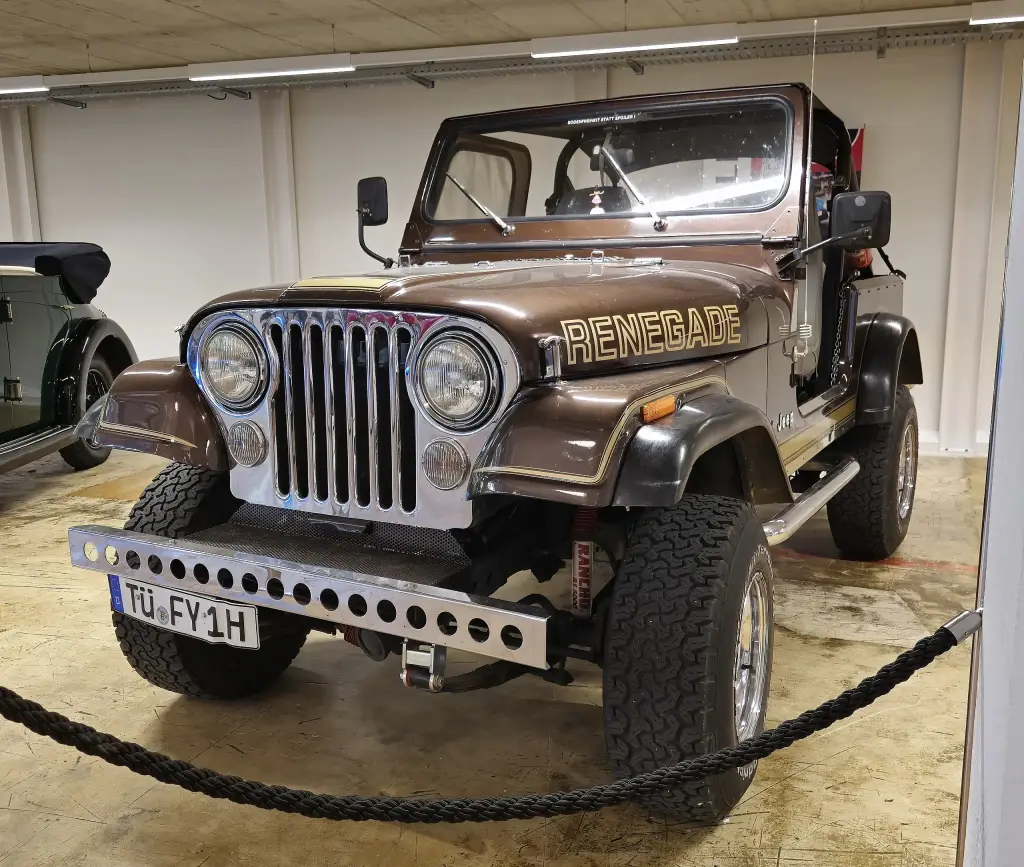
The Jeep CJ-7 was the roomier, more civilised version of the CJ, sold from 1976 to 1986. Its wheelbase was 10 inches longer than the CJ-5’s, its curved side cut-outs were partly squared to take hinged doors, and for the first time a moulded hardtop was a factory option. It was the last CJ, and 379,299 were built over eleven years.
Jeep CJ-7 at a glance
| Maker | American Motors (Jeep) |
|---|---|
| Production | 1976–1986 |
| Wheelbase | 10 in (25 cm) longer than the CJ-5 |
| Chassis | two parallel C-section rails, rear section stepped out |
| Body | squared side cut-outs for hinged steel doors |
| Roof | optional moulded hardtop |
| Four-wheel drive | part-time two-speed transfer case; Quadra-Trac automatic all-wheel drive optional |
| Transfer case | Dana 20 (1976–1979), Dana 300 (1980–1986) |
| Engines | 2.5 I4, 3.8 I6, 4.2 I6, 5.0 V8; Isuzu 2.4 diesel for export |
| Trims | Renegade, Golden Eagle, Golden Hawk, Laredo |
| Built | 379,299 |
| Long version | Scrambler (CJ-8), 1981–1986 |
The English Wikipedia article on the Jeep CJ covers the whole series; the CJ-7, Scrambler and CJ-10 sections are the basis of this page.
History of the Jeep CJ-7
A CJ for the road
The CJ-7 appeared for the 1976 model year with a wheelbase 10 inches longer than the CJ-5’s and a body whose curved side openings were partly squared off so that proper hinged doors could be fitted. Underneath, the chassis used two parallel C-section rails, and behind the doors the rear section stepped outwards so that the springs and shock absorbers could sit closer to the outside of the body, improving stability. A moulded hardtop and steel doors were on the option list, which made the CJ-7 the first CJ that could be used as an everyday car in cold weather.
Engines, axles and trims
Buyers could have a 2.5 litre four, the 3.8 and 4.2 litre AMC straight-sixes or the 5.0 litre AMC V8, with a four-speed, five-speed or three-speed automatic gearbox. The standard system was a part-time two-speed transfer case, but from 1976 an automatic all-wheel drive system called Quadra-Trac was offered. The final-drive ratio depended on the engine: 4.10 for the Isuzu diesel, 3.73 for the 258 six and the 2.5 four, and 3.55 for the 304 V8. From 1976 to 1979 the CJ-7 used a Dana 20 transfer case and an AMC 20 rear axle; from 1980 the Dana 300 arrived, and in mid-1986 the Laredo received a Dana 44. The Laredo package added high-back leather seats, a tilting steering wheel and chrome bumpers, grille cover and mirrors.
Scrambler and CJ-10
In 1981 Jeep added the CJ-8, sold as the Scrambler: a CJ-7 with a 103.5 in wheelbase, a removable half cab and a small pickup-style box. Most had a four- or five-speed manual, a three-speed automatic was optional, and a full-length steel hardtop with a rear barn door was built for the Alaskan postal service, 230 of them. The Scrambler was replaced in effect by the Cherokee-based Comanche. The CJ-10 of 1981–1985 was a different animal: a CJ body on a heavily modified J10 pickup chassis, made for export and sold mainly in Australia, with rectangular headlights in the fenders and a ten-slot grille. The CJ-10A was a flightline aircraft tug built in Mexico from 1984 to 1986, about 2,300 of them.
The end of the line
The Canadian Army took 195 militarised CJ-7s in 1985 as a stop-gap between the M38A1 and the Bombardier Iltis. Special editions included the 1982–1983 Limited, of which 2,500 were built, and the 1982 Jamboree Commemorative Edition, 630 numbered cars for the 30th anniversary of the Rubicon Trail and the rarest CJ-7. The last cars carried a dash plaque reading “Last of a Great Breed”, and in 1987 the CJ-7 gave way to the first-generation Wrangler, which kept the same wheelbase and leaf springs. CJ-7s remain popular for mud racing and rock crawling today.
Design and features
- Doors and hardtop: the first CJ with factory steel doors and a moulded hardtop as options.
- Wider stance: the stepped rear chassis put the springs and dampers nearer the body sides.
- Quadra-Trac: an automatic all-wheel drive system offered from 1976.
- Laredo trim: leather seats, a tilting wheel and a chrome package from 1980.
- Collector editions: the 630-car Jamboree of 1982 is the rarest CJ-7.
Jeep CJ-7 versions
- CJ-7 (1976–1986): the standard car, 379,299 built.
- Renegade (1976–1986): the long-running performance package.
- Golden Eagle (1977–1980) and Golden Hawk (1980): decal and trim packages with the 304 V8.
- Laredo (1980–1986): the luxury version with leather and chrome.
- Limited (1982–1983): 2,500 cars with the 4.2 six.
- Jamboree (1982): 630 numbered cars; Scrambler CJ-8 (1981–1986) and CJ-10 (1981–1985) as relatives.
The CJ-7 followed the CJ-5 and the earlier CJ-2A, CJ-3A and CJ-3B, and was replaced by the Wrangler; its pickup cousin is the Comanche. More models are in the Jeep collection.
Video: Offroad Wochenende im Jeep CJ-7
Video by AUTO BILD on YouTube.
Sources
- Jeep CJ, English Wikipedia: CJ-7, Scrambler and CJ-10 sections, production figures