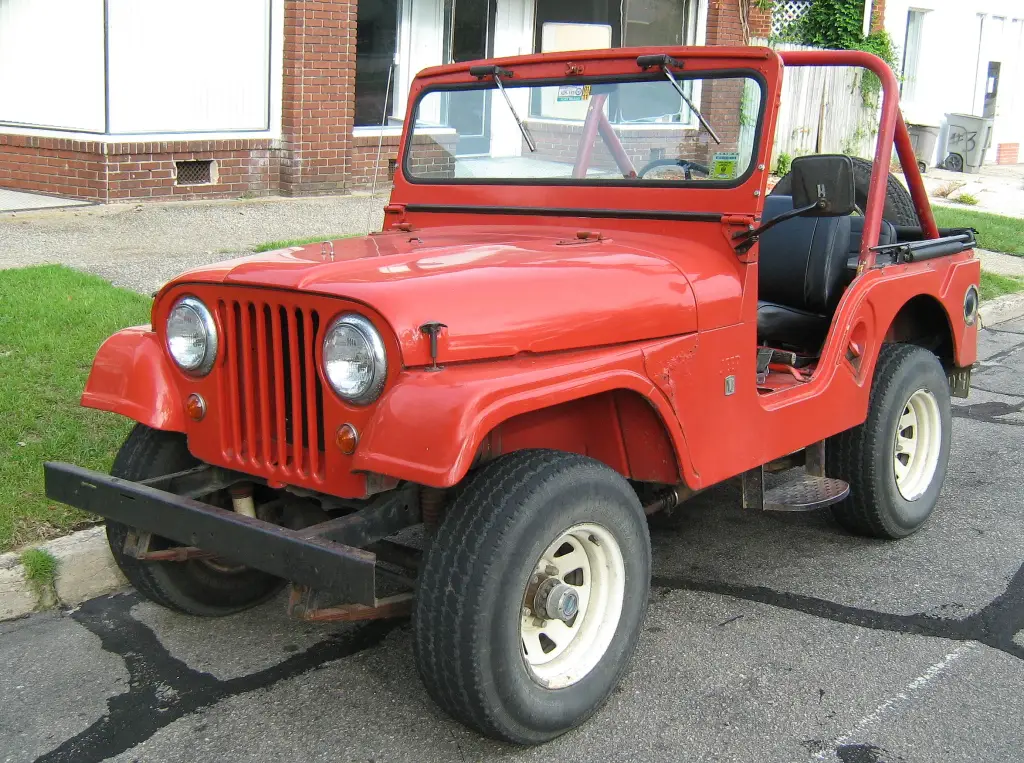
The Jeep CJ-5 was the round-fendered civilian Jeep introduced for 1955 and built, in one form or another, until 1983. It was shaped by the new owner Kaiser and by the Korean War M38A1, and it was meant to replace the CJ-3B, which carried on beside it. The CJ-5 continued for three decades while three newer models appeared, and it is remembered as a vehicle that was hard to kill off.
Jeep CJ-5 at a glance
| Maker | Willys Motors, then Kaiser Jeep, then American Motors |
|---|---|
| Production | 1954–1983 |
| Body | round-fendered open body, fold-flat windshield |
| Base engine | Willys Hurricane four-cylinder, 75 hp |
| Diesel option | Perkins 3.15 L four, 62 hp, 1961–1965 |
| V6 option | Buick 225 cu in Dauntless, 155 hp, from 1965 |
| V6 take-up | about 75 per cent of CJ-5 sales by 1968 |
| From 1972 | AMC 232 and 258 straight-six, 304 cu in V8 |
| Chassis, 1972 | wheelbase 2.5 in longer, bonnet and fenders 5 in longer |
| Long version | CJ-6, 20 in longer, 50,172 built 1955–1981 |
| Trims | Tuxedo Park, Renegade, Super Jeep, Golden Eagle, Laredo |
| End of production | 1983 |
The English Wikipedia article on the Jeep CJ covers the whole series; this page describes the CJ-5 and CJ-6 and is based on one source.
History of the Jeep CJ-5
A rounder CJ
The CJ-5 arrived for 1955 as a more rounded replacement for the flat-fendered CJ-3B, influenced by Kaiser, which had bought Willys in 1953, and by the military M38A1. The new body had curved fenders and a wider, lower look, but the recipe was unchanged: separate frame, live axles on leaf springs and part-time four-wheel drive. Buyers could still strip the doors and fold the windshield flat. The CJ-3B stayed in production beside it, and the CJ-5 went on to become the longest-serving CJ of all.
Sixes from Buick and AMC
The four-cylinder Hurricane was thought underpowered, so from 1965 Kaiser offered the Buick 225 cu in V6 with 155 hp, a licensed design that proved so popular that by 1968 some 75 per cent of CJ-5s were sold with it. Power steering cost $81. Between 1961 and 1965 a British Perkins diesel of 3.15 litres and 62 hp was also on the list. American Motors bought Kaiser Jeep in 1970 and retired the Buick engine after 1971; the limited-slip Trac-Lok differential replaced the Powr-Lok in 1971 and power take-offs disappeared that year.
The 1972 revamp
For 1972 AMC fitted its own engines, which meant a new front axle, more room under the bonnet and a longer wheelbase. The 232 cu in straight-six became standard, the 258 cu in was optional, and AMC’s 304 cu in V8 gave the CJ-5 a power-to-weight ratio comparable to a V8 muscle car. The wheelbase grew by 2.5 in, the fenders and bonnet by 5 in, a new box frame appeared and the fuel tank moved from under the driver’s seat to between the rear frame rails. For 1976 the tub and frame were altered again, the body becoming more rounded, and in 1977 the frame was fully boxed and power disc brakes appeared. The 258 six became standard in 1979, and from 1980 to 1983 the CJ-5 used the GM Iron Duke four with a close-ratio four-speed.
The end and the CJ-6
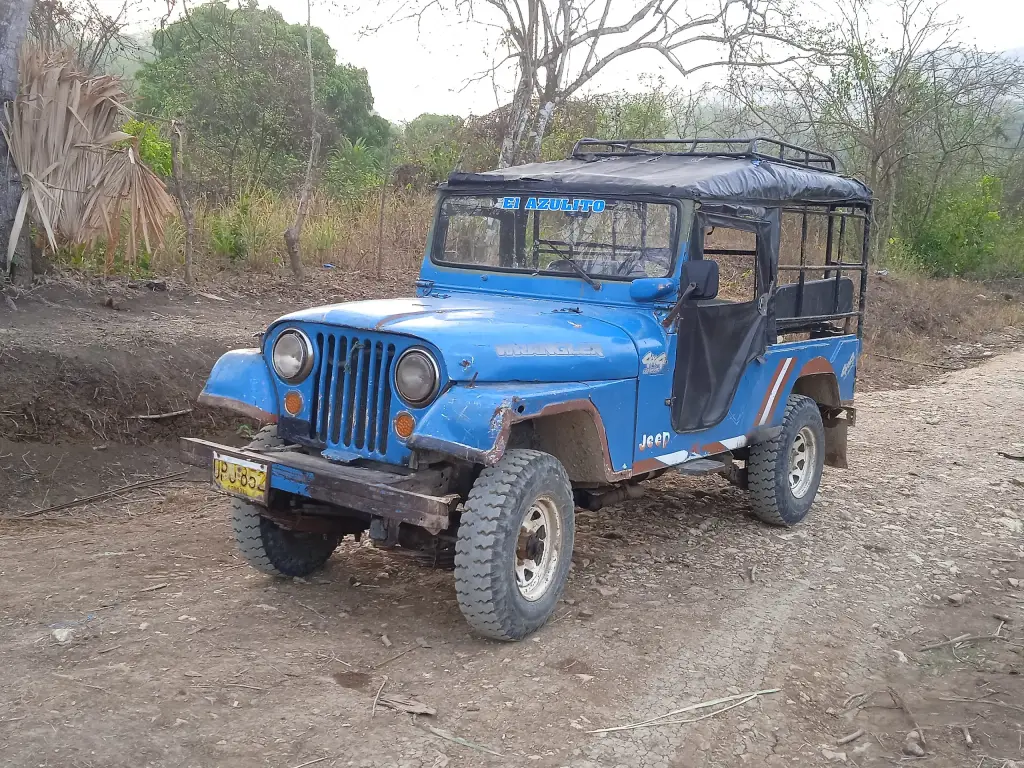
The end of the CJ-5 is often linked to a December 1980 60 Minutes report in which the Insurance Institute for Highway Safety staged a demonstration of the Jeep rolling over in routine cornering; years later it emerged that the testers achieved only eight rollovers in 435 runs and were asked to hang hidden weights in the body to create worst-case conditions. The long-wheelbase CJ-6, introduced for 1956, was 20 in longer, sold mostly in Sweden and South America, and was built in South Africa and Israel as well; 50,172 were made before it stopped in 1981. Australia fitted Ford Falcon sixes to CJ-5s and CJ-6s at Rocklea, and Brazil assembled the Willys Jeep Universal from 1957, with Ford taking over in 1967 and building it until 1983.
Design and features
- Round fenders: the CJ-5 broke with the flat-fendered CJ-3B and set the shape of the CJ for two decades.
- Buick V6: the 155 hp Dauntless option of 1965 cured complaints about the 75 hp four.
- AMC V8: the 304 cu in engine from 1972 gave the little Jeep muscle-car acceleration.
- Boxed frame: a fully boxed frame and power disc brakes arrived for 1977.
- Appearance packages: Tuxedo Park, Renegade, Super Jeep and Golden Eagle turned a utility vehicle into a lifestyle car.
Jeep CJ-5 versions
- CJ-5 (1954–1983): the standard short-wheelbase open Jeep.
- CJ-6 (1955–1981): 20 in longer, with room for a second row of seats; 50,172 built.
- Tuxedo Park (1961–1964): chrome-trimmed comfort models, sold as CJ-5A and CJ-6A from 1964.
- Renegade (1970–1983): the performance package, with the 304 V8 from 1972.
- Golden Eagle (1977–1983): decals, disc brakes, power steering and a V8.
- Silver Anniversary (1979): 1,000 cars marking 25 years of the CJ-5.
The CJ-5 sits between the earlier CJ-2A, CJ-3A and CJ-3B and the longer CJ-7, and its military cousin is the Willys M38. More models are in the Jeep collection.
Video: 67 jeep cj5
Video by everetward on YouTube.
Sources
- Jeep CJ, English Wikipedia: CJ-5 and CJ-6 history, engines, trims, production