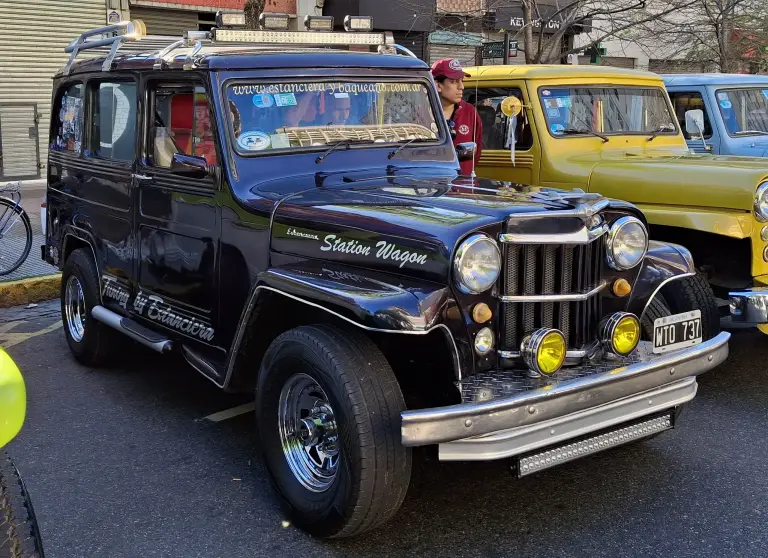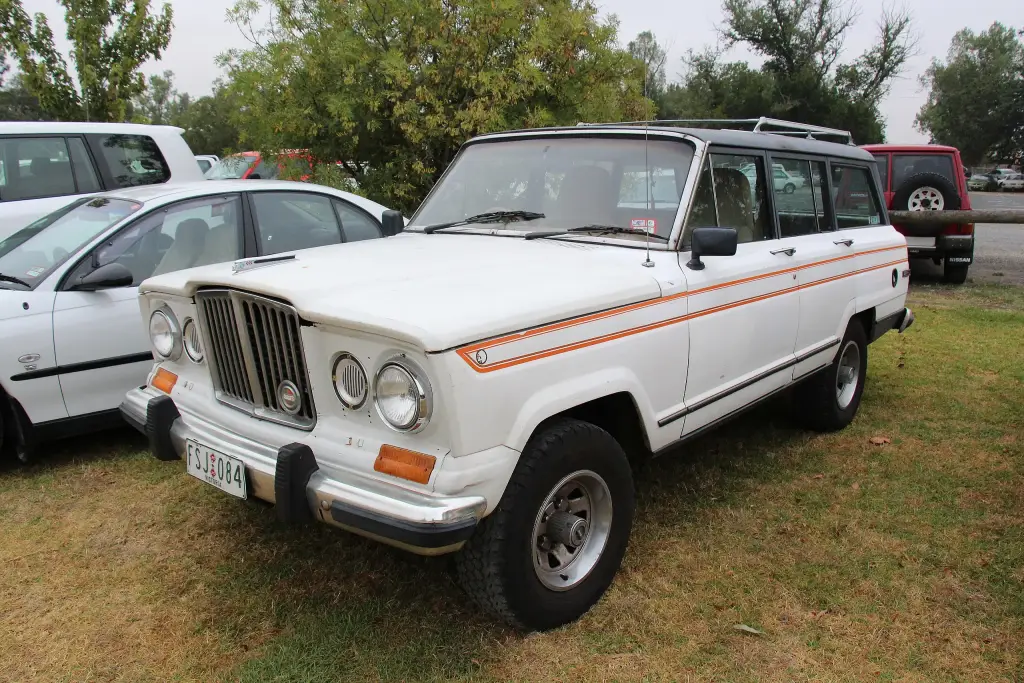
The Jeep Wagoneer was a luxury four-wheel-drive vehicle sold from the 1963 to 1991 model years. Introduced as the replacement for the Jeep Station Wagon, it was the first Jeep line completely distinct from the CJ, and the design that made the truck-based station wagon into a comfortable family car, an ancestor of the modern SUV.
Jeep Wagoneer at a glance
| Maker | Kaiser Jeep, then American Motors, then Chrysler |
|---|---|
| Production | 1963–1991 |
| Shown | November 1962 |
| Designer | Brooks Stevens |
| Chassis | Jeep SJ, shared with the Gladiator pickup |
| Bodies | five-door wagon, three-door wagon and two-door panel truck |
| Engine at launch | Tornado 230 cu in overhead-cam six, 140 hp |
| Transmission | three-speed manual or automatic |
| Drive | rear-wheel drive or part-time four-wheel drive with manual hubs |
| Front suspension | independent as standard on rear-wheel drive, optional on 4WD |
| Made in | Stickney Plant, Toledo, Ohio |
| Later name | Grand Wagoneer from 1984 |
The English Wikipedia page covers the SJ Wagoneer; this article follows it and mentions the later revivals only briefly.
History of the Jeep Wagoneer
A wagon that drove like a car
Willys management wanted something more advanced than the Station Wagon, which had been in production since 1946, as the big three moved into the four-wheel-drive market. The Wagoneer was conceived in the early 1960s by Kaiser Jeep, designed by a team under Brooks Stevens and developed over three years at a cost of around $20 million. It was introduced in November 1962 for the 1963 model year. Although it shared a pickup chassis with the Gladiator, its body was more carlike than any other 4×4 on sale, with a low stance, car-like manners, an overhead-cam straight-six and features that no mainstream four-wheel-drive vehicle had offered before: independent front suspension, power steering, automatic transmission, a factory radio and optional air conditioning. At launch it had no direct competition, and it took eight years for the Range Rover to appear, in a two-door body only.
Bodies and equipment
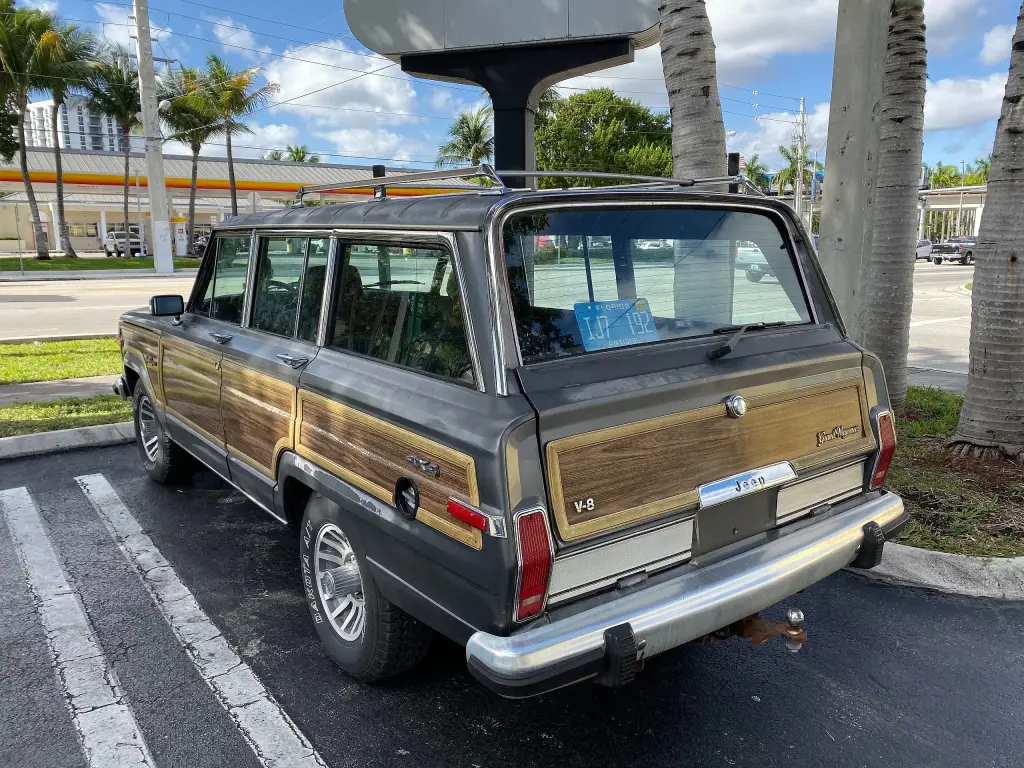
At first the Wagoneer came as a two- or four-door wagon, the two-door also as a Panel Delivery with windowless sides behind the doors and double barn doors at the back. The standard engine was Willys’ Tornado 230 cu in overhead-cam six of 140 hp, praised for its fuel economy, with a three-speed manual or an automatic, rear-wheel drive or a part-time four-wheel drive without a centre differential but with manually locking front hubs. Independent front suspension, using swing axles and torsion bars, was standard on two-wheel-drive cars and cost $135 or $160 on four-wheel-drive ones. A higher-content Super Wagoneer arrived for 1966, and from 1971 to 1991 the cars had simulated woodgrain panelling on the body sides.
Grand Wagoneer and the long run
After 1968 the Wagoneer was sold only as a five-door wagon; the three-door body returned as the Cherokee for 1974. When the XJ Cherokee arrived in 1984, the SJ Wagoneer became the Grand Wagoneer for the rest of its life. It was built at Jeep’s Stickney plant in Toledo for the whole run and lasted 29 model years, the third longest run in American automotive history, while the company passed from Kaiser to American Motors to Chrysler. The name was briefly revived in 1993 as a flagship version of the Grand Cherokee, then lay dormant for three decades until the WS-series Wagoneer and Grand Wagoneer.
Design and features
- Car-like comfort: power steering, automatic transmission, a radio and optional air conditioning in 1963.
- Independent front suspension: standard on two-wheel-drive cars and optional on four-wheel drive.
- Overhead-cam six: the Tornado engine of 140 hp, efficient for its day.
- Woodgrain trim: simulated panels from 1971 to 1991.
- Long life: 29 model years on one platform, the third longest American run.
Jeep Wagoneer versions
- Wagoneer (1963–1983): two- and four-door wagons, plus the Panel Delivery.
- Super Wagoneer (1966): the high-content version with sedan features.
- Grand Wagoneer (1984–1991): the renamed SJ wagon.
- Wagoneer trim of the XJ Cherokee (1984): the wood-panelled compact version.
- 1993 revival: a flagship version of the Grand Cherokee.
The Wagoneer shares its SJ platform with the J-series pickup, and its three-door body became the Cherokee. More models are in the Jeep collection.
Video: SCC 1979 Jeep Wagoneer
Video by Sean B. Real Deal on YouTube.
Sources
- Jeep Wagoneer (SJ), English Wikipedia: design, launch, engines, bodies, production run