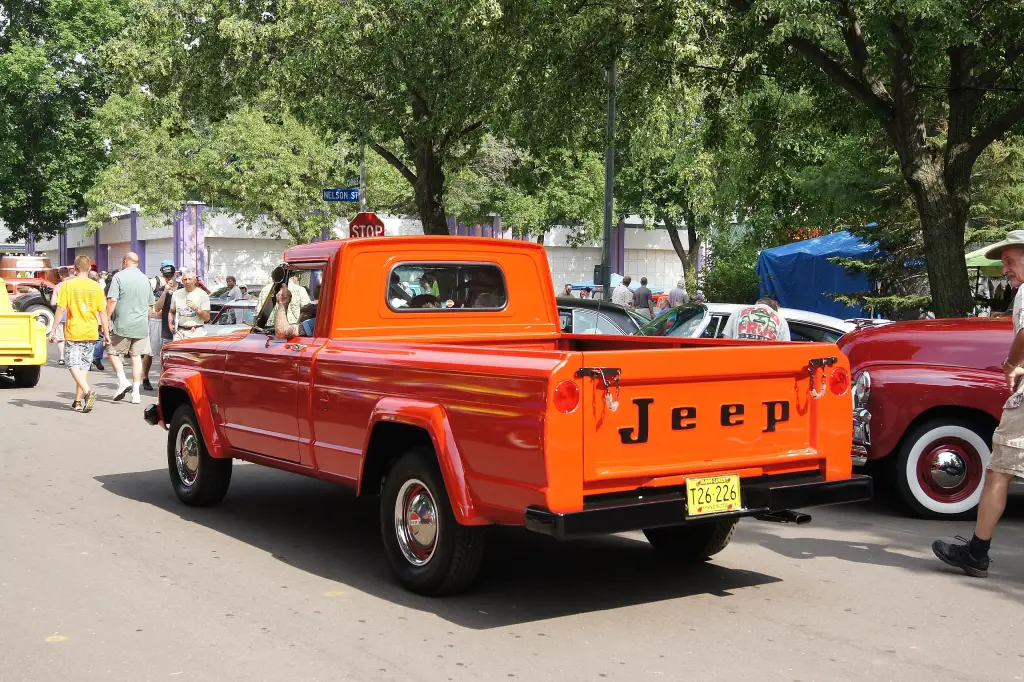
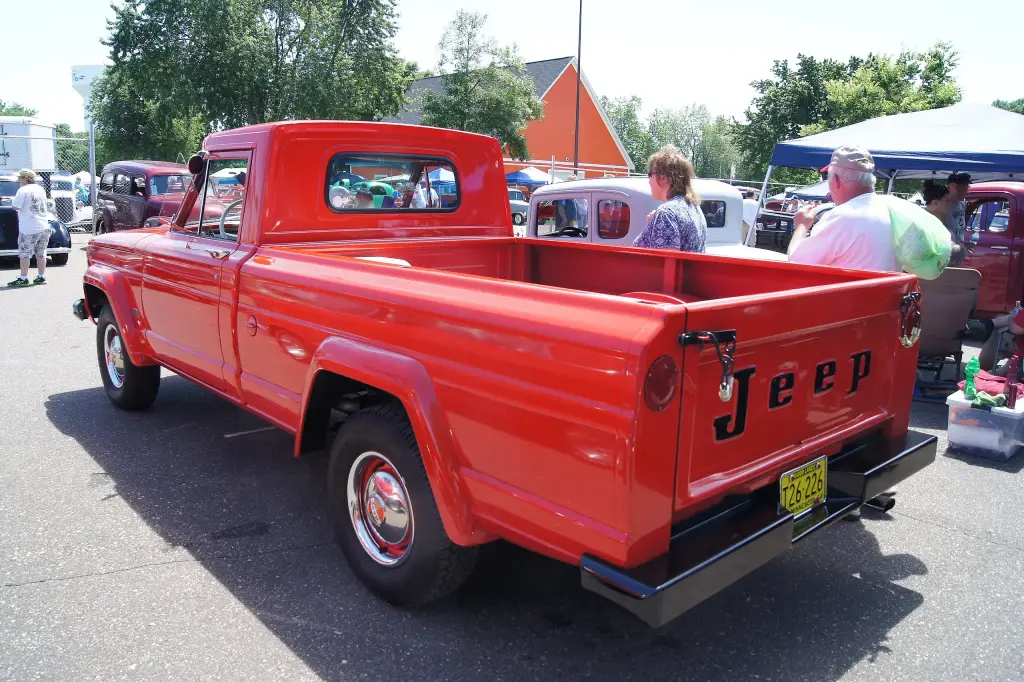
The Jeep Gladiator, later known as the Jeep pickup or J-series, was a range of full-size pickups built on the Jeep SJ platform of the Wagoneer. Production ran from 1962 to 1988, more than 26 years on a single platform generation, with RWD and 4WD, single and dual rear wheels, and bodies from bare chassis to chassis-mounted campers.
Jeep J-series at a glance
| Maker | Kaiser Jeep, later American Motors (Jeep) |
|---|---|
| Production | 1962–1988 |
| Platform | Jeep SJ, shared with the Wagoneer |
| First model | Gladiator, 1962 for the 1963 model year |
| Drive | rear-wheel or four-wheel drive; dual rear wheels optional |
| First engine | Tornado 230 cu in overhead-cam six, 140 hp |
| Front suspension | solid axle; independent front suspension 1963–1965 |
| Beds | Townside, Thriftside and flat stake bed |
| Gross weight | up to 8,600 lb, almost two tons of payload |
| Gearbox | manual standard; automatic offered from 1963 |
| Named | Gladiator to 1972, then J2000/J4000, then J10/J20 |
| Built abroad | Mexico (VAM) and Argentina (IKA) |
The English Wikipedia page is titled Jeep Gladiator (SJ); this article covers the J-series pickups rather than the modern JT truck.
History of the Jeep J-series
The first Gladiator
The first Jeep pickup development mule ran around May 1960, about three months after the first station-wagon prototype. The Gladiator was introduced in 1962 for the 1963 model year as a conventional body-on-frame pickup that shared its basic frame architecture and front end with the Wagoneer station wagon. It came with rear- or four-wheel drive and optional dual rear wheels, and it could be ordered as a cab and chassis, a wrecker, a stake bed or with a chassis-mounted camper on an extended wheelbase. A remarkable option was independent front suspension, with a Dana 44 centre section, on half-ton four-wheel-drive Gladiators; it proved troublesome and was deleted in 1965. The standard engine was the new overhead-cam Jeep Tornado 230 cu in six of 140 hp, the first production overhead-cam engine in an American light truck or SUV. Four-wheel-drive Gladiators could also be had with an automatic transmission, an industry first, along with power brakes, power steering and a power take-off for snow ploughs and other equipment.
Kaiser to AMC
In early 1963 Willys Motors changed its name to Kaiser Jeep Corporation. For 1965 the 327 cu in AMC V8 of 250 hp became available, and the Tornado was replaced by AMC’s 232 cu in overhead-valve six. In 1967 all two-wheel-drive versions except the J-100 panel delivery were dropped for poor sales; for 1968 the flared-fender Thriftside was discontinued and a camper option was added for the J-3600, while the Buick 350 cu in V8 of 230 hp was offered from 1968 to 1971. American Motors bought Kaiser’s Jeep operations in 1970 and moved the trucks to AMC engines, the Buick V8 giving way to the 360 and 401 cu in AMC units; the grille was also changed to the Wagoneer design, the truck’s first styling change since launch.
J2000, J4000, J10 and J20
The Gladiator name was dropped after 1972 and the line became the Jeep pickup, or J-series. The trucks were designated J2000 and J4000 until 1973, the 3000 series having been dropped in 1971, and J10 and J20 from 1974 to 1988, the numbers now standing for payload rather than wheelbase. The AMC 304 V8 of 210 hp was offered in 1971 and 1972, the 258 cu in six arrived in 1972 and lasted to 1988, and the 360 V8 was sold from 1971 to 1988, later versions producing 195 hp. For 1974 the designations were simplified, larger brakes became standard and the turning circle was reduced. The trucks were also built in Mexico by Vehículos Automotores Mexicanos and in Argentina by Industrias Kaiser Argentina, and the Gladiator was the basis of the first post-war US Army trucks designed as civilian vehicles and then adapted for military use.
Design and features
- Long life: more than 26 years on one platform generation.
- Overhead-cam Tornado: the first OHC engine in an American light truck or SUV.
- Early automatic: an industry first for four-wheel-drive pickups.
- Independent front suspension: offered on half-ton 4WD Gladiators in 1963–1965.
- Many bodies: from bare chassis and stake bed to wrecker and camper.
Jeep J-series versions
- Gladiator (1963–1972): the original SJ pickup.
- J2000 and J4000 (to 1973): designations by wheelbase.
- J10 (1974–1988): half-ton pickup, the most common survivor.
- J20 (1974–1988): the heavier three-quarter-ton version.
- Townside, Thriftside and stake bed: the load bed choices.
- J-100 panel delivery: the two-wheel-drive van-bodied version kept after 1967.
The modern pickup that revived the Gladiator name is the Gladiator JT; the J-series shared its platform with the Wagoneer and the SJ range, and its compact successor was the Comanche. More models are in the Jeep collection.
Sources
- Jeep Gladiator (SJ), English Wikipedia: Gladiator, J-series, engines, trims and production years