The Jeep Hurricane is a one-off concept vehicle shown by Jeep at the 2005 North American International Auto Show in Detroit. Its principal exterior designer was Aaron Pizzuti. The concept won an IDEA Silver Award, a Popular Science “Best of What’s New” award and an Autoweek Editor’s Choice award in the “Most Fun” category.
Jeep Hurricane at a glance
| Type | bespoke concept vehicle, two seats |
|---|---|
| Shown | 2005 North American International Auto Show, Detroit |
| Designer | Aaron Pizzuti, exterior |
| Engines | two 5.7 L HEMI V8s, 335 hp each |
| Total output | 670 hp and 740 lb·ft |
| Gearbox | five-speed automatic, four-wheel drive |
| 0–60 mph | 4.9 seconds |
| Cylinder deactivation | 16, 12, 8 or 4 cylinders in use |
| Steering | Chrysler four-wheel steering, built by MillenWorks, two modes |
| Body | one-piece, largely structural carbon fibre |
| Ground clearance | 14.3 in (363 mm) |
| Tyres | 305/70R20 on 20×10 in wheels |
The English Wikipedia article on the Hurricane is a short specification page; this page is based on it alone. No free photograph of the concept car was found, so the article keeps the old cover image.
History of the Jeep Hurricane
Twin HEMIs
The Hurricane was built around two 5.7 litre HEMI V8 engines, each producing 335 hp and 370 lb·ft, for a total of 670 hp and 740 lb·ft. Power went to all four wheels through a five-speed automatic, and automatic cylinder deactivation shut down cylinders in sets of four so the engines could run on 16, 12, 8 or 4 of their total sixteen. That was enough for 0–60 mph in 4.9 seconds. The transfer case was a custom multi-mode unit with 1:1, 2:1 and 4:1 ratios, and the suspension was long-travel, short/long arm independent at both ends.
Turning on the spot
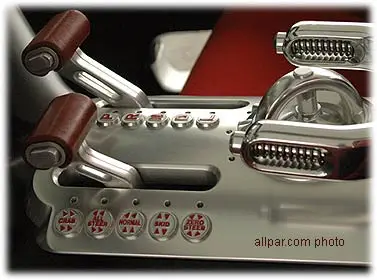
Its most striking feature was a Chrysler-designed and patented four-wheel steering system, engineered with MillenWorks, with two selectable modes. In the first, all four wheels turn the same way and the Hurricane can move sideways, like a crab. In the second, the front and rear wheels turn in opposite directions at equal angles, giving a turning radius of zero: the car can rotate in a circle while staying in one spot. The body is a one-piece shell made largely of lightweight structural carbon fibre, with an aluminium spine as skid plate connecting chassis to underside. There are no side doors and no roof, seating for two, and driver and passenger climb in over bulkheads on each side.
Dimensions and proportions
The Hurricane stood 14.3 in off the ground, with approach and departure angles of 64 and 86.7 degrees and a break-over angle of 31.5 degrees. Front and rear overhangs were 25.0 and 18.7 in, the track was 67.5 in at both ends, and all four wheels wore 305/70R20 tyres. Like most show cars it never reached production, but its four-wheel steering and its proportions fed the idea of a Jeep that could go anywhere and still turn in its own length.
Design and features
- Two HEMIs: 670 hp from a pair of 5.7 litre V8s, with cylinder deactivation.
- Zero turning radius: opposite steering front and rear lets the car spin in place.
- Crab mode: all four wheels turning together move the Hurricane sideways.
- Carbon-fibre body: a one-piece shell with no doors and no roof.
- Aluminium spine: the skid plate runs as a structural spine under the car.
Jeep Hurricane versions
- Hurricane concept (2005): the only example, a two-seat show car.
The Hurricane is one of Jeep’s concept cars; another is the Trailhawk of 2007. See also the production Wrangler and the Jeep collection.
Video: Jeep Hurricane – Dream Cars
Video by AutomotiveDreams on YouTube.
Sources
- Jeep Hurricane, English Wikipedia: engines, steering, body, dimensions, awards