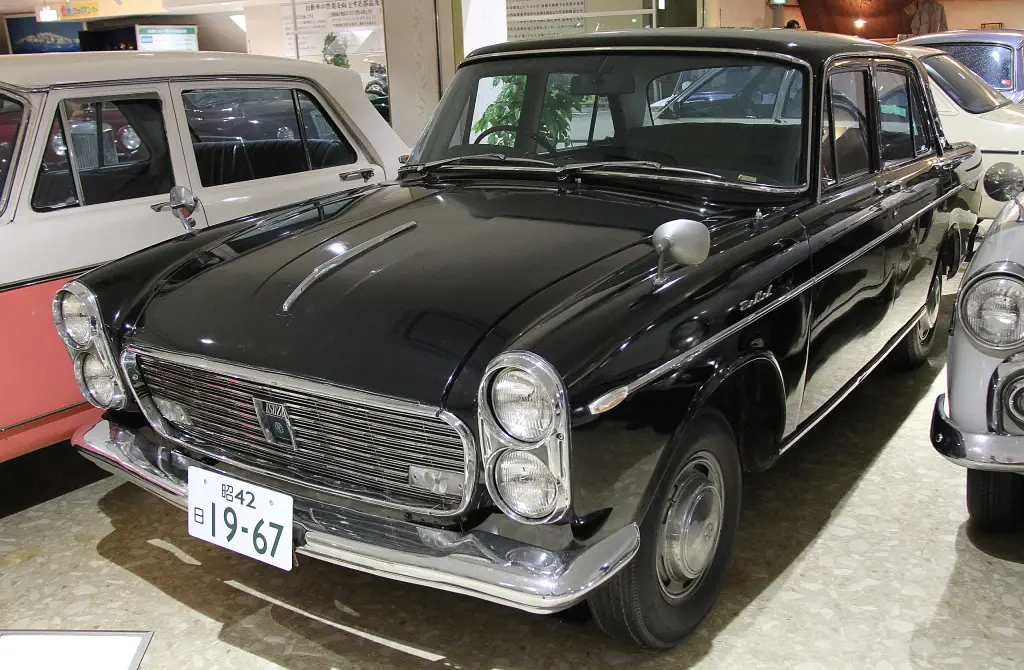
The Isuzu Bellel is a compact car that Isuzu produced from 1961 to 1967. It was the company’s first design of its own and Japan’s first passenger car with a diesel engine. It was offered as a four-door sedan and as a five-door station wagon called the Bellel Express, which in Japan of the time counted as a commercial vehicle.
Isuzu Bellel at a glance
| Maker | Isuzu Motors, Japan |
|---|---|
| Production | 1961–May 1967 |
| Class | compact car |
| Bodies | four-door sedan; Bellel Express estate/van |
| Petrol engines | 1.5 L and 1.9 L OHV with Bosch-licensed fuel injection |
| Diesel engine | 2.0 L DL200 with 52 PS, later DL201 with 55 PS |
| Gearbox | four-speed manual, column shift |
| Suspension | modelled on the Hillman Minx |
| Facelift | October 1965, vertical quad headlights |
| US imports | about 300 cars in 1964–1965 |
| Built | 37,206 |
based on one source (English Wikipedia)
History of the Isuzu Bellel
Isuzu’s own design
The Bellel was the first Isuzu designed without a licence, and the name combined the English word bell with the Roman numeral L for fifty, so that it stood for fifty bells — the meaning of the word Isuzu in Japanese. It was released in selected Japanese cities in April 1962, with production timed for the 1964 Tokyo Olympics. The car was aimed at buyers of the Toyota Crown, Nissan Cedric and Prince Gloria and was equipped well enough to justify the road tax on a large-displacement engine while staying within Japanese dimension rules.
Engines and the diesel first
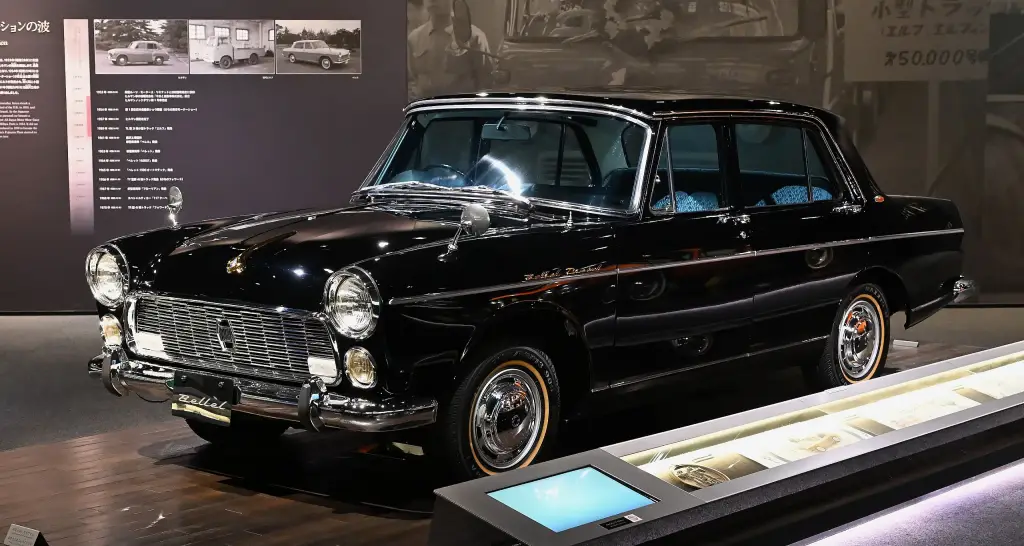
Power came from 1.5 and 1.9-litre OHV petrol engines with Bosch-licensed fuel injection, and from a 2.0-litre diesel. The original DL200 diesel gave 52 PS, and the later DL201 55 PS; it was Japan’s first diesel in a passenger car. Every engine was matched to a four-speed manual gearbox with the lever on the steering column, and the suspension was modelled on the Hillman Minx, which Isuzu had built under licence from the Rootes Group. The diesel made the Bellel popular as a taxi, which partly offset its poor reception among private buyers, who disliked the harshness of the early engine and the unusual styling.
Facelift and exports
In October 1965 the front and rear were restyled to give the car a more formal look, the single round headlamps being replaced by four round units arranged vertically. A small number of Bellels were exported, including about 300 cars sent to the United States by the Trans-Alpac Corporation of Burbank, California, in 1964 and 1965, and the model was also available in left-hand drive. Production ended in May 1967 after 37,206 cars, including the Express, had been built.
Design and features
- First Isuzu design: the company’s first car developed without a foreign licence.
- First Japanese diesel car: a 2.0-litre oil engine from 1961.
- Column gearshift: a four-speed manual with the lever on the steering column.
- Hillman-derived chassis: suspension modelled on the Hillman Minx Isuzu built under licence.
Isuzu Bellel versions
- Bellel sedan (1961–1967): the standard four-door car.
- Bellel Express: five-door estate and van, a commercial vehicle in Japan.
- DL200 diesel: the original 52 PS engine.
- DL201 diesel: the later 55 PS version.
- 1965 facelift: vertical quad headlights and a more formal rear.
The Bellel was followed by the smaller Bellett, whose name meant a smaller Bellel, and its place in the range was eventually taken by the Aska. More models are in the Isuzu collection.
Video: 1964 Isuzu Bellel Diesel Deluxe Walk Around Part 1
Video by 00elderstrom on YouTube.
Sources
- Isuzu Bellel, English Wikipedia: history, engines, production