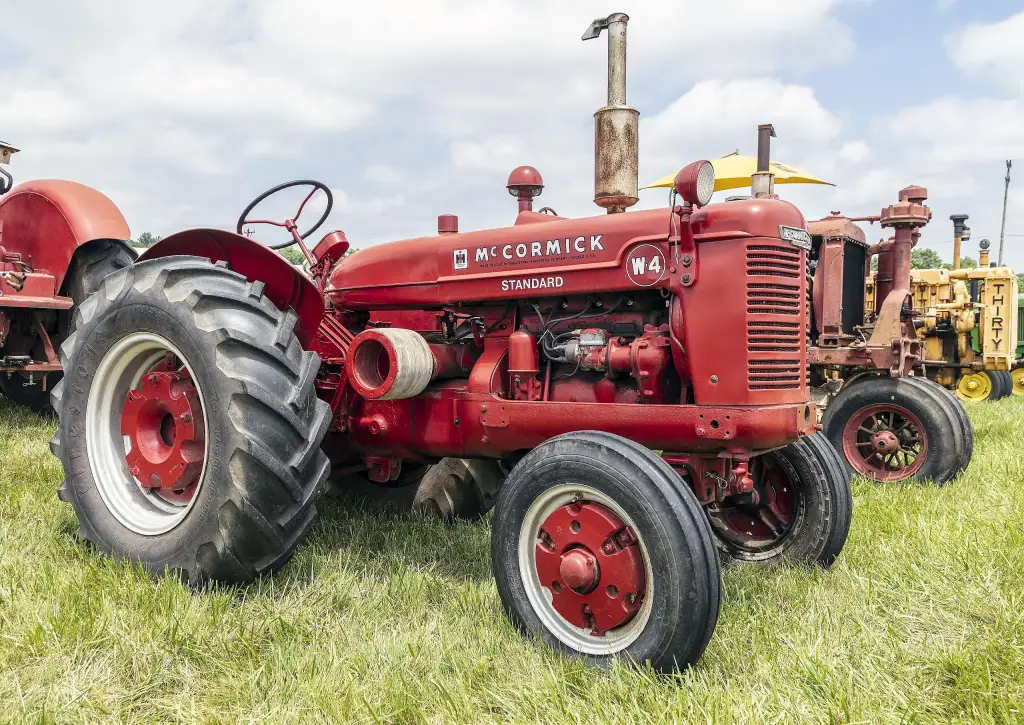
The McCormick-Deering W series were standard-tread farming and industrial tractors produced by International Harvester, derived from the Farmall letter-series row-crop tractors of the 1940s and 1950s. They wore the same styling and red paint, but they were built for a different job.
McCormick-Deering W series at a glance
| Maker | International Harvester, McCormick-Deering brand |
|---|---|
| Production | 1940–1956 under the W name |
| Class | standard-tread tractor |
| Layout | fixed wheel widths, lower build, wide front axle |
| W-4 | based on the Farmall H, C152 152 cu in engine |
| W-4 production | 35,868 of all versions, 1940–1954 |
| W-6 | based on the Farmall M, C248 engine; WD-6 diesel |
| W-6 production | 56,482 of all models, 1940–1954 |
| W-9 | C335 engine from the T-9 crawler, 44 hp, over 10,000 lb |
| Industrial versions | I-4, I-6 and I-9; orchard O-4 and O-6 |
| Branding dropped | 1956, when the series joined the International numbering |
| Later models | 300, 400, 600, 650 and 660 |
Written from the English Wikipedia article on the McCormick-Deering W series, a single source.
History of the McCormick-Deering W series
The W series existed because not every farm needs a row-crop tractor. The letter-series Farmalls were built to straddle rows, with high clearance and adjustable axles; the W tractors had fixed wheel widths, a lower profile with smaller rear wheels and wide front axles, and were meant for ploughing, orchards, wheatfields and similar work. They kept the Raymond Loewy styling and red paint of the Farmalls and were sold as McCormick-Deering products, and they were closely related to International Harvester’s industrial tractors, which differed mainly in gearing and a foot-operated throttle.
The W-4 was based on the Farmall H and used the same C152 152 cubic inch engine, with kerosene and distillate options, a five-speed sliding-gear gearbox and fifth gear disabled on tractors delivered with steel wheels. Single rear wheel tractors weighed about 3,800 lb. It first appeared in 1940; the industrial version was the I-4, while the O-4 was intended for vineyards and orchards, with wings and fairings shaped to avoid snagging branches and the exhaust routed underneath instead of overhead, and the OS-4 kept the underslung exhaust without the sheet-metal guards. The Super W-4 of 1953 used a C164 engine of 164 cubic inches, and 35,868 W-4s of all versions were built from 1940 to 1954.
The W-6 was the W-series version of the Farmall M, using the M’s C248 engine in petrol, distillate or kerosene form and weighing 4,800 lb. A diesel version, the WD-6, was also offered and was rated for three or four ploughs; as with the W-4 there were W-6, WD-6, O-6, I-6 and ID-6 versions, and the OS-6 and ODS-6 omitted the sheet-metal guards. Super versions arrived in 1952 with the C264 engine, and a Super W6-TA and WD6-TA line with torque amplifiers followed in 1954. Production of all W-6 models came to 56,482 between 1940 and 1954, and Australian AW-6 models were built from 1949 to 1953, followed by the AW-7 from 1957 to 1960.
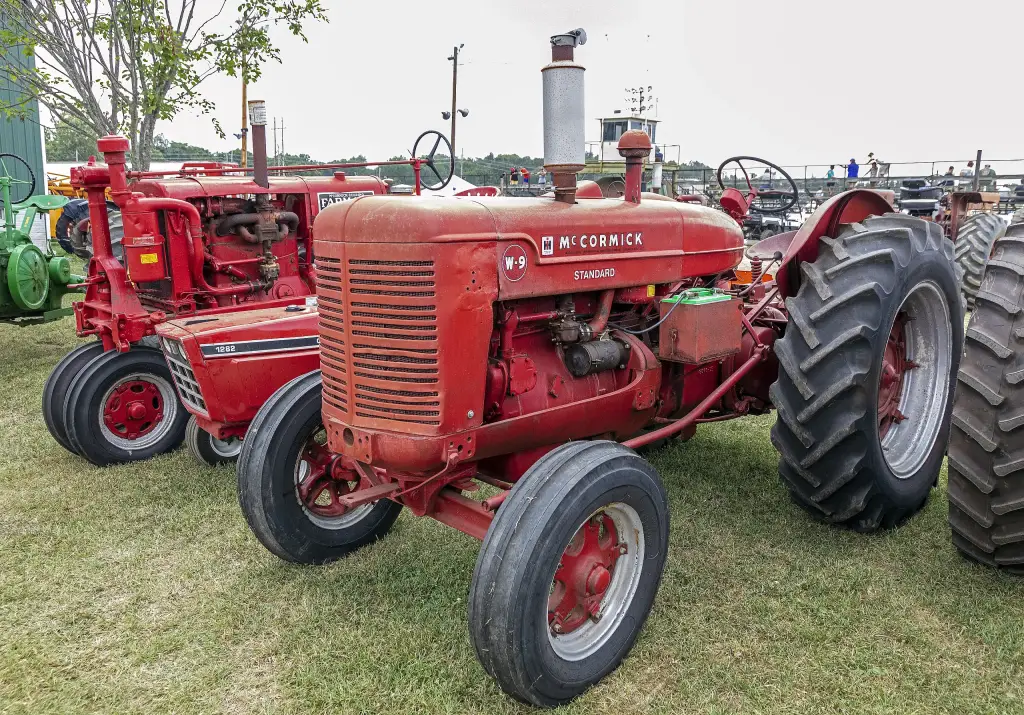
The W-9 broke the parallel with the letter series. It used much more powerful engines from International Harvester’s crawler tractors and heavier drivetrains: the C335 from the T-9 crawler, running on petrol, distillate or kerosene, gave 44 horsepower and the tractor weighed over 10,000 lb. A WD-9 diesel of the same displacement was available, the industrial versions were the I-9 and ID-9, and a steel-wheeled rice-field variant was sold as the WR-9 and WDR-9; a Super W-9 and WD-9 with more torque appeared in 1953. From 1956 the W series was folded into International Harvester’s numbering system and the McCormick-Deering branding was dropped: the Super W-4 became the 300 Utility or W-300, the Super W-6 the 400 Utility or W-400, and the Super W-9 the International 600, followed by the 650 and the restyled 660 in 1959.
Design and features
- Standard tread: fixed wheel widths and wide front axles instead of row-crop adjustment.
- Lower build: smaller rear wheels and a lower profile for ploughing and orchards.
- Farmall engines: the W-4 shared the H’s C152, the W-6 the M’s C248.
- W-9 power: the C335 from the T-9 crawler, 44 hp and over 10,000 lb.
- Industrial and orchard versions: I, O and OS models with guards and underslung exhausts.
McCormick-Deering W series versions
- W-4 (1940–1954): standard-tread version of the Farmall H.
- W-6 (1940–1954): standard-tread version of the Farmall M, with the WD-6 diesel.
- W-9 (1940–1953): heavy standard-tread tractor with the crawler engine.
- O-4, O-6, OS-4 and OS-6: orchard versions with protective bodywork.
- I-4, I-6 and I-9: industrial tractors with different gearing.
The W tractors were the standard-tread counterparts of the Farmall H and the Farmall M, and their line was continued by the Farmall 60 series. The whole family is described in the article on Farmall.
Video: Grinding cob corn with International Harvester W4 and Letz grinder
Video by McCormickSW4 on YouTube.
Sources
- McCormick-Deering W series tractors, English Wikipedia: design, W-4, W-6, W-9, production, later numbering