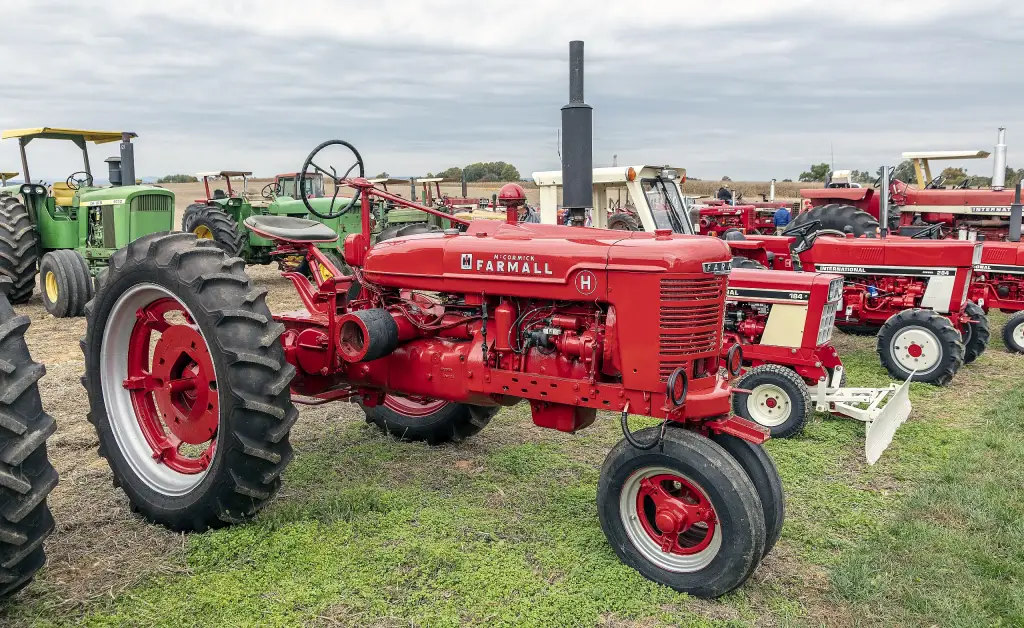
The Farmall H was a medium-sized two-plough row-crop tractor built by International Harvester from 1939 to 1954. It was the most widely produced of the company’s letter-series tractors, with approximately 390,000 built over fourteen years, and it succeeded the Farmall F-20.
Farmall H at a glance
| Maker | International Harvester, Farmall brand |
|---|---|
| Production | 1939–1954 |
| Class | medium two-plough row-crop tractor |
| Predecessor | Farmall F-20 |
| Styling | Raymond Loewy |
| Engine | C152 four-cylinder in-line, 152 cu in (2,490 cc) |
| Rated ploughing | two 14-inch (36 cm) ploughs |
| Transmission | five forward gears and one reverse |
| Top speed | 17 mph (27 km/h) |
| Rear track | adjustable from 44 to 80 in (110–200 cm); up to 100 in with extended axles |
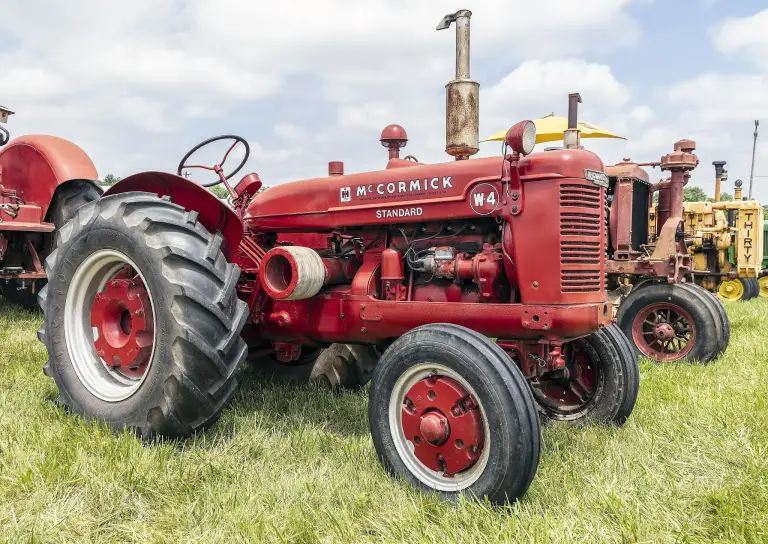
| Variants | HV high-boy, W-4 standard tread, I-4 industrial, O-4 orchard |
| Price | $850–$1,650 |
| Built | about 392,000 of all kinds |
Written from the English Wikipedia article on the Farmall H, a single source.
History of the Farmall H
The H replaced the Farmall F-20 and sat below the larger Farmall M in International Harvester’s row-crop range. It was part of the letter series styled by Raymond Loewy, whose shapes gave the tractors a recognisable family face. The H was rated for two 14-inch ploughs and marketed to farmers with 100 acres or more of tilled land — a size of holding that had been the preserve of horse teams only a generation earlier.
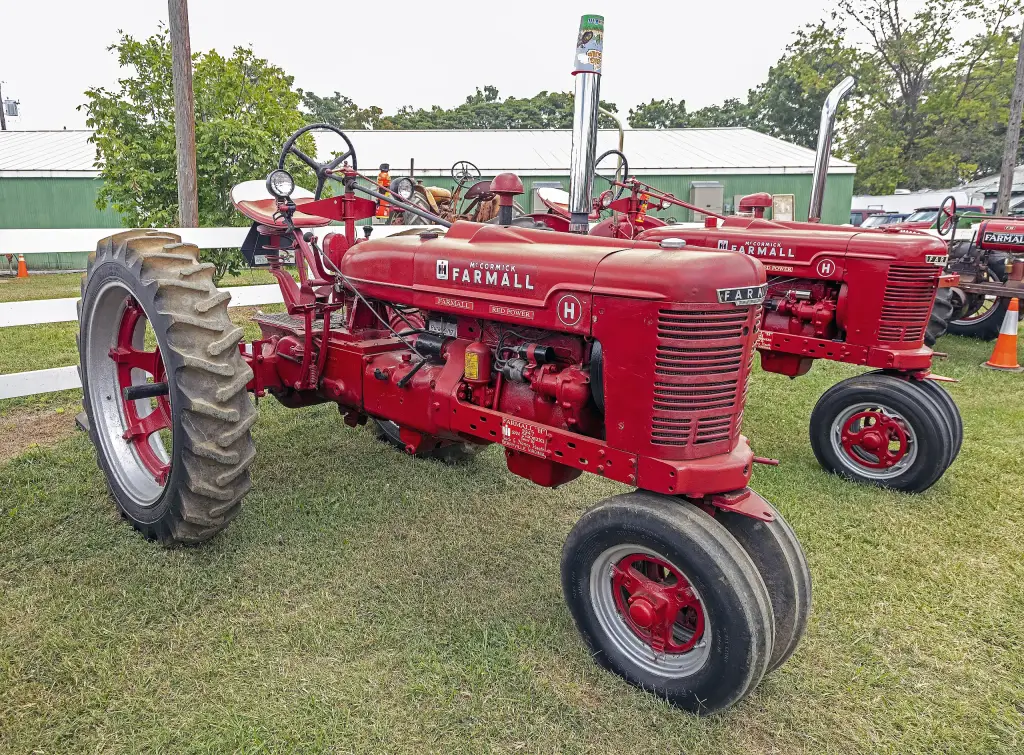
Mechanically the H was conventional but well considered. A 152 cubic inch overhead-valve four-cylinder drove through a sliding-gear gearbox with five forward speeds and one reverse, giving a top road speed of 17 mph, although fifth gear was not enabled on tractors sold with steel wheels — an option that mattered again during the Second World War, when rubber was rationed. Early distillate and kerosene versions started on petrol and switched fuels once warm; a petrol engine joined the range in 1940.
The chassis was built for row crops. Standard front wheels were closely spaced nose wheels, with a single wheel or a wide front axle available, and the rear track could be adjusted from 44 to 80 inches to suit different row widths, or up to 100 inches with optional extended axles. Like the other letter-series tractors, the H used a modular design in which assemblies could be removed and replaced as units, which made repair and servicing simpler. All Hs had hydraulic lifts, and the H could use the same implements as the larger M.
The design proved durable enough to be developed rather than replaced. The Farmall Super H of 1953 and 1954 had a 164 cubic inch engine of 32 horsepower and sealed disc brakes, and about 29,000 were built. It was followed by the Farmall 300 of 1954–1956, which added a torque amplifier and a 169 cubic inch engine with an LP gas option, and then by the interim Farmall 350 of 1956–1958. The completely new Farmall 340 finally replaced the line in 1957, though production of the earlier versions ran on until 1963. Functional versions of the H itself included the high-clearance HV, the W-4 with standard tread, the I-4 industrial and the O-4 orchard tractor.
Design and features
- Raymond Loewy styling: the letter-series look that defined Farmall tractors of the period.
- Adjustable rear track: 44–80 inches as standard, up to 100 inches with extended axles.
- Modular construction: major assemblies could be swapped as complete units.
- Hydraulic lift: fitted to every H.
- Shared implements: the same equipment as the larger Farmall M.
Farmall H versions
- Farmall H (1939–1954): the standard row-crop tractor.
- HV: high-boy version with 30.25 inches of clearance for tall crops.
- W-4: standard-tread version.
- I-4 and O-4: industrial and orchard versions.
- Super H, 300 and 350: developed versions built until 1958.
The H sat below the larger Farmall M and above the small Farmall Cub; the rest of the family is described in the article on the Farmall line.
Video: 1943 International Harvester Farmall H tractor
Video by blinksum1722 on YouTube.
Sources
- Farmall H, English Wikipedia: engines, gearbox, track adjustment, variants, production