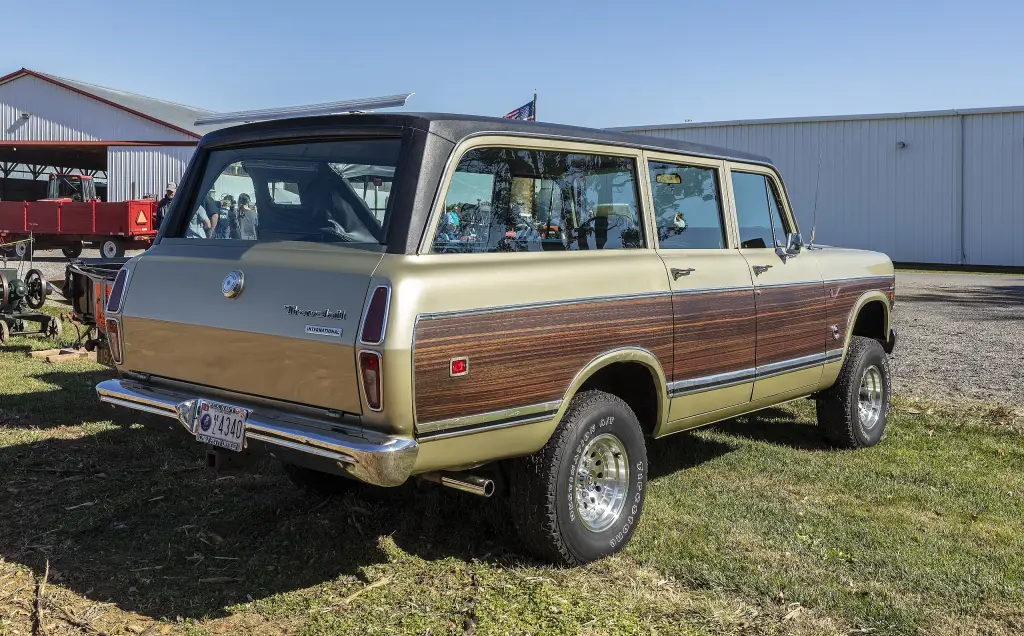
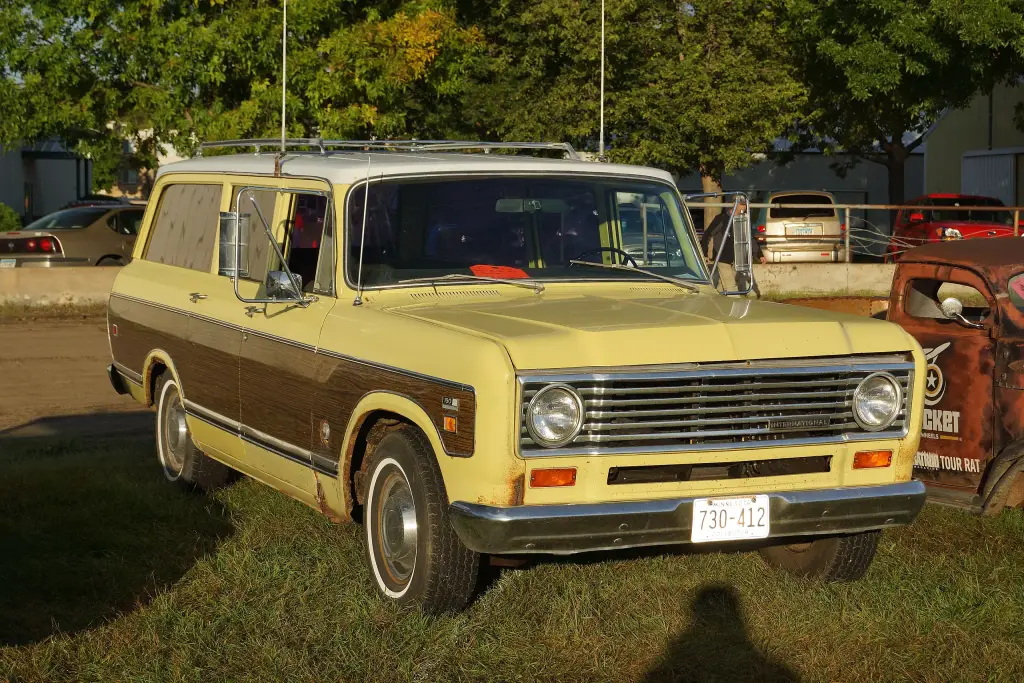
The International Travelall was a station wagon built by International Harvester from 1953 to 1975. Based on the company’s truck chassis, it competed with the Chevrolet Suburban for its entire life and was the first vehicle in the class to offer four passenger doors.
International Travelall at a glance
| Maker | International Harvester |
|---|---|
| Production | 1953–1975 |
| Class | truck-based station wagon |
| Rival | Chevrolet Suburban |
| First generation | 1953–1957, on the R series and then the S series |
| Second generation | 1958–1960, on the A and B series |
| Third generation | 1961–1968, on the C and D series with independent front suspension |
| Fourth generation | 1969–1975, on the Light Line |
| First rear passenger door | 1958, nine years before the Suburban |
| Fourth door | 1961, two years before the Wagoneer |
| Wheelbase, 1961 | 119 in (3,020 mm) |
| Rear doors | twin panel doors or a wagon-style tailgate |
Written from the English Wikipedia article on the Travelall, a single source.
History of the International Travelall
International Harvester did not build passenger cars, so its station wagon had to come from a truck. Before 1953 the company’s truck chassis were fitted with wooden station wagon bodies by outside firms; after the war, as wooden bodies gave way to steel, K-series panel vans were converted into airport people carriers by adding windows and rear seats. The L-series panel truck with windows and rear seats was a step in the same direction, and its use of the Travelall name is not recorded.
The Travelall proper arrived in 1953 with the R series. It was offered on the half-ton R-110 on a 115-inch wheelbase, powered by a 100 horsepower 220 cubic inch Silver Diamond six, and it was essentially a windowed panel van fitted with two or three rear seats. Like the two-door station wagons of the day it had no rear side doors: access to the back was gained by folding the passenger-side front seat forward. Twin panel doors at the rear were standard and a wagon-style tailgate was optional, and a Travelall badge on the front cowl told it apart from other Internationals. When the truck line became the S series in 1955, the Travelall moved to the S-110 and heavier S-120, and four-wheel drive became a factory option for 1956.
The first big functional change came with the A series of 1957. A second door on the passenger side was added so that passengers could reach the rear seats easily; a door on the driver’s side was ruled out by the position of the fuel filler. The Travelall was derived from the A-100, A-110 and A-120, with four-wheel drive optional on the A-120, and its 220 cubic inch engine was offered with outputs from 113 to 154 horsepower. For 1959 the A series became the B series, which added power steering, power brakes and optional V8 engines; the Travelall was sold as the B-100, B-110 and B-112 in two-wheel drive, with the three-quarter-ton B-120 as the only four-wheel-drive version.
The C series Travelall of April 1961 brought a new frame and independent front suspension on torsion bars, with the front axle moved four inches forward to stretch the wheelbase to 119 inches and the body mounted lower. The body itself carried over most of its design, with a concave grille and horizontally mounted quad headlamps, and the rear could be had with twin doors or a tailgate with an electrically retractable window. This was also the generation that gained the fourth door, two years before the Jeep Wagoneer and twelve years before the Suburban. Development continued in small steps through the 1960s, the light trucks becoming the D series for 1965, and for 1969 the Travelall moved to the Light Line generation shared with the pickups. Production of the Travelall and the Light Line pickups ended after the 1975 model year, as International Harvester turned its light-duty effort towards the Scout and then left the market altogether.
Design and features
- Four doors first: a rear door on the passenger side in 1958 and a fourth door in 1961.
- Truck chassis: the wagon followed the pickup line through four generations.
- Seating: two or three rows in a windowed van body.
- Rear access: twin panel doors or a tailgate with an electric window.
- Four-wheel drive: a factory option from 1956.
International Travelall versions
- R-110 and S-110/S-120 (1953–1957): the first generation.
- A and B series (1958–1960): second generation, with the first rear passenger door.
- C and D series (1961–1968): third generation with independent front suspension.
- Light Line Travelall (1969–1975): fourth generation.
- Travelette: the crew-cab pickup derived from the same body.
The Travelall was joined in the range by the Travelette crew cab, built from the same body, and it was eventually replaced in spirit by the Scout.
Video: 1968 International Harvester Travelall
Video by East Coast Classics on YouTube.
Sources
- International Travelall, English Wikipedia: origins, generations, doors, chassis, end of production