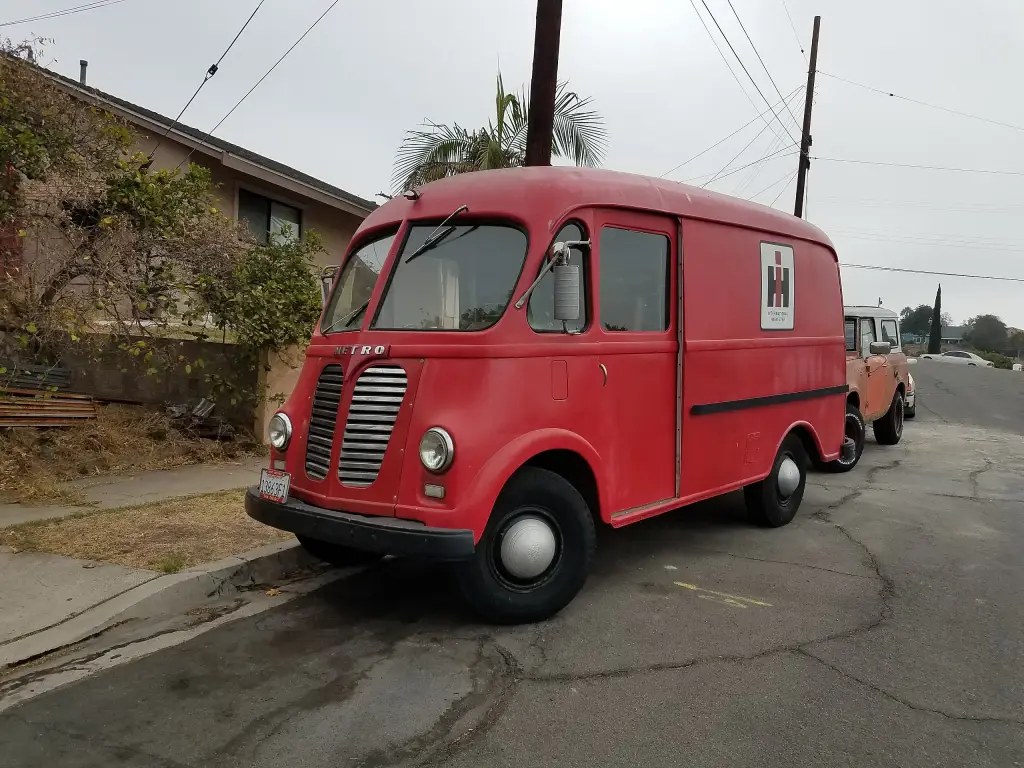
The International Metro Van was a multi-stop truck built by International Harvester from 1938 to 1975. It was one of the earlier mass-produced forward-control vehicles and was once a common sight delivering milk and bread — and it was originally styled by Raymond Loewy.
International Metro Van at a glance
| Maker | International Harvester; bodies by Metropolitan Body Company, Bridgeport |
|---|---|
| Production | 1938–1975 |
| Class | multi-stop delivery van |
| Design | Raymond Loewy |
| Payload classes | half-, three-quarter- and one-ton panel vans |
| Body variants | van, Metro Coach passenger bus, walk-in cab, cab-chassis |
| Redesign | 1964, by the in-house team at the Chicago Metro plant |
| Other models | Metro-Lite and Metro-Multi-Stop in the 1950s, Metro Mite in 1959 |
| Final form | stripped chassis by 1972 |
| Replaced by | nothing in the IH range; the name returned on a Navistar truck in 2000 |
Written from the English Wikipedia article on the Metro Van, a single source.
History of the International Metro Van
The Metro Van was one of the first mass-produced vehicles of the forward-control kind, with the driver sitting over the front axle and the body squared off behind. It was used for milk and bakery delivery, but also as an ambulance, a mobile office and a radio transmitter van. The typical vehicle was a half-, three-quarter- or one-ton panel van in which the driver could either sit or stand at the wheel.
The range was wider than the delivery van suggests. There was a passenger version called the Metro Coach, a partial cab-chassis with front-end sections for customers who wanted to build their own body, and a cab-over “walk-in cab”. The chassis-cab could take a separate box or container, or be left open for equipment such as a refuse compactor or a stake bed. The drivetrain in the early years was based on the 1937–40 D-series trucks.
Unusually for an International Harvester vehicle, the Metro bodies were not made by International. They were built by the Metropolitan Body Company on Grand Street in Bridgeport, Connecticut, a firm International Harvester would buy in 1948; final assembly was then done in one of the company’s own plants. The original design was by Raymond Loewy, and it was one of several projects he worked on for International Harvester. The earliest “D” and “D-M” series vans stayed closest to his design, with teardrop headlights, rear wheel spats carrying Art Deco “Metro” badges, the triple diamond grille emblem and a more streamlined nose than later versions — a shape sometimes called the “giant scarab”.
The design stayed much the same until 1964, when the in-house team at the Chicago Metro plant squared off the corners and added an opening bonnet for easier access to the coolant and the oil dipstick, along with an optional eight-cylinder engine. In the 1950s came the Metro-Lite and Metro-Multi-Stop, and in 1959 the Metro Mite, which used the Scout drivetrain and a Nash Metropolitan engine; underpowered at first, it received International’s own new four-cylinder in 1961. The American military used Metros as ambulances and personnel carriers during the Second World War, and the first example sold went to the Czechoslovak Army, only to be destroyed by the German army. By 1972 every Metro was a stripped chassis for other manufacturers to body, and the line was discontinued in 1975 along with International’s other light trucks, leaving only the Scout. Navistar revived the name in 2000 for an unrelated medium delivery truck.
Design and features
- Forward control: the driver sits over the front axle, so the body can be almost all load space.
- Loewy styling: teardrop headlights and a streamlined nose on the earliest vans.
- Many bodies: van, passenger coach, walk-in cab and bare chassis.
- Metropolitan Body Company: bodies built in Bridgeport, Connecticut.
- Long life: the same basic design from 1938 to 1964, then an updated one to 1975.
International Metro Van versions
- D and D-M series: the original Loewy-styled vans.
- Metro Coach: passenger bus version.
- Metro-Lite and Metro-Multi-Stop: 1950s variants.
- Metro Mite (1959): small van on Scout mechanicals.
- 1964 redesign: squared corners, opening bonnet and an optional V8.
The Metro shared its mechanicals with International’s light trucks, among them the L series and the R series. More commercial vehicles are in the collection.
Video: 1950 International Harvester Metro -DRIVING- FOR SALE- VintageStepVans.com
Video by Step Vans on YouTube.
Sources
- International Metro Van, English Wikipedia: history, bodies, Loewy design, Metropolitan Body Company, end of production