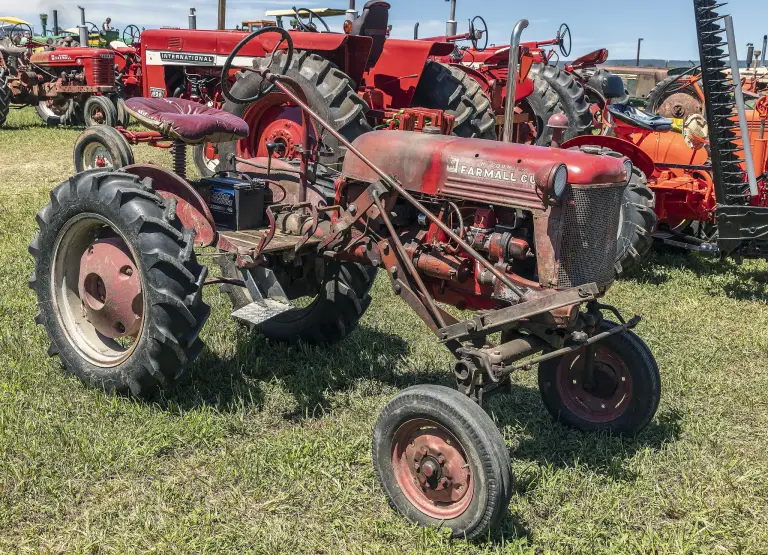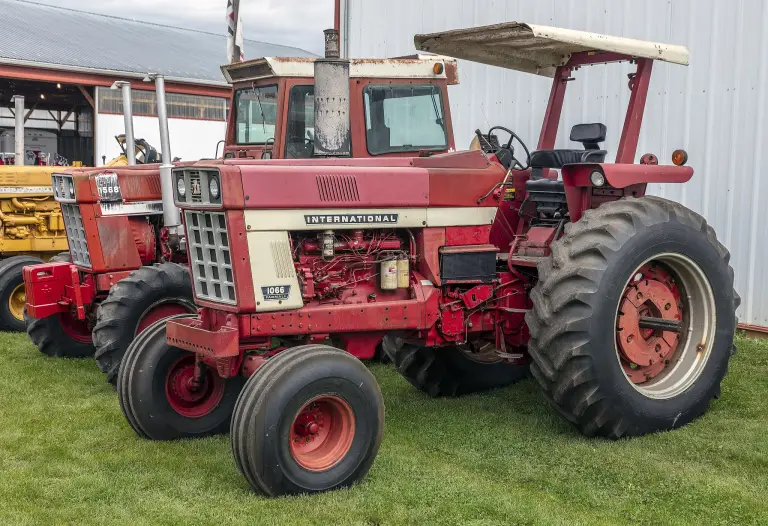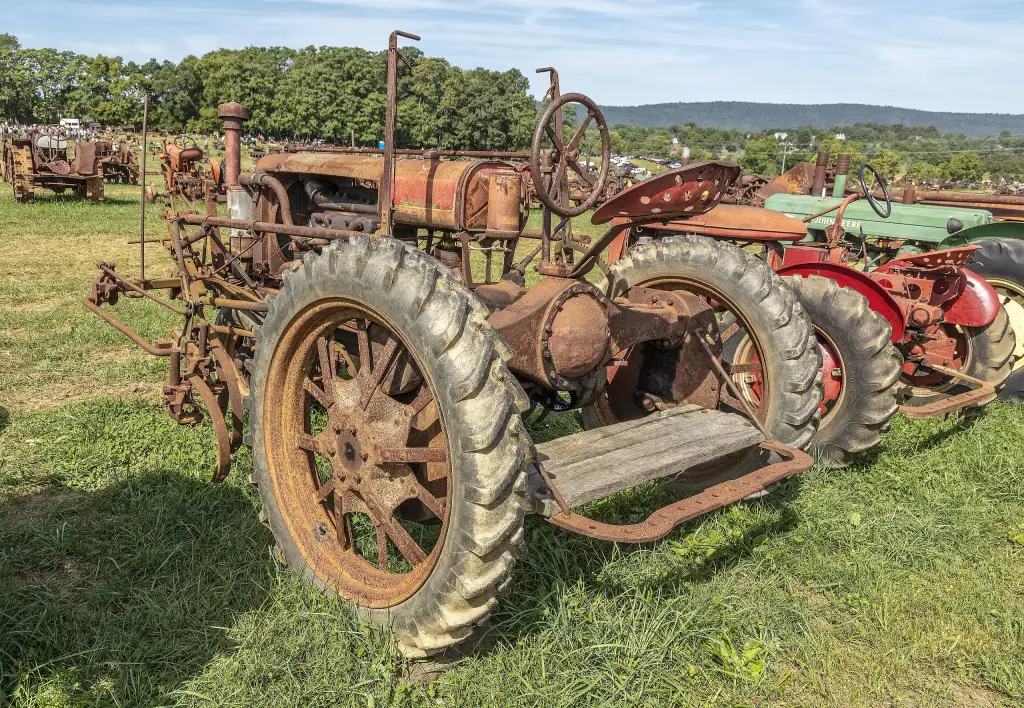
Farmall began as the name of a single model and grew into International Harvester’s brand for general-purpose row-crop tractors. The original Farmall of the 1920s is widely regarded as the first tractor to combine the traits that defined the row-crop class, and the line stayed in production from the 1920s into the 1980s.
Farmall at a glance
| Maker | International Harvester (McCormick-Deering Farmall, later McCormick Farmall) |
|---|---|
| Production | from the 1920s to the 1980s |
| Class | general-purpose row-crop tractor |
| Layout | ‘tricycle’ front end, high ground clearance |
| Rear track | quickly adjustable for different row widths |
| Work equipment | belt pulley for belt-driven machines |
| Colour | bright red, a distinctive badge from 1936 |
| Variants | orchard, fairway and other special versions |
| Built for | small and medium family farms |
| Later descendants | letter series, 60 series, 06 and 86 series |
Written from the English Wikipedia article on the Farmall line, a single source.
History of the Farmall
Row-crop cultivation — guiding a machine between young plants to kill weeds — was the unmet need that International Harvester set out to answer in the early 1920s. Its first attempt was a motor cultivator, little more than a horse implement with an engine added. The original Farmall went much further: it combined a tricycle front end or a narrowly spaced pair of front wheels, high clearance, an adjustable rear track, good visibility around and under the machine, enough power for ploughing and harrowing, and a belt pulley for stationary work.
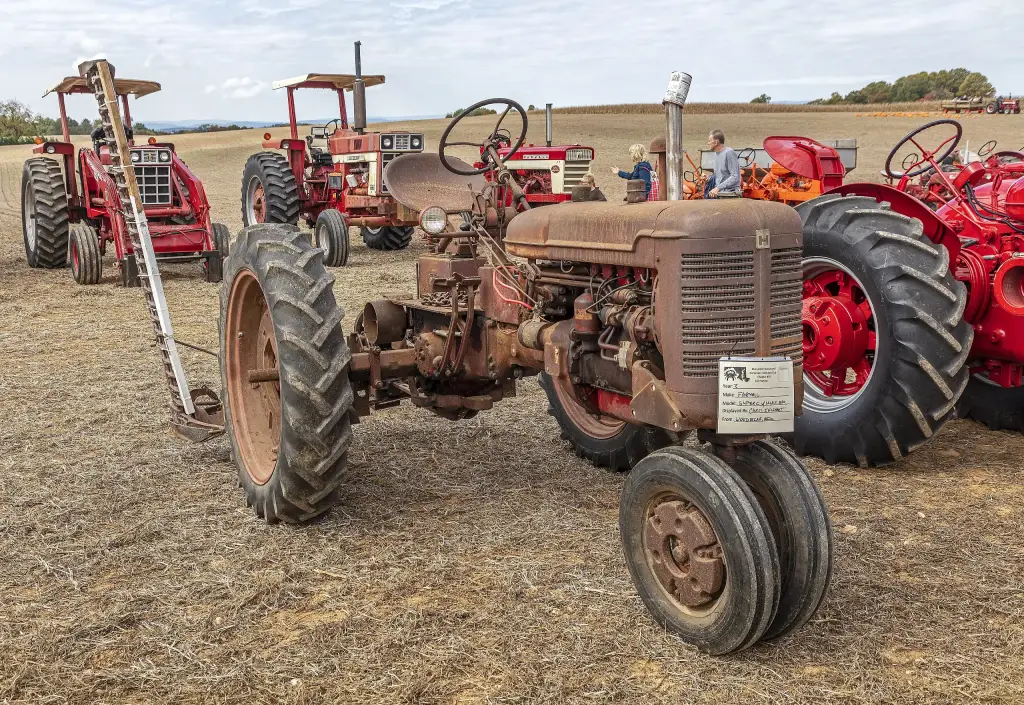
None of those features was new on its own, but the combination was, and it was offered at a price small and medium farms could pay. That mattered because a tractor only replaced a team of horses if it was cheap enough and reliable. Mass production in the spirit of the Ford Model T and the Fordson made the Farmall affordable, while its cultivating ability was better than the Fordson’s. Once farmers could give up horses altogether, the economics of mechanised agriculture tipped decisively.
The line was gradually systematised. The Farmall name was usually written as McCormick-Deering Farmall and later McCormick Farmall, drawing on the McCormick and Deering brands that International Harvester had absorbed. In 1936 the tractors moved to a bright, distinctive red that became a badge in itself, and through the 1940s and 1950s the brand was ubiquitous on North American farms. In the post-war years the letter series and then the numbered series carried the name forward, with orchard, fairway and industrial versions alongside the row-crop machines.
After the 1960s the ground shifted: chemical weed control reduced the need to cultivate, and farms grew larger and fewer. Farmall production ended in the 1980s, but a large number of the tractors stayed at work, and many more have been restored and collected. The renewed interest in small-scale and organic farming has even brought a modest revival in cultivating with machines of this kind.
Design and features
- Tricycle front end: a single front wheel or a narrow pair, so the rear wheels run in the row middles.
- Adjustable rear track: the wheels could be moved to match the spacing of the crop rows.
- Belt pulley: the tractor could drive stationary machinery as well as pull implements.
- Low price: mass production put a general-purpose tractor within reach of family farms.
- Red paint: from 1936 the bright colour scheme became the brand’s strongest identifier.
Farmall versions
- Original Farmall (1920s): the first model to combine the row-crop traits in one machine.
- Letter series: the F-series and later the H, M and their relatives.
- 60 series (1958–1963): the 460 and 560 replaced the larger letter-series models.
- Special versions: orchard, fairway and industrial tractors built on the same ideas.
The best-known member of the line is the Farmall H, and the smallest is the Farmall Cub. The 1958–1963 generation is described in the article on the Farmall 60 series. More machines are in the International Harvester collection.
Video: International Harvester Farmall 400 Tractor Restoration
Video by samiam123ful on YouTube.
Sources
- Farmall, English Wikipedia: history, design traits, brand architecture, decline