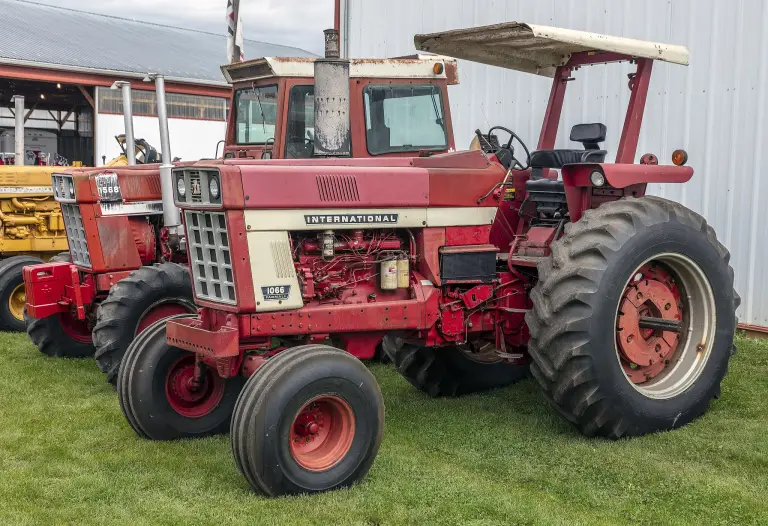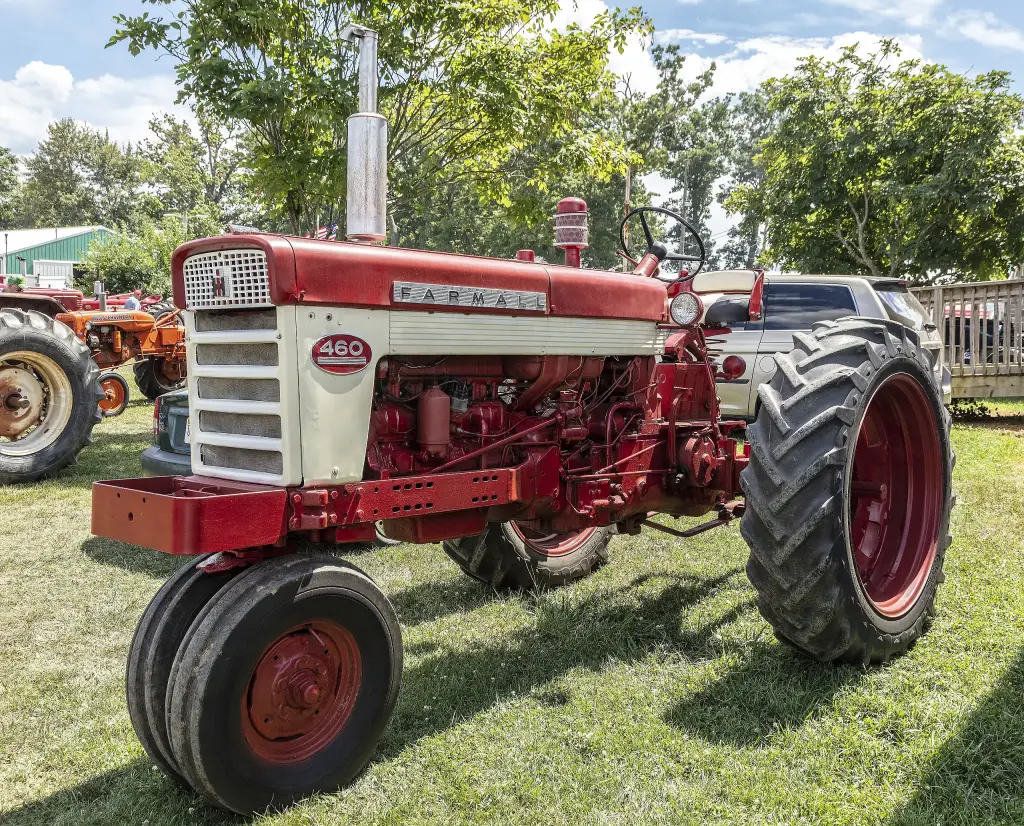
The Farmall 60 series replaced the larger models of the letter series from 1958. The 460 and 560 were modernised versions of the Farmall H and Farmall M with more powerful six-cylinder engines and new styling, but the drivetrain underneath was carried over almost unchanged, and that caused serious trouble.
Farmall 60 series at a glance
| Maker | International Harvester (Farmall brand) |
|---|---|
| Production | 1958–1963 |
| Farmall 460 | successor to the Farmall 350 line |
| 460 engine | 221 cu in (3,620 cc) six-cylinder, 55 hp (41 kW); 236 cu in diesel |
| Farmall 560 | successor to the Farmall 450 line |
| 560 engine | 263 cu in (4,310 cc) six-cylinder, 66 hp (49 kW); 282 cu in diesel |
| International 660 | heavy general-purpose tractor sold without the Farmall badge |
| 660 production | 6,959 built, 1959–1963 |
| Fuels | petrol, kerosene, LP gas and distillate, plus diesel options |
| Transmission | five-speed with torque amplifier, optional ten-speed |
| Built | about 35,000 of the 460 and about 70,000 of the 560 |
| Prices | about $4,700–$5,400 for the 460, $6,000–$6,700 for the 560 |
Written from the English Wikipedia article on the Farmall 60 series, a single source.
History of the Farmall 60 series
The 60 series arrived in 1958 as the answer to competitors who were bringing out more modern tractors with more power. The Farmall 460 continued the medium line that had begun with the Farmall H, and the Farmall 560 continued the large line that had begun with the Farmall M. Both were restyled: the rounded Raymond Loewy shapes of the letter series gave way to a squared-off look that lasted until the end of Farmall production.
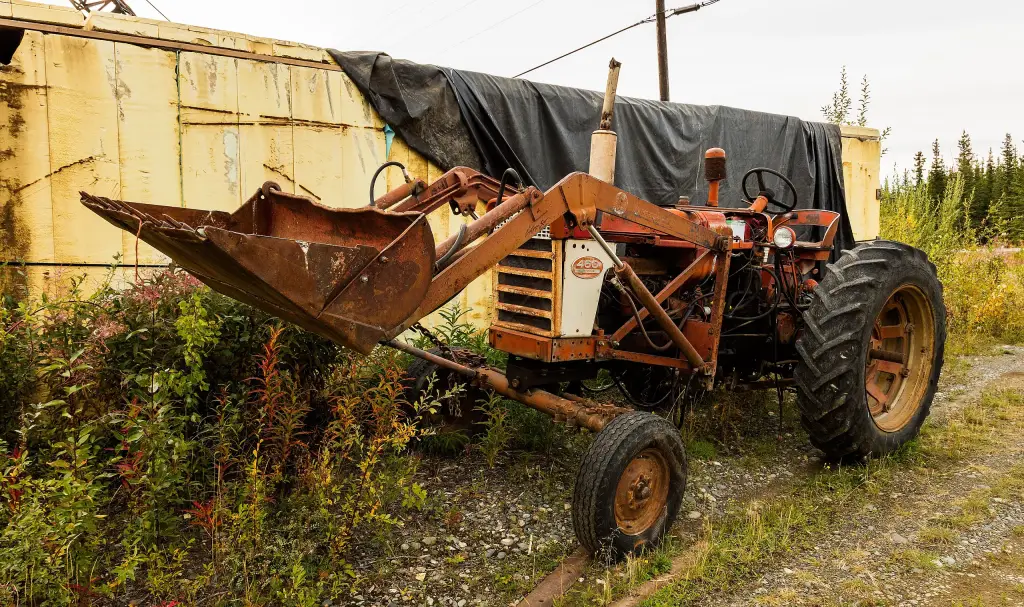
Under the new sheet metal the story was less modern. The larger engines were bolted to essentially the unaltered drivetrain of the earlier models, and the extra power quickly produced reliability problems, above all with the 560. The damage to International Harvester’s reputation was severe enough to require new, redesigned drivetrain components and a massive recall effort. Hydraulics and operator comfort, by contrast, were genuine improvements.
The engines could run on petrol, kerosene, LP gas or distillate, and a diesel was offered for each size. The 460 used a 221 cubic inch six-cylinder rated at 55 horsepower, or a 236 cubic inch diesel; the 560 used a 263 cubic inch six rated at 66 horsepower, or a 282 cubic inch diesel. Both drove through a five-speed gearbox with a torque amplifier, with a ten-speed transmission as an option. About 35,000 of the 460 and about 70,000 of the 560 were built.
The heavy general-purpose 660 was not sold as a Farmall row-crop tractor. Its lineage ran back to the McCormick-Deering W-9 rather than to the letter series, it succeeded the International Harvester 650, and 6,959 were built between 1959 and 1963. As with the rest of the family, there were utility, Hi-Clear and Wheatland versions to suit different kinds of farming.
Design and features
- Squared-off styling: the rounded look of the letter series replaced by flatter panels.
- Six-cylinder power: 55 hp in the 460 and 66 hp in the 560, with diesel options.
- Improved hydraulics: better systems than on the tractors they replaced.
- Flexible fuels: petrol, kerosene, LP gas and distillate versions.
- Many bodies: utility, Hi-Clear and Wheatland versions of the same tractor.
Farmall 60 series versions
- Farmall 460 (1958–1963): medium row-crop tractor, successor to the 350 line.
- Farmall 560 (1958–1963): large row-crop tractor, successor to the 450 line.
- IH 460 and IH 560 utility: general-purpose versions.
- 460 Hi-Clear and 560 Hi-Clear: high-clearance models.
- International 660 (1959–1963): heavy general-purpose tractor without the Farmall badge.
The 460 and 560 were the direct descendants of the Farmall H, and the range that followed them is described in the article on the Farmall 340. The whole line is covered by Farmall.
Sources
- Farmall 60 series tractors, English Wikipedia: engines, models, recall, production, prices