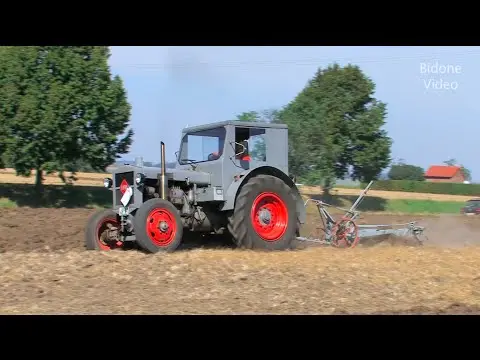
The RS 01/40 Pionier was the first tractor produced in East Germany. Its design came from the pre-war FAMO XL, and it was built from 1949 at Zwickau before production moved to the new tractor works at Nordhausen, where it remained in production until 1956.
IFA Pionier at a glance
| Type | RS 01/40, brand name Pionier |
|---|---|
| Origin | FAMO XL, built before the war at Breslau |
| First production | 1949, VEB Horch works, Zwickau |
| Built at Zwickau | 2,250 tractors, 1949–1950 |
| Second production site | VEB Schlepperwerk Nordhausen, from 1950 |
| Production until | 1956 |
| Engine | 4F 145 BE, four-cylinder diesel, about 5 litres |
| Power | 29.4 kW (40 PS) |
| Gearbox | five-speed mechanical with reverse |
| Brakes | drum brakes on the rear wheels, gearbox handbrake |
| PTO | 540 rpm, belt pulley optional |
| Developed version | RS 01/40-II Harz, 1957–1958, 2,175 built |
History of the IFA Pionier
The Pionier goes back to the FAMO XL, a tractor that the Fahrzeug- und Motoren-Werke in Breslau had built in the 1930s. After the war, former FAMO engineers in Schönebeck revised the drawings and adapted them to the production facilities available. Because the intended plant at Schönebeck had no manufacturing equipment yet, the Horch works in Zwickau was given the job of putting the tractor into production.
Production at Zwickau ran from 1949 to 1950 and accounted for 2,250 machines. The first tractor was shown at the Leipzig Trade Fair in 1949 still carrying the FAMO emblem. In 1950 production moved to the newly founded VEB Schlepperwerk Nordhausen, where the tractor was renamed the RS 01/40 Pionier and built until 1956.
From 1957 a revised version was made as the RS 01/40-II Harz. It sold far less well, and its production ended in 1958 after 2,175 tractors. The end of the Harz left a gap in the 40 PS class, which was only filled in the early 1960s by the RS14/40.
Technically the Pionier was a frameless block construction with a rigid rear axle and a leaf-sprung swing axle in front, available with or without a driver’s cab. The water-cooled four-cylinder diesel, type 4F 145 BE, had pre-chamber injection and about five litres of displacement, giving 29.4 kW (40 PS). To make hand-crank starting easier, the engine was started on petrol and switched to diesel once running. The drive went through a single dry clutch to a mechanical five-speed gearbox with reverse; only the rear wheels were driven. Braking was by an internal-shoe brake on the rear wheels, with a band brake on the gearbox as the handbrake. A clutch-dependent PTO of 540 rpm was standard and a belt pulley was optional.
From 1953 a new five-litre engine, the 4F 145 DL, replaced the pre-chamber unit with swirl-chamber injection, and the hand crank gave way to a compressed-air starting system that allowed the engine to be started on diesel. The Harz used a further revised 4F 145 DE of 31 kW (42 PS) with a 24-volt electric starter, a different gearbox and a three-point hitch. One weakness of the Pionier was its steering, which could lock at full lock when suspension parts were worn.
Design and features
- FAMO XL ancestry: a pre-war design revised for East German production by former FAMO engineers.
- Five-litre diesel: 29.4 kW (40 PS), started on petrol by hand crank until the compressed-air system arrived in 1953.
- Simple chassis: frameless block construction, rigid rear axle and a swing axle in front.
- Harz development: a revised version of 1957 with a swirl-chamber engine and electric starting.
IFA Pionier versions
- RS 01/40 Pionier (1949–1956): the original tractor, with or without cab.
- 1953 specification: 4F 145 DL engine with swirl-chamber injection and compressed-air starting.
- RS 01/40-II Harz (1957–1958): revised model with a 31 kW engine, electric starter and three-point hitch.
The other great tractor of the period was the RS09 Maulwurf, and the Zwickau works also built the H3 lorry. More vehicles are in the IFA collection.
Video: Ploughing with the IFA Pionier tractor
Video on YouTube.
Sources
- RS01, English Wikipedia: production history, technical description
- RS 01/40, German Wikipedia: technical data, Harz version