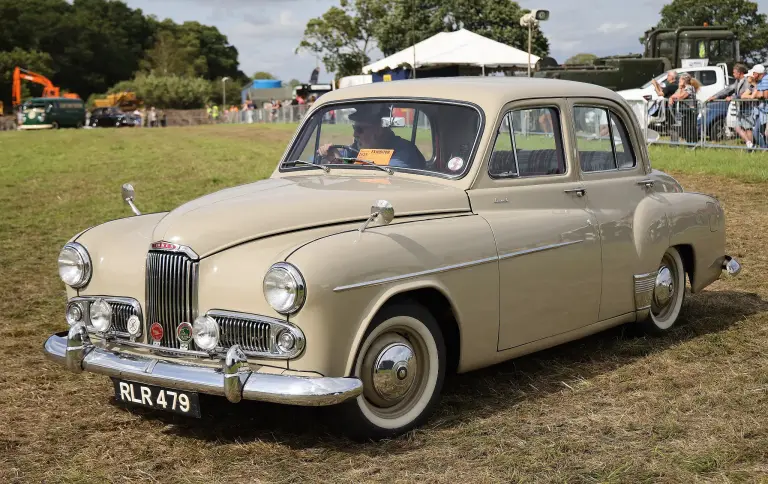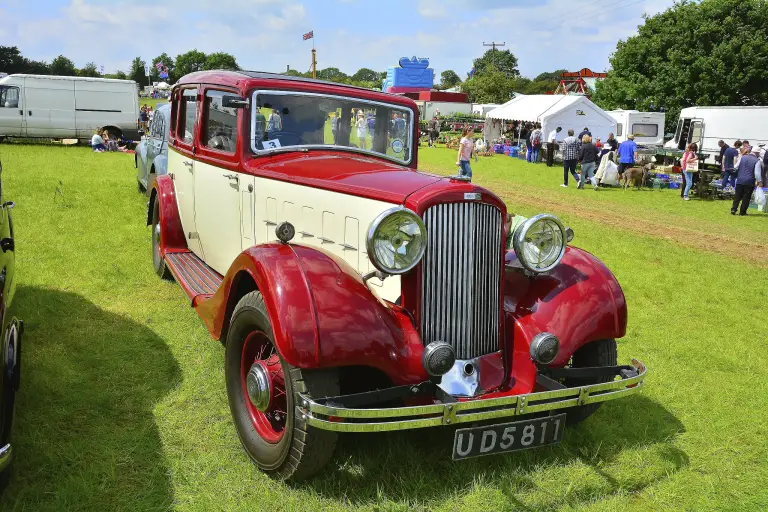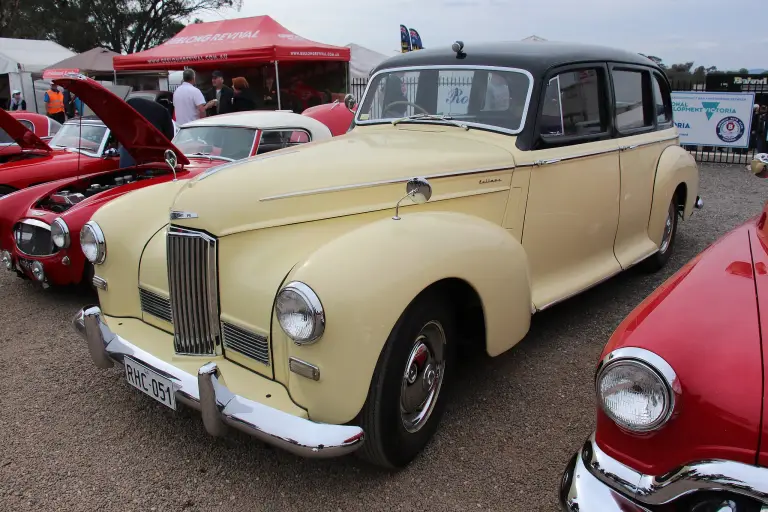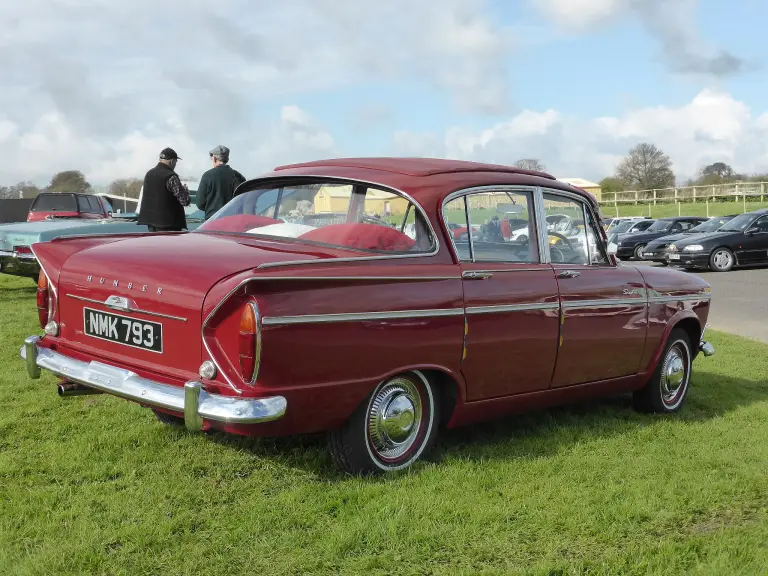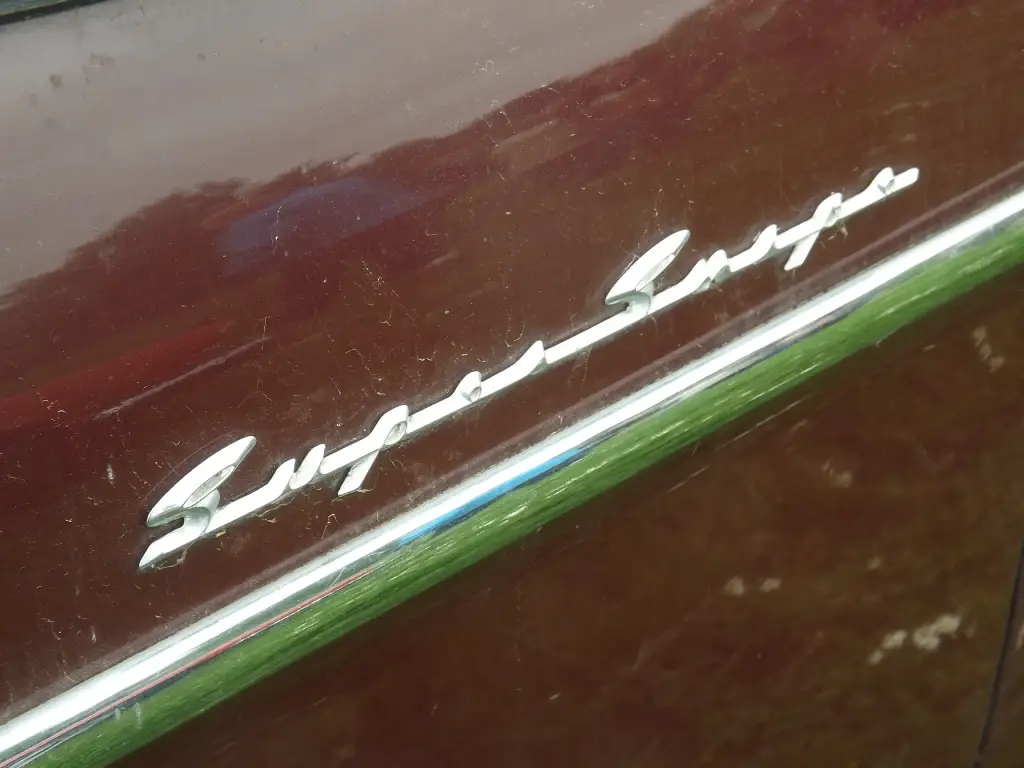
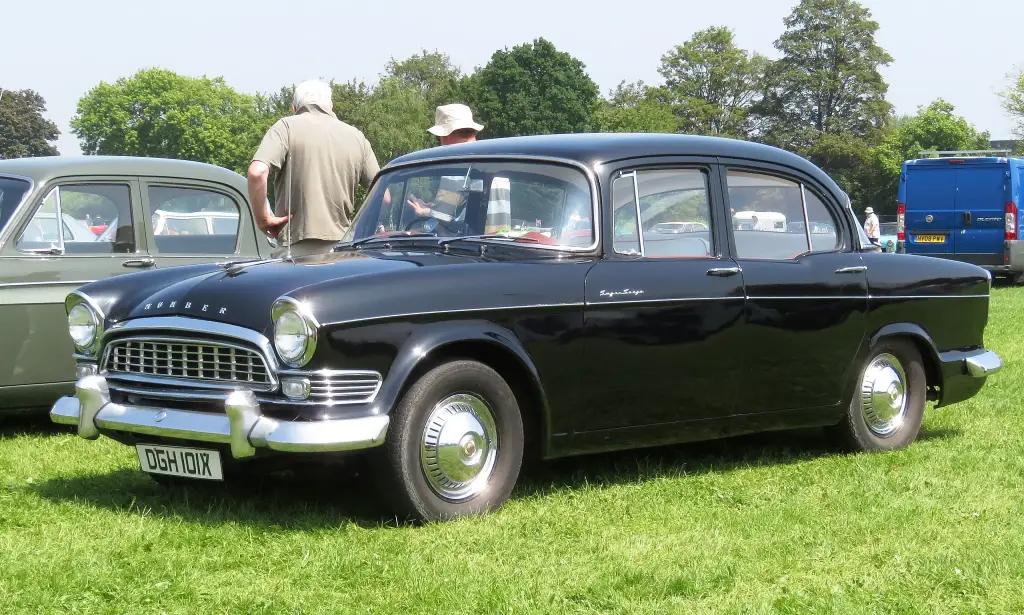
The Humber Super Snipe was produced from 1938 to 1967 by Humber Limited. It was created by combining the four-litre six-cylinder engine of the larger Humber Pullman with the chassis and body of the Humber Snipe, and it became the Rootes Group’s big owner-driver car.
Humber Super Snipe at a glance
| Maker | Humber Limited, Rootes Group |
|---|---|
| Production | 1938–1967 |
| Introduced | October 1938 |
| Basis | Pullman 4-litre engine in the Snipe chassis and body |
| Engine, 1938–1952 | 4,086 cc side-valve six, 100 bhp at 3,400 rpm |
| Engine, 1952 on | 4,138 cc overhead-valve six, 113 bhp |
| Body | four-door saloon, full six-seater; 125 Tickford drophead coupés |
| Transmission | four-speed manual; overdrive from 1955, automatic from 1956 |
| Suspension | transverse-leaf independent front; Panhard rod at the rear from 1950 |
| Top speed | 79 mph (1938), 91 mph (Mark IV), 97 mph (automatic, 1956) |
| Test economy | 17.7 mpg (Mark III), 15.5 mpg (Mark IV) |
| Price in 1953 | £1,481 including taxes (Mark IV) |
Based on one source, the English Wikipedia article on the Humber Super Snipe; the article covers the Marks I–IV in detail.
History of the Humber Super Snipe
The Super Snipe was introduced in October 1938, derived by combining the four-litre inline six-cylinder engine from the larger Humber Pullman with the chassis and body of the Humber Snipe, which was normally powered by a three-litre engine. The result was a car of enhanced performance and a top speed of 79 mph, fast for its day. Its design was contributed to by the American engine designer Delmar “Barney” Roos, who left a successful career at Studebaker to join Rootes in 1936. The car was marketed to upper-middle-class managers, professional people and government officials: it was relatively low-priced for its size and performance, similar to American cars in appearance and concept, and good value for money.
Within a year of its introduction war broke out in Europe, but the car continued in production as a British military staff car designated Car, 4-seater, 4×2, while the same chassis was used for an armoured reconnaissance vehicle, the Humber Light Reconnaissance Car. It served with the British Army, the Royal Navy and the RAF.
Post-war Mark I
In 1946 post-war civilian production resumed and the Super Snipe evolved through several versions, each designated by a Mark number and each generally larger, more powerful and more modern, until production ended in 1957 with the Mark IVB. The Mark I was essentially a six-cylinder version of the 1945 Humber Hawk, itself a facelifted pre-war car. A version of the 1930s Snipe with the 2,731 cc engine introduced in 1936 remained available, but the standard Super Snipe engine was the 4,086 cc side-valve six that had appeared in the Pullman nearly a decade earlier. Throughout 1936–1952 the maker always quoted its maximum output as 100 bhp at 3,400 rpm.
Mark II (1948)
The Mark II announced in mid-September 1948 was mostly redesigned in chassis and body. Now a full six-seater with a bench-type front seat, it was given a wider track and a variable-ratio steering unit, and the gear lever moved to the steering column. As on the Pullman, the headlamps were fitted into the wings and running boards were re-introduced. The transverse-spring independent front suspension, first used on the Snipe and Pullman in 1935, continued but with 14 leaves instead of eight. The smaller-engined Snipe was discontinued. Early Mark II cars can be distinguished by round lamps below the headlamps: the left one was a fog lamp and the right a pass lamp with a low narrow beam. These were dropped in 1949 in favour of rectangular side lamps. The Times tested the car at the end of 1948, criticising the difficult spare wheel and the not altogether quiet indirect gears but finding that the finish reflected the excellent taste that distinguished Rootes Group products. Tickford made 125 drophead coupés in 1949 and 1950.
Mark III (1950)
The Mark III followed in August 1950, easily identified by the spats over the rear wheels. It had a Panhard rod added to the rear suspension, which limited sideways movement of the rear wheels and so permitted softer springs. The 1950 car can also be told from the previous model by its simpler dome-shaped bumpers and the rectangular stainless-steel foot-treads on the running boards. The Motor tested a Mark III in 1951: 81.6 mph, 0–60 mph in 19.1 seconds, 17.7 mpg and £1,471 including taxes.
Mark IV (1952)
The all-new Mark IV, announced in mid-October 1952 at Earls Court Motor Show time, used a Hawk Mark IV body shell lengthened by six inches but a 4,138 cc overhead-valve engine of 113 bhp, also used in a Rootes Group Commer truck. Chassis and suspension components were uprated to take the greater weight and power, and those parts ceased to be interchangeable with the Hawk’s. From 1955 overdrive was available as an option, followed by an automatic gearbox in 1956.
Shortly after the car’s announcement Leslie Johnson, Stirling Moss and two Rootes Group staff drove a new silver-grey Super Snipe from Oslo to Lisbon, travelling through fifteen European countries in 3 days, 17 hours and 59 minutes; the run demonstrated the car’s high-speed reliability in far from ideal conditions. In 1953 The Motor tested a Mark IV and found the larger engine had raised the top speed to 91 mph with 0–60 mph in 14.7 seconds and 15.5 mpg; the car cost £1,481 including taxes. An automatic Mark IV saloon tested in 1956 recorded 97.0 mph mean and 98.9 mph best, 0–60 mph in 14.8 seconds, 0–90 in 38.2 seconds and a standing quarter mile in 20.4 seconds, with 122 bhp. In 1957 The Times called the car handsome if somewhat dated: it attracted favourable attention from passers-by, gave a satisfying sense of solidity and respectability, and had “enormous” front seats whose backs could recline flat, though the steering was generally imprecise and uncomfortably low-geared for parking.
Design and features
- Four-litre power: the Pullman engine gave the Snipe body a top speed of 79 mph in 1938.
- Six-seater comfort: a wide bench front seat, a wider track and generous rear space.
- Progressive chassis: transverse-leaf independent front suspension, a Panhard rod from 1950.
- Long-distance reputation: an Oslo–Lisbon run in 1952 demonstrated high-speed reliability.
- Overdrive and automatic: available from 1955 and 1956 respectively.
Humber Super Snipe versions
- Pre-war Super Snipe (1938–1945): four-litre engine, 79 mph, also built as a military staff car.
- Mark I (1946–1948): six-cylinder version of the post-war Hawk, 4,086 cc, 100 bhp.
- Mark II (1948–1950): full six-seater with column gear change, headlamps in the wings.
- Mark III (1950–1952): rear wheel spats, Panhard rod, dome-shaped bumpers.
- Mark IV (1952–1957): lengthened Hawk body, 4,138 cc overhead-valve engine, 113 bhp.
- Tickford drophead coupé (1949–1950): 125 coachbuilt open cars.
The Super Snipe was the larger brother of the Humber Snipe and shared its engine with the Pullman; its post-war body was related to the Hawk. More cars are in the Humber collection.
Video: Humber Super Snipe 1962. A look around.
Video on YouTube.
Sources
- Humber Super Snipe, English Wikipedia: history, Marks I–IV, road tests, military use