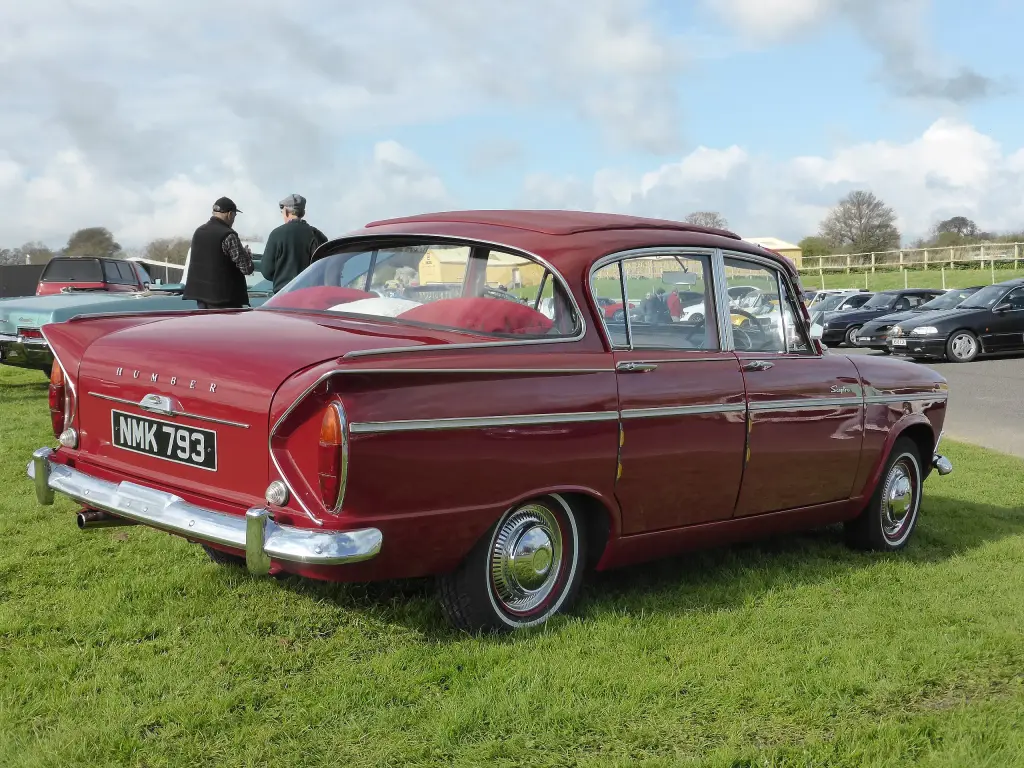
The Humber Sceptre was an automobile produced in the United Kingdom from 1963 to 1976 by Humber. A luxury car based on the Hillman Super Minx, it sat at the top of the Rootes Group’s mid-range and was the last model to carry the Humber name.
Humber Sceptre at a glance
| Maker | Humber, Rootes Group (later Chrysler UK) |
|---|---|
| Production | 1963–1976 |
| Mark I | 1963–1965, 1,592 cc, 80 bhp |
| Mark II | 1965–1967, 1,725 cc twin carburettor |
| Mark III | 1967–1976, 1,725 cc, 87 bhp |
| Body | four-door saloon; estate from 1974 |
| Brakes | disc front |
| Transmission | four-speed manual with overdrive; automatic optional |
| Top speed | 94.8 mph (Mark II, 1966 test) |
| Acceleration | 0–60 mph in 12.5 s, standing quarter mile 19.5 s (Mark II) |
| Built | 17,011 Mark I/IA, 11,983 Mark II, 43,951 Mark III |
Based on one source, the English Wikipedia article on the Humber Sceptre.
History of the Humber Sceptre
The Mark I Sceptre, introduced in 1963, was a luxury car based on the Hillman Super Minx with a unique roof, glass and upper and rear bodywork that it shared with neither the Super Minx nor the related Singer Vogue. The Sceptre had originally been intended as a four-door replacement for the Sunbeam Rapier, but it was launched as a Humber while the Rapier continued in production with little modification until 1967; the result was a more sporting character than traditional Humbers. The car was positioned at the top of the mid-range Rootes Group cars, above the Hillman Super Minx and Singer Vogue.
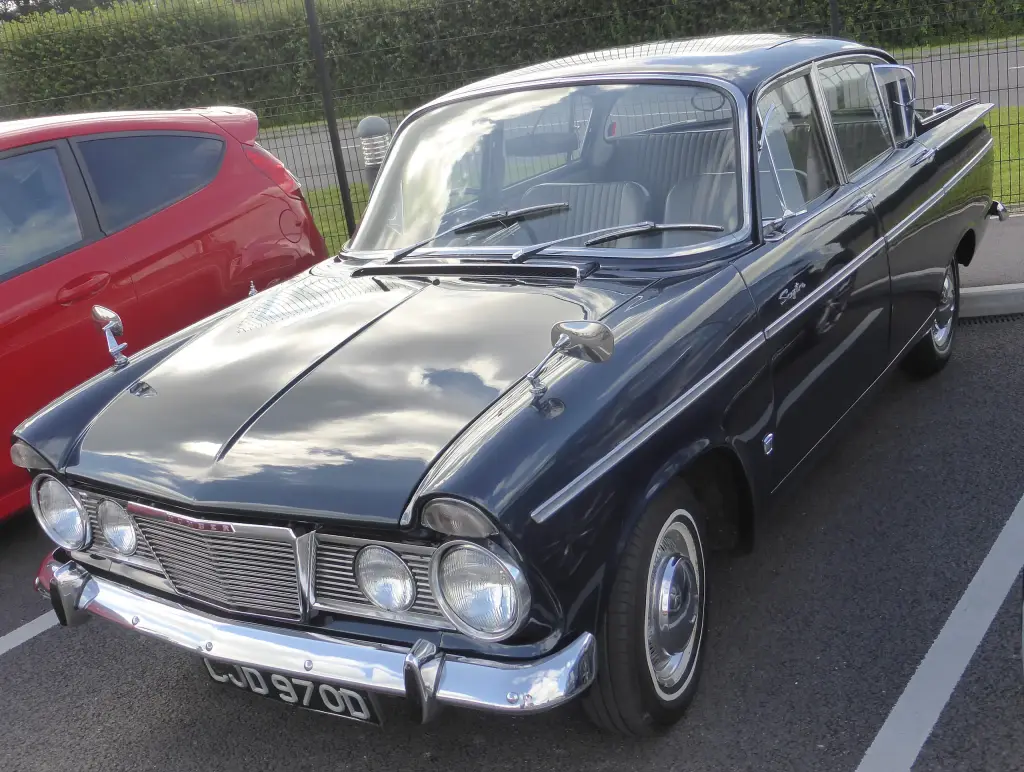
Mark I (1963–1965)
The Mark I had twin headlamp styling similar to the Vogue and a more powerful 80 bhp version of the 1,592 cc Minx engine. The high level of equipment included disc front brakes, overdrive, screen washers, a reversing lamp, a rev counter and a full range of instruments, with automatic transmission made available later. A Mark IA was introduced in 1964. While the Super Minx and Vogue received revised six-light styling in 1964, the Sceptre body continued unchanged until 1965, when it was replaced by the Mark II. Production of the Mark I and IA totalled 17,011 units.
Mark II (1965–1967)
The Mark II, introduced in 1965, featured revised front-end styling and a twin-carburettor version of the 1,725 cc engine, and it was produced until 1967. It was a capable car: figures recorded by Motor magazine in its issue of 16 April 1966 were a maximum of 94.8 mph, 0–60 mph in 12.5 seconds and a standing quarter mile in 19.5 seconds. Production of the Mark II totalled 11,983 units.
Mark III (1967–1976)
The Mark III, introduced in 1967, was a derivative of the Rootes Arrow design and the best-appointed version of that model offered by Rootes. It continued Humber’s tradition of building luxury cars and featured a wood-veneer fascia, complete instrumentation, an adjustable steering column, a vinyl roof and extra brightwork on the wheel arches and rear panel. Its 1,725 cc engine had twin carburettors and gave 87 bhp. Manual-gearbox cars used either the D-type or the later J-type Laycock de Normanville overdrive, the J-type being fitted from chassis numbers L3 onwards from July 1972; a closer-ratio G-type gearbox came later. As with all models in the Arrow range, an automatic gearbox was an option.
An estate car variant was introduced at the London Motor Show in October 1974. It had a built-in roof rack and a carpeted loading floor protected by metal strips and lit by an additional interior light, and it came with a washer and wiper for the rear window — a rare feature on UK-market estate cars of the time.
The end of the name
The Sceptre was discontinued in September 1976, together with the Humber and Hillman marque names; from that time all models in the Chrysler UK range were branded as Chryslers. Production of the Mark III totalled 43,951 units. The name Sceptre reappeared in 1990 on some SRi versions of the Peugeot 205, 405 and 605, after Peugeot had bought Chrysler’s European operations in 1978 and rebranded the whole European Chrysler range under the Talbot marque.
Design and features
- Own bodywork: a unique roof and rear glass, not shared with the Super Minx or Singer Vogue.
- Generous equipment: disc front brakes, overdrive, rev counter and full instrumentation from the start.
- Sporting character: a more powerful engine and a closer-ratio gearbox option than other Humbers.
- Luxury details: wood-veneer fascia, vinyl roof and extra brightwork on the Mark III.
- Estate version: built-in roof rack, metal-strip loading floor and rear wash-wipe from 1974.
Humber Sceptre versions
- Mark I (1963–1965): 1,592 cc, 80 bhp, twin headlamps, overdrive and disc brakes.
- Mark IA (1964–1965): detail improvements to the Mark I.
- Mark II (1965–1967): revised front end and 1,725 cc twin-carburettor engine.
- Mark III saloon (1967–1976): Arrow-based, 87 bhp, wood veneer and vinyl roof.
- Mark III estate (1974–1976): factory estate with roof rack and carpeted load floor.
The Sceptre shared its floorpan with the Hillman Super Minx and Singer Vogue and was the last Humber. Other Humbers: the Hawk and Super Snipe. More cars are in the Humber collection.
Video: 1963 Humber Sceptre
Video on YouTube.
Sources
- Humber Sceptre, English Wikipedia: history, Marks I–III, production, road test