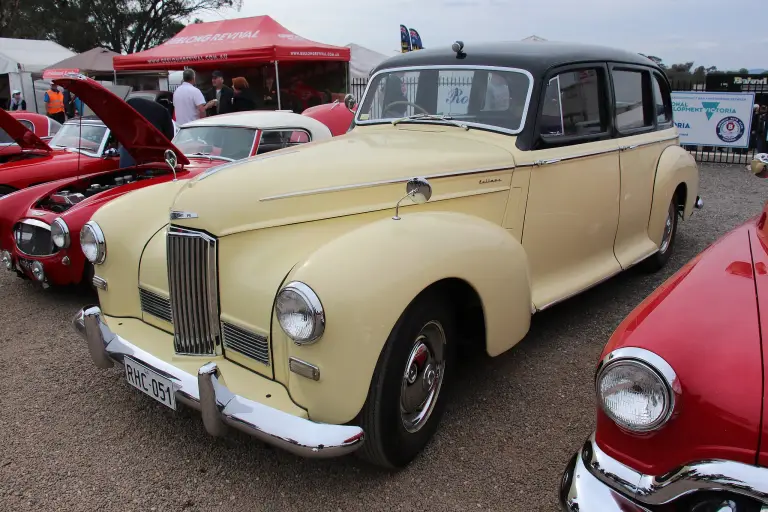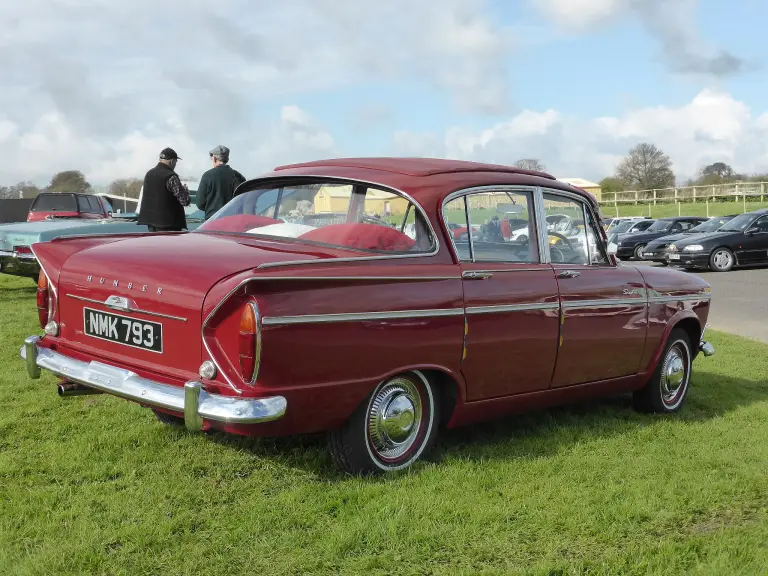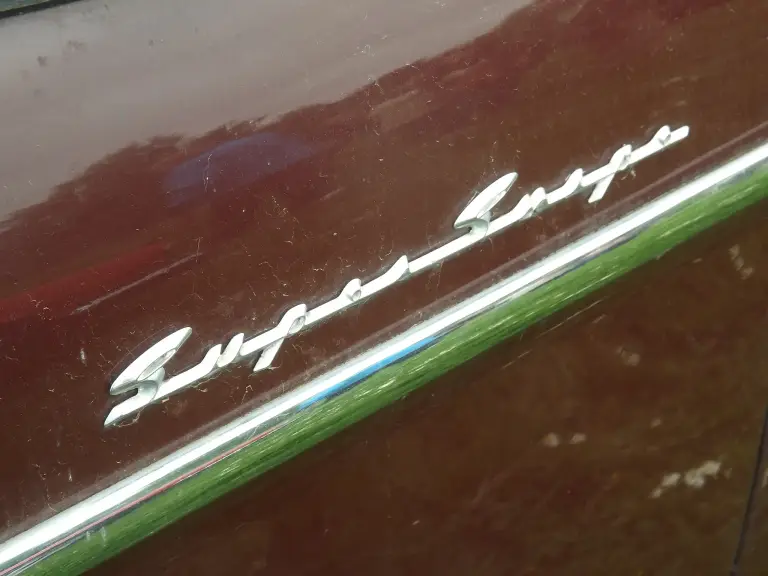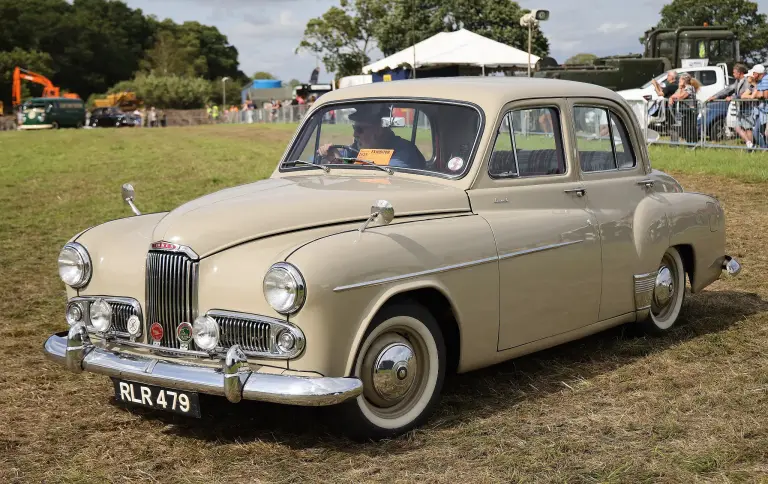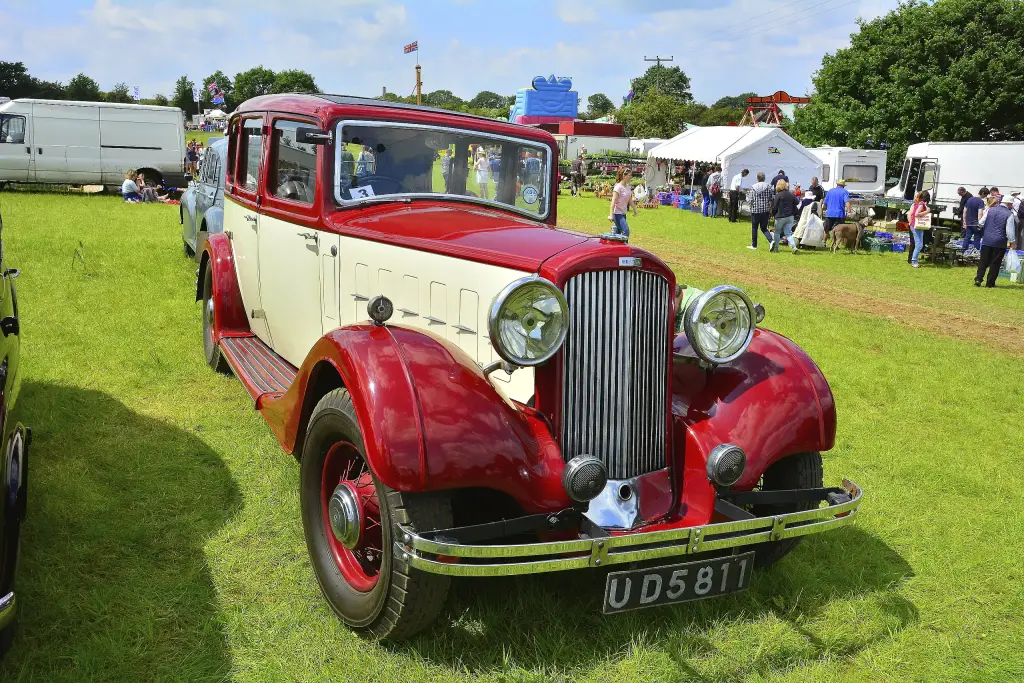
The Humber Snipe was a four-door luxury saloon introduced by Humber Limited for 1930 as successor to the Humber 20/55 hp. It appeared at the same time as the similar but slightly longer Humber Pullman, and it was built in four generations until 1948.
Humber Snipe at a glance
| Maker | Humber Limited, later Rootes Group |
|---|---|
| Production | 1930–1948 |
| Engine, 1930–1935 | 3,498 cc six, 80 bhp; 85 bhp from 1933 |
| Engine, 1936–1937 | 4,086 cc side-valve six, 100 bhp |
| Engine, 1938–1940 | 3,180 cc side-valve six, 75 bhp |
| Engine, 1945–1948 | 2,731 cc side-valve six, 65 bhp |
| Wheelbase | 120 in (1930), 124 in (1936), 114 in (1938) |
| Bodies | four- and six-light saloons, sports saloon, tourer, drophead coupé |
| Top speed | 72–84 mph depending on model |
| Price in 1930 | chassis £410, saloon £535, tourer £495 |
History of the Humber Snipe
The first Humber Snipe was launched in September 1929 under the headline “Such Cars As Even Humber Never Built Before”. It showed the influence of William Rootes’ marketing skills after Rootes Limited had been appointed Humber’s world exporter, and it was noticeably similar to his Hillmans. Almost three years later Humber Limited joined what became the Rootes Group, in July 1932, as part of a necessary restructuring of its capital and ownership. Snipes, and later Super Snipes, were the Rootes Group’s owner-driver big cars until the brand disappeared under Chrysler ownership.
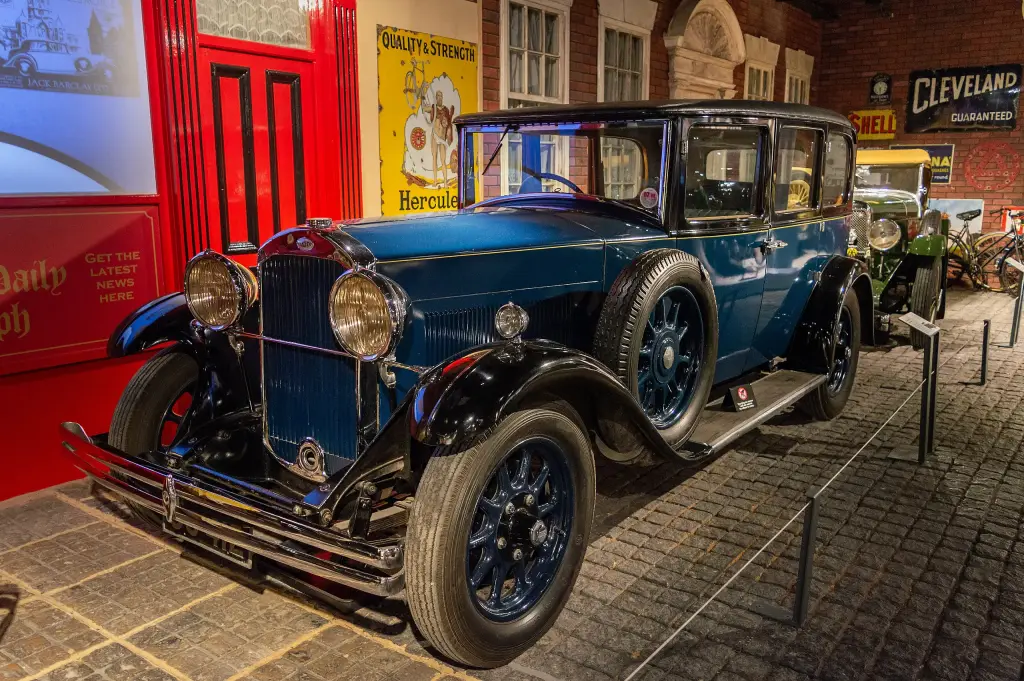
Snipe 80 (1930–1935)
The Snipe, known from late 1932 as the Snipe 80, had a 3,498 cc six-cylinder engine with an 80 mm bore and 116 mm stroke and the overhead-inlet, side-exhaust valve gear used on Humber sixes since the mid-1920s. A single Stromberg carburettor was fitted. The four-speed gearbox had a right-hand change lever on right-hand-drive cars until 1931, when it moved to the centre of the car and made left-hand-drive examples easier to build. Shutters on the radiator grille opened and closed thermostatically to control the flow of cooling air. For 1933 the engine was redesigned with overhead valves and gained 5 bhp, and Bendix mechanical brakes were fitted.
The conservatively boxy four- or six-light saloon had spare wheels mounted on the front wings and rear-hinged doors for back passengers. A fabric saloon was listed until 1930, and a sports saloon, tourer and drophead coupé were also available; bare chassis were supplied to outside coachbuilders. On the home market in 1930 the chassis sold for £410, the tourer for £495, the coupé for £565 and the saloon for £535. With a 120-inch wheelbase and a total length of 173 inches the Snipe was, by the standards of the British market, larger and more spacious than the average family car. Its success showed that Humber was succeeding, where many had failed, in marketing large cars at competitive prices.
There were several minor body updates for 1933, including windscreen wipers mounted below rather than above the screen, recessed direction indicators and two-tone paint on the four-light sports saloon; 1,205 of the 1933 models were made. In 1931 a fleet of Snipes was used by the Prince of Wales on his tour of the West Indies. The body and chassis were shared with the smaller-engined 16-50 and 16-60 models.
Snipe 80 (1936–1937)
For 1936 the wheelbase was increased by four inches to 124 inches, while the overall length of the standard-bodied car grew by two inches. The chassis was new, with independent front suspension using a transverse spring, and a vacuum servo was fitted to the braking system. The engine was now a side-valve 4,086 cc six with a stated output of 100 bhp — the unit later used in the post-war Super Snipe — and the claimed top speed was 84 mph. Four- and six-light saloons, a sports saloon and a drophead coupé were offered, the tourer having been dropped. 2,652 were made in two years. The same chassis and body range served the smaller-engined Humber 18.
Snipe 75 (1938–1940)
Perhaps prompted by concern that the Snipe was outgrowing the wishes of the marketplace, the 1938 Snipe was the smallest-engined Snipe to date, with the wheelbase reduced to 114 inches, although overall length stayed at 175 inches because the body, the same as on the Hillman 14, had acquired a more streamlined shape. The 3,180 cc side-valve six produced 75 bhp and a claimed 79 mph. For 1939 there was a new cross-braced chassis and hydraulic brakes, and the Snipe and its sister model became more firmly differentiated, since the Pullman kept the older and more powerful 4,086 cc engine. 2,706 were made.
War service (1940–1945)
Civilian availability ended in 1940 when the factory was largely given over to production of the Humber Light Reconnaissance Car, also known as the Ironside or Humberette. Humber saloons based on pre-war designs continued to be built for government use. The militarised Super Snipe had increased ground clearance, a wider track and lower-pressure tyres, and an open tourer was built for desert use. Humber also produced the “heavy utility”, a two-ton 4×4 staff car using Snipe components such as the four-litre engine; it could reach 63 mph on roads in two-wheel drive and 40 mph cross-country in four-wheel drive, and was built as a staff car, an ambulance and an 8-cwt General Service truck. Around 6,500 were made up to 1945.
Snipe 65 (1945–1948)
Before the end of 1945 Humber had announced its post-war range of four models, which closely resembled the Humbers offered just before the war. At the top was the Pullman, and the other three shared a smaller body: the four-cylinder Hawk and the six-cylinder Snipe and Super Snipe. The 1945 Snipe used a side-valve 2,731 cc six whose block dated back to the Humber 18 of 1935 and gave 65 bhp at a stated 72 mph. Production of the Snipe ended in 1948 after 1,240 examples of the Snipe 65.
Design and features
- Six-cylinder engines: from 3,498 cc in 1930 to 4,086 cc in 1936 and down to 3,180 cc in 1938.
- Coachbuilt choice: saloons, tourers, coupés and bare chassis for outside coachbuilders.
- Value for size: a large car at a competitive price, which made Humber’s name in the class.
- War work: Snipe components went into staff cars, ambulances and trucks built for the military.
Humber Snipe versions
- Snipe 80 (1930–1935): 3,498 cc, overhead inlet and side exhaust valves, 80 bhp and 85 bhp from 1933.
- Snipe 80 (1936–1937): 4,086 cc, 100 bhp, independent front suspension, vacuum-servo brakes.
- Snipe 75 (1938–1940): 3,180 cc, 75 bhp, cross-braced chassis and hydraulic brakes from 1939.
- Snipe 65 (1945–1948): 2,731 cc, 65 bhp, post-war body shared with the Hawk.
- Heavy utility (1940–1945): two-ton 4×4 staff car, ambulance and truck on Snipe components.
The Snipe was the smaller six-cylinder sister of the Humber Pullman and the basis of the Super Snipe; its post-war body was shared with the four-cylinder Hawk. More cars are in the Humber collection.
Sources
- Humber Snipe, English Wikipedia: history, bodies, prices, production
- Humber Snipe, German Wikipedia: metric dimensions, model names, 1945–48 production