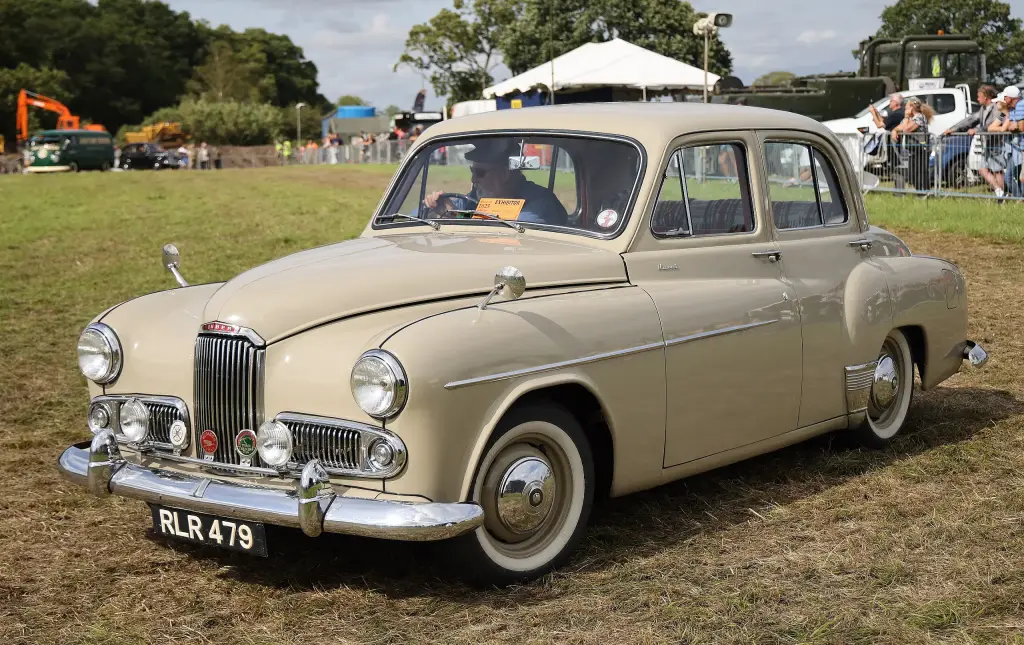
The Humber Hawk was a four-cylinder automobile manufactured by Humber Limited from 1945 to 1967. It was the first Humber launched after the Second World War, a re-badged Hillman 14 that grew through successive Marks into a large unitary-bodied saloon and estate.
Humber Hawk at a glance
| Maker | Humber Limited, Rootes Group |
|---|---|
| Production | 1945–1967 |
| First model | re-badged Hillman 14 of 1938–1940 |
| Engine, Mark I–III | 1,944 cc side-valve four, 56 bhp |
| Engine, Mark IV on | 2,267 cc, 58 bhp |
| Body | four-door saloon; estate from 1955 |
| Construction | separate chassis to 1948; unitary body from 1957 |
| Transmission | four-speed manual; overdrive and automatic later |
| Suspension | transverse leaf front until 1948, then coil springs |
| Top speed | 65 mph (Mark I), 71.4 mph (Mark IV), 79.7 mph (Mark VI estate) |
| Test economy | 24.2 mpg (Mark IV, 1951) |
| Price in 1951 | £850 including taxes (Mark IV) |
Based on one source, the English Wikipedia article on the Humber Hawk.
History of the Humber Hawk
Hawk Mark I and II (1945–1948)
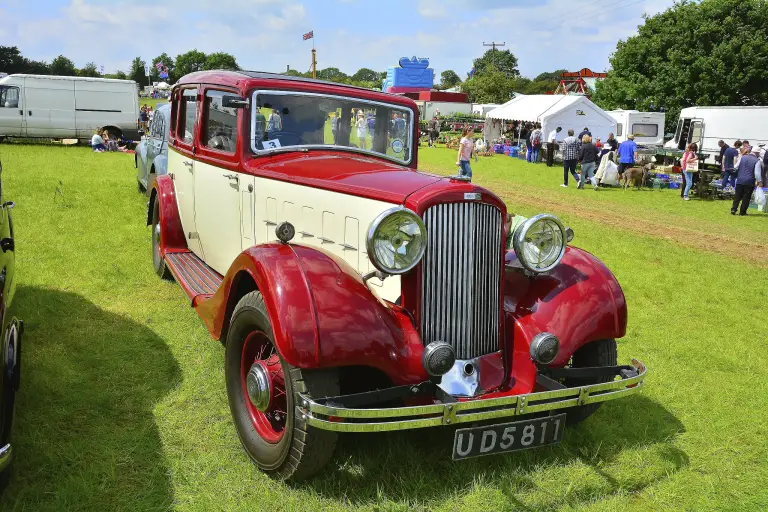
The Hawk, a re-badged Hillman 14, was the first Humber car launched after the Second World War. Slightly longer because a new boot lid was superimposed on its fastback tail, and narrower because it had shed its running boards, it was also 112 lb (51 kg) lighter than the pre-war car. The engine, taken from the Hillman 14 but uprated by almost ten per cent to 56 bhp, was shared with the Sunbeam-Talbot 90; it drove a live rear axle through a four-speed gearbox with a centrally located floor change. The four-door body sat on a separate chassis and was of the six-light design, with three windows on each side and a sunshine roof as standard. Suspension was independent at the front on a transverse leaf spring, and the rear axle had half-elliptic springs. Top speed was around 65 mph.
The Mark II of September 1947 was not even a facelift. Its main difference was a column gear change with a control ring on the gearbox that made it impossible to crash the synchromesh gears. The engine received a new water jacket, the petrol tank a breather to prevent air locks, and provision was made for a car radio and retracting aerial. There was no change to the car’s external appearance.
Mark III to Mark V (1948–1954)
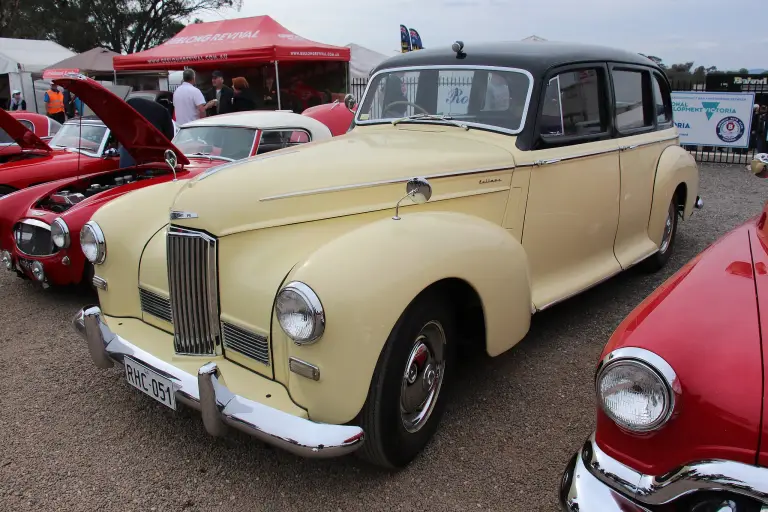
The Mark III was a completely new car, first shown at the London Motor Show in October 1948, although it kept the 1,944 cc side-valve engine of 56 bhp and its transmission with new rubber mountings. The body was styled by the Loewy Studio: the separate headlamps and front wings were gone, the body became an integral part of the structure, and two-tone and metallic finishes were offered on every Hawk until the end of production. A new chassis brought coil-sprung independent front suspension in place of the transverse leaf spring, and the rear axle used hypoid gearing. The new body was 3 cwt (336 lb) lighter than the pre-war style, the front bench seat three inches wider and the rear seat five inches wider, while the car was six inches shorter and an inch and a half lower.
The Mark IV arrived in the early spring of 1951 with a 2,267 cc engine of 58 bhp and about 15 per cent more power at mid-range speeds. It rode on larger 15-inch wheels and had more highly geared steering, commended for its lightness when manoeuvring in a confined space despite 53 per cent of the car’s 2,996 lb being carried by the front wheels. The Motor tested a Mark IV in 1951: 71.4 mph, 0–60 mph in 30.0 seconds, 24.2 mpg and £850 including taxes.
The Mark V of September 1952 was given a larger clutch, larger rear shock absorbers, a strengthened body-frame and other minor mechanical changes. It had a new treatment at the front, a lowered bonnet line and wrap-around bumpers with over-riders, and it was also listed as a luxury touring limousine.
Mark VI and VIA (1954–1957)
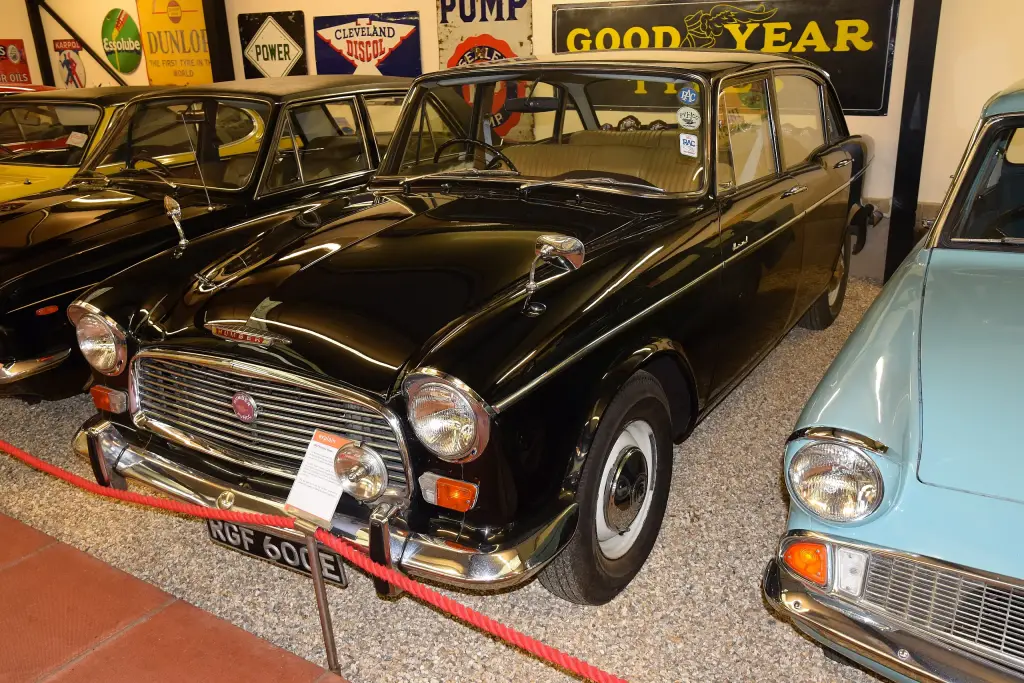
The main change with the Mark VI of June 1954 was an overhead-valve cylinder head. The rear of the body was slightly changed, making the car longer, and in 1955 an estate version with a fold-down tailgate appeared. The April 1956 Mark VIA was a fairly minor upgrade with changes mainly to the interior and a new de-luxe version. The Times found that any previous Hawk owner would be astonished by the Mark VI’s 20 per cent more powerful engine, which swung the car along at 70 mph effortlessly; it also thought the driver’s windscreen wiper badly located. In 1956 The Motor tested a Mark VI estate with overdrive: 79.7 mph, 0–60 mph in 25.2 seconds, 22.8 mpg and £1,405.
Series I to IVA (1957–1967)
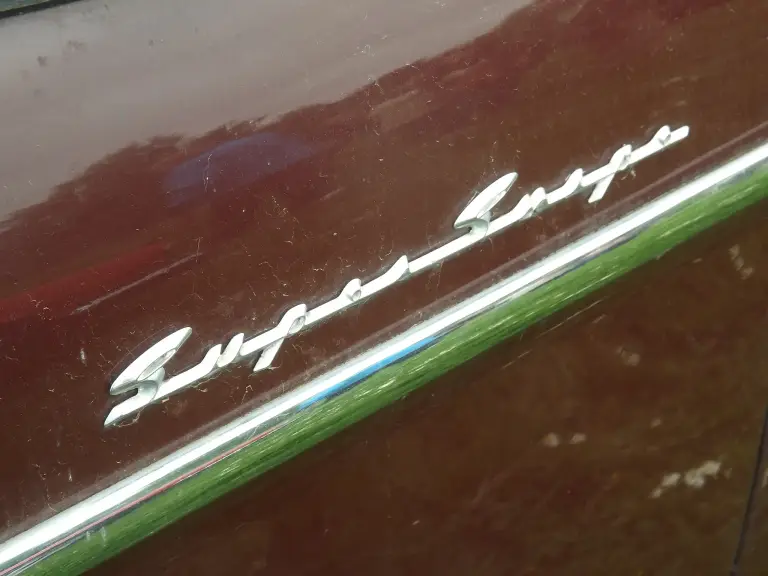
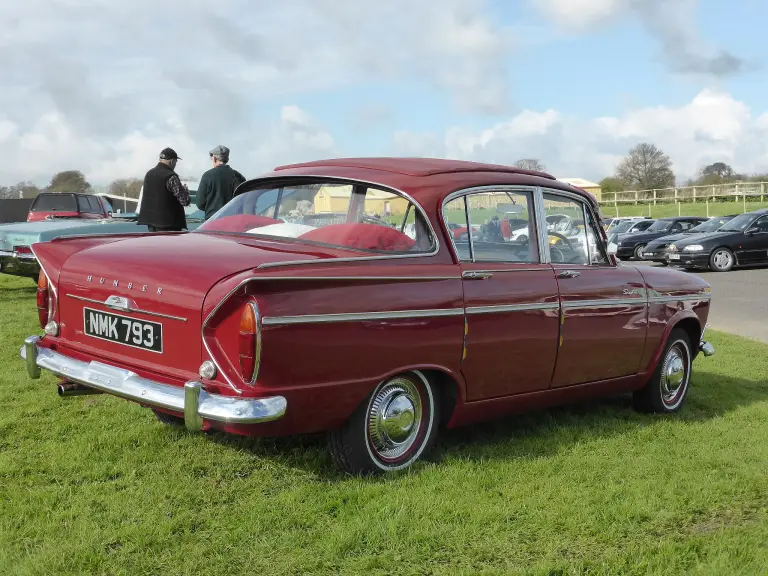
A new Hawk announced in May 1957 had a completely new body with unitary construction, which it shared with the 1958 Humber Super Snipe. The estate version had the largest unitary bodyshell of any British-built car up to that point, a status it retained until the Jaguar Mark X was launched in 1961. The 2,267 cc engine was carried over with modifications to the distributor mounting and other details, and the Borg-Warner D.G. automatic transmission was now available. The Hawk remained in production until 1967.
Design and features
- Six-light body: three windows on each side and a sunshine roof as standard on the early cars.
- Climbing engine size: 1,944 cc at first, 2,267 cc from 1951, overhead-valve head from 1954.
- Modern chassis: coil-sprung independent front suspension from 1948, unitary construction from 1957.
- Estate option: the 1957 estate carried the largest unitary bodyshell of any British car until 1961.
- Automatic transmission: the Borg-Warner D.G. unit became available with the 1957 Series cars.
Humber Hawk versions
- Mark I (1945–1947): Hillman 14-based saloon with a floor gear change, 56 bhp.
- Mark II (1947–1948): column gear change and engine refinements, same body.
- Mark III (1948–1951): Loewy-styled integral body, new chassis, hypoid rear axle.
- Mark IV (1951–1952): 2,267 cc engine, 15-inch wheels, faster steering.
- Mark V (1952–1954): new front treatment, wrap-around bumpers, luxury touring limousine.
- Mark VI and VIA (1954–1957): overhead-valve head and the first factory estate.
The Hawk shared its post-war body with the six-cylinder Humber Snipe and with the larger Super Snipe. More cars are in the Humber collection.
Sources
- Humber Hawk, English Wikipedia: history, engines, road tests, production