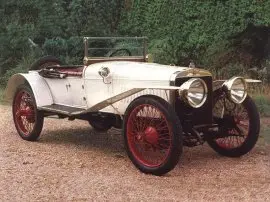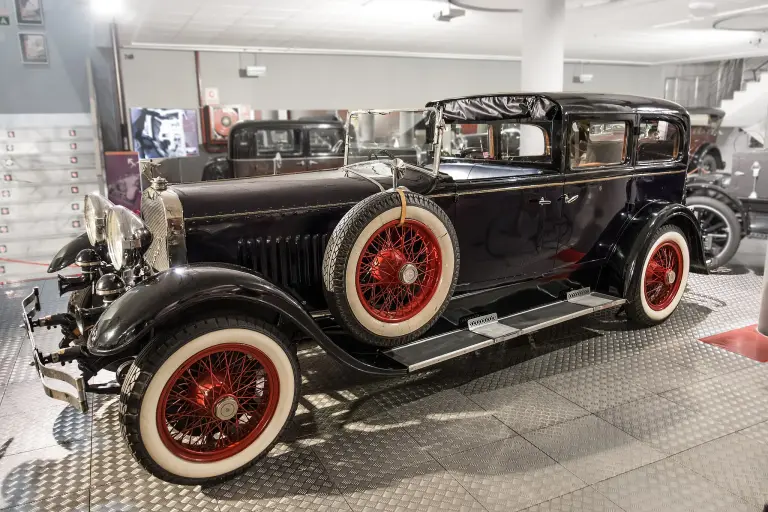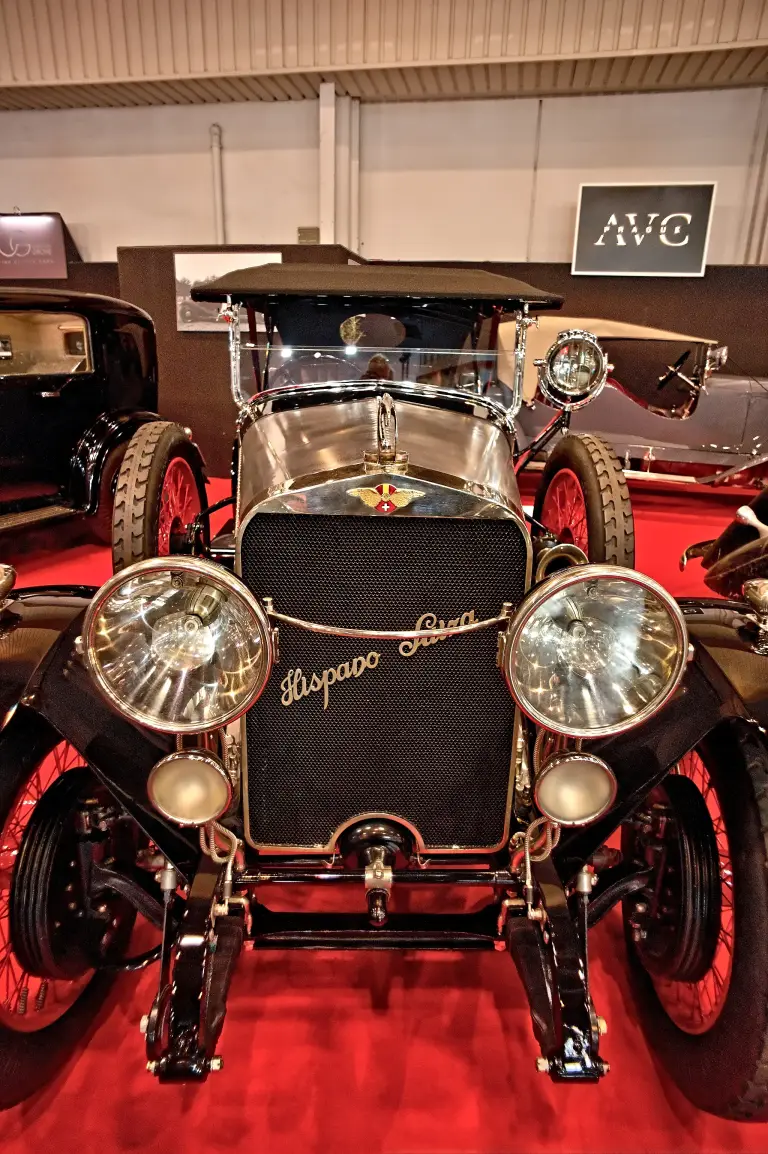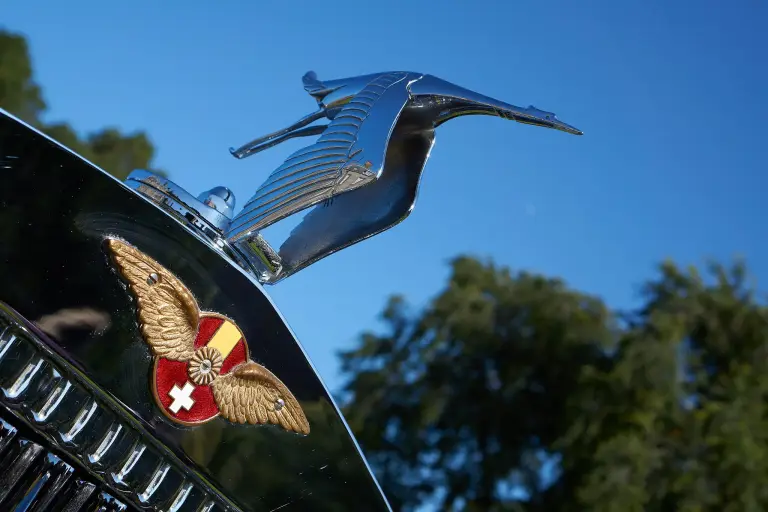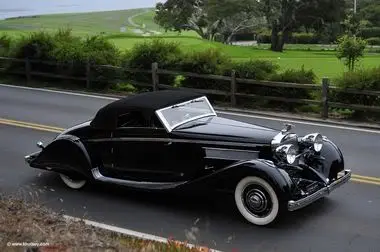
The Hispano-Suiza K6 was the last of the Hispano-Suizas produced in series. It combined a 5.2-litre six-cylinder engine with the lowered chassis of the J12, and it was built from the mid-1930s until 1937, fitted with bodies by the most prestigious coachbuilders of the day.
Hispano-Suiza K6 at a glance
| Maker | Hispano-Suiza, Bois-Colombes, France |
|---|---|
| Shown | Paris Motor Show 1934 (French Wikipedia; Italian Wikipedia says early 1933) |
| Production | until 1937 |
| Built | 206 according to French Wikipedia; more than 1,000 according to Italian Wikipedia |
| Chassis | lowered Hispano-Suiza J12 chassis |
| Engine | 5,181 cc six-cylinder in line, two valves per cylinder |
| Power | 120 hp at 3200 rpm |
| Gearbox | four-speed manual |
| Brakes | drums on all four wheels with servo assistance |
| Top speed | 140 km/h |
| Coachbuilders | Kellner, Figoni & Falaschi, Vanvooren, Saoutchik, Chapron, Pourtout, Franay |
| Bodies | coupé, cabriolet and limousine, with different wheelbases on request |
There is no English Wikipedia page for the K6, so this page is based on French and Italian Wikipedia. The two sources disagree on the date of introduction (1934 against early 1933) and on the number built (206 against more than 1,000); both figures are given.
History of the Hispano-Suiza K6
A six in a V12 chassis
The K6 was presented at the Paris Motor Show in 1934 as an evolution of the earlier H6. It used the lowered chassis of the J12 with the six-cylinder engine of the H6 reduced from 8 litres to 5.2 litres, giving 120 hp and a top speed of 140 km/h. The car was bodied by the most prestigious coachbuilders of the time, among them Kellner, Figoni & Falaschi, Vanvooren, Jacques Saoutchik, Henri Chapron, Marcel Pourtout and Marius Franay. The K6 earned an excellent reputation for robustness, performance, roadholding and braking.
Engineering
The K6 replaced the HS26 and broadly kept that car’s external dimensions, although bodies could be made to the customer’s order and with different wheelbases. Coupé, cabriolet and limousine bodies were among those fitted. The front-mounted six-cylinder engine displaced 5,181 cc with two valves per cylinder and produced 120 hp at 3200 rpm; its innovations included sodium-cooled valves and tubular connecting rods. Transmission was through a servo-assisted single-disc clutch and a four-speed manual gearbox, one gear more than the HS26, with rear-wheel drive. Suspension used leaf springs, the brakes were drums on all four wheels with a servo, and the steering was servo-assisted too: the K6 was among the first cars in the world to have servo assistance for clutch, brakes and steering. Its 140 km/h was a clear improvement on the 130 km/h of its predecessor.
The end of car production
In 1936, after the outbreak of the Spanish Civil War, the French Popular Front nationalised the Hispano-Suiza plant at Bois-Colombes and stopped car production to concentrate on aircraft engines and the HS-404 cannon motor for the French Air Force and the Allies. The K6 was discontinued at the end of 1937. French Wikipedia gives 206 K6 cars built, alongside more than 2,500 chassis and engines of Hispano-Suiza luxury cars in total, and describes the K6 as the last series-produced Hispano-Suiza and one of the best cars of the company from a mechanical point of view.
Design and features
- Last of the line: the final Hispano-Suiza produced in series, built until 1937.
- J12 chassis: a lowered chassis from the V12 flagship under a smaller six-cylinder engine.
- Servo assistance everywhere: clutch, brakes and steering were all servo-assisted, among the first such cars in the world.
- Coachbuilt luxury: bodies by Kellner, Figoni & Falaschi, Vanvooren, Saoutchik, Chapron, Pourtout and Franay.
- Reputation for strength: known for robustness, performance, roadholding and braking.
Hispano-Suiza K6 versions
- K6 coupé: a closed coachbuilt body.
- K6 cabriolet: an open version.
- K6 limousine: the formal body style.
- Custom wheelbases: chassis built to individual order with different wheelbase lengths.
The K6 was the last series model after the Hispano-Suiza H6 and the J12 whose chassis it used. More cars of the marque are in the Hispano-Suiza collection.
Sources
- Hispano-Suiza K6, French Wikipedia: presentation, engine, coachbuilders, production
- Hispano-Suiza K6, Italian Wikipedia: engineering, performance, production history