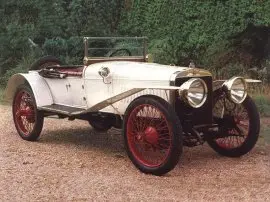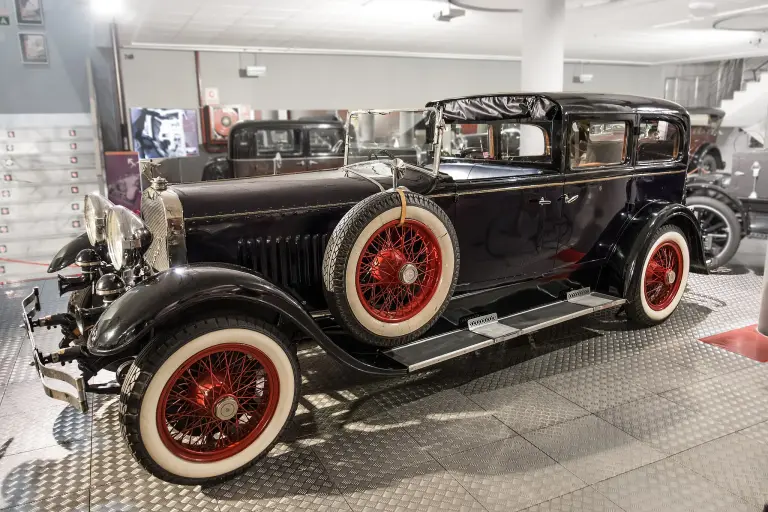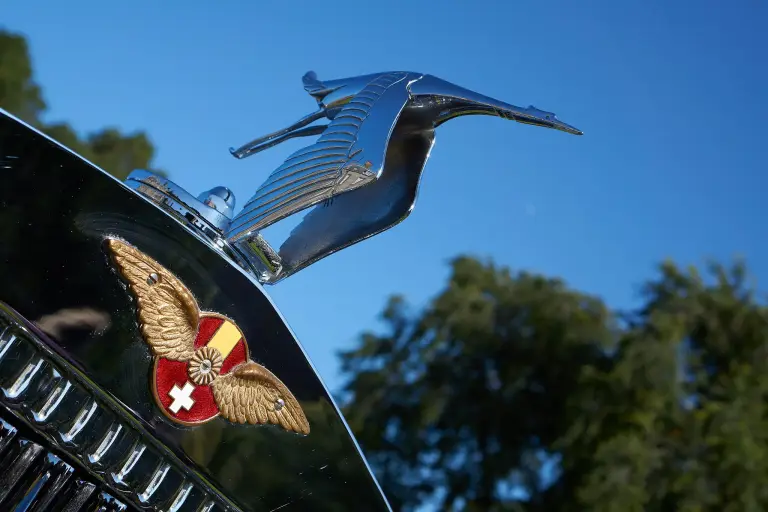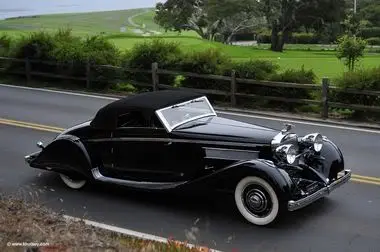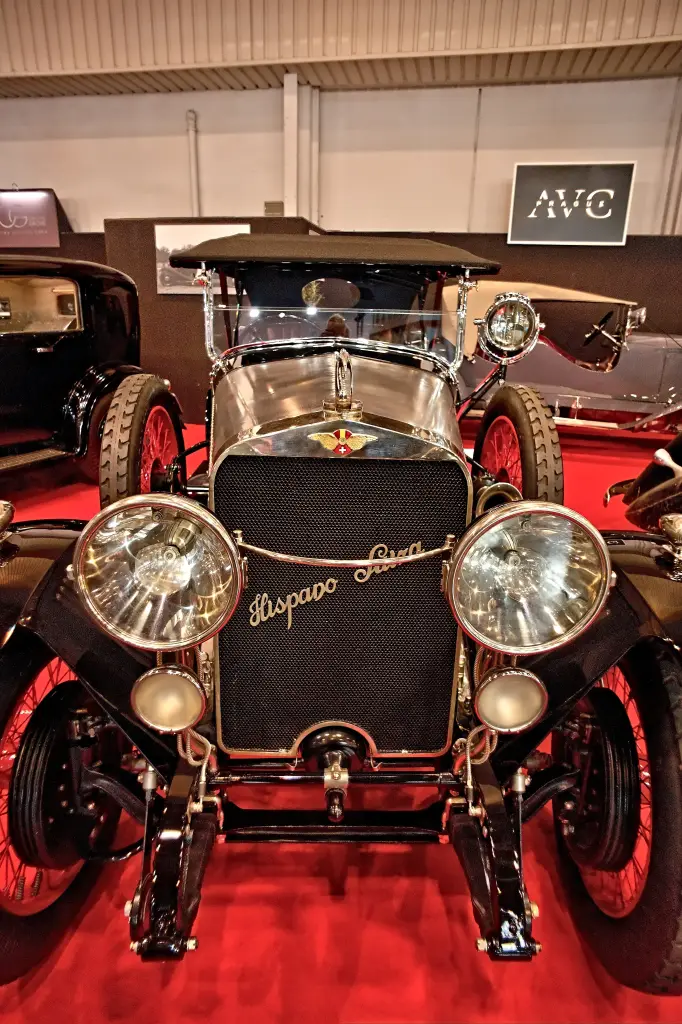
The Hispano-Suiza H6 was a luxury car produced by Hispano-Suiza, mostly in France, from 1919 to 1933. Introduced at the Paris Motor Show in 1919, it used a six-cylinder engine derived from Marc Birkigt’s wartime aviation V12 and became one of the most admired cars of its time. In total about 2,350 H6, H6B and H6C cars were made.
Hispano-Suiza H6 at a glance
| Maker | Hispano-Suiza, chiefly at Bois-Colombes near Paris |
|---|---|
| Introduced | 1919 Paris Motor Show |
| Production | 1919–1933 |
| Engine | 6,597 cc straight-six, all aluminium, overhead camshaft |
| Crankshaft | seven bearings, milled from a 272 kg steel billet down to 16 kg |
| Brakes | light-alloy drums on all four wheels with power assistance |
| Clutch | cone; dry plate from the 1922 H6B |
| H6C engine | 8.0 litres, introduced in 1924 |
| Licensed production | about 100 cars built by Škoda, 1926–1929 |
| Built | about 2,350 H6, H6B and H6C in total |
| Bodies | chassis sold to customers, coachbuilt to order |
| Replaced by | J12 in 1933 |
The H6B and H6C are described by Wikipedia as part of the same H6 range, so one page covers all three versions.
History of the Hispano-Suiza H6
An engine from the air
The H6 engine was a straight-six inspired by designer Marc Birkigt’s work on aircraft engines. Apart from its new overhead camshaft it was essentially half of Birkigt’s aviation V12. The unit was all aluminium, with screwed-in steel liners and water passages enamelled to prevent corrosion. The seven-bearing crankshaft was milled from a 600 lb (272 kg) steel billet to become a sturdy 35 lb (16 kg) unit.
Brakes ahead of their time
One of the H6’s most notable features was its braking. Light-alloy drums on all four wheels were power-assisted, the first such system in the industry, driven by a special shaft from the transmission. As the car decelerated, its own momentum drove the brake servo to provide additional power. The technology was later licensed to other manufacturers, including Hispano-Suiza’s arch-rival Rolls-Royce.
H6B and H6C
The 1922 H6B received only minor changes, among them a dry plate clutch in place of the original cone clutch, and its torque figures reportedly rose marginally. The H6C of 1924 used a larger 8.0-litre engine with a 110 by 140 mm bore and stroke. The H6 series was replaced in 1933 by the J12, which initially used a 9.5-litre V12 pushrod engine.
Boulogne and Monza
A series of five racing H6Bs with short wheelbases and slightly enlarged engines was built in 1922 and called “Boulogne”, celebrating the model’s triple victory at the sports car race at Boulogne in 1923 with Dubonnet, Garnier and Boyriven at the wheel. At Brooklands in 1924 Woolf Barnato drove a Boulogne to eight international records, including an average of 92 mph (148 km/h) over 300 miles (480 km). Andre Dubonnet entered an H6C Boulogne in the 1924 Targa Florio with a 7,983 cc engine estimated at 195 hp; the aircraft maker Nieuport-Astra clothed it in tulipwood strips on an aluminium frame, and the car finished the event without a body failure. It is now at the Blackhawk Museum in California. A later series of short-wheelbase H6Cs became known as “Monzas”, and a six-wheeled H6A is displayed at the Forney Museum in Denver.
Built in Spain, France and Czechoslovakia
The earliest H6As and the T49 version were built at Hispano-Suiza’s industrial complex at La Sagrera in Barcelona, but most H6s were made at the French division in Bois-Colombes. Some 100 H6s were built under licence by Škoda in Czechoslovakia from 1926 to 1929; to cope with the poor fuels available, compression was limited to 4.5:1 and power to 100 hp at 1800 rpm. In 1938 Hispano-Suiza built a one-off H6B for Andre Dubonnet with the H6C engine, his own suspension and Saoutchik bodywork; it is now at the Petersen Automotive Museum in Los Angeles.
Design and features
- Aviation-derived engine: an all-aluminium six that was half of Birkigt’s V12, with an overhead camshaft and a crankshaft milled from a 272 kg billet.
- Power brakes: light-alloy drums on all four wheels with servo assistance driven from the transmission — the first such system in the industry.
- Coachbuilt bodies: only the chassis was sold, and customers had their cars bodied by the coachbuilder of their choice.
- Racing pedigree: the Boulogne and Monza versions took victories and records at Boulogne and Brooklands.
- Built in several countries: Spain, France and a licensed batch in Czechoslovakia by Škoda.
Hispano-Suiza H6 versions
- H6 (1919): the original 6,597 cc car with a cone clutch.
- H6B (1922): dry plate clutch, minor mechanical changes and slightly more torque.
- H6C (1924): the 8.0-litre version, the most powerful of the range.
- Boulogne: five short-wheelbase racing H6Bs of 1922.
- Monza: later short-wheelbase H6Cs.
- Dubonnet Xenia: a one-off 1938 H6B with H6C engine and Saoutchik body.
The H6 was followed by the Hispano-Suiza J12, and its smaller stablemate was the T49. Earlier cars from the same maker include the Alfonso XIII; more are in the Hispano-Suiza collection.
Video: 1922 Hispano-Suiza H6B
Video on YouTube.
Sources
- Hispano-Suiza H6, English Wikipedia: engine, brakes, versions, records, licence production
- Hispano-Suiza H6, French Wikipedia: production total, versions, Xenia
- Hispano-Suiza H6, Italian Wikipedia: history, performance, H6B and H6C