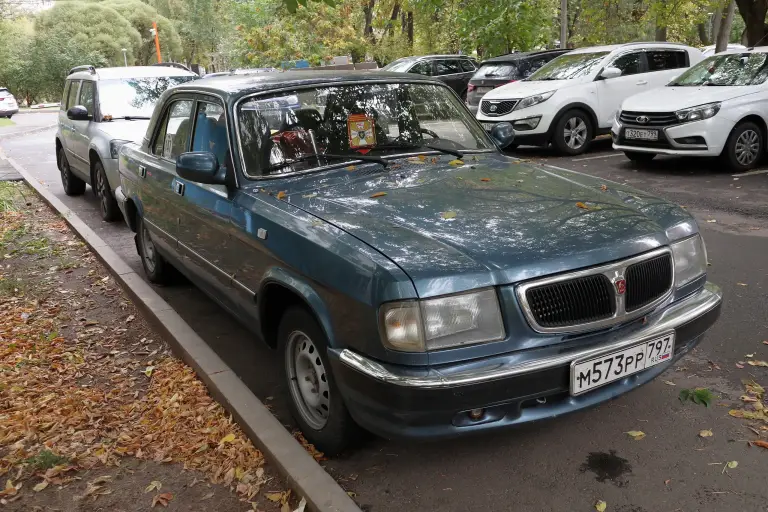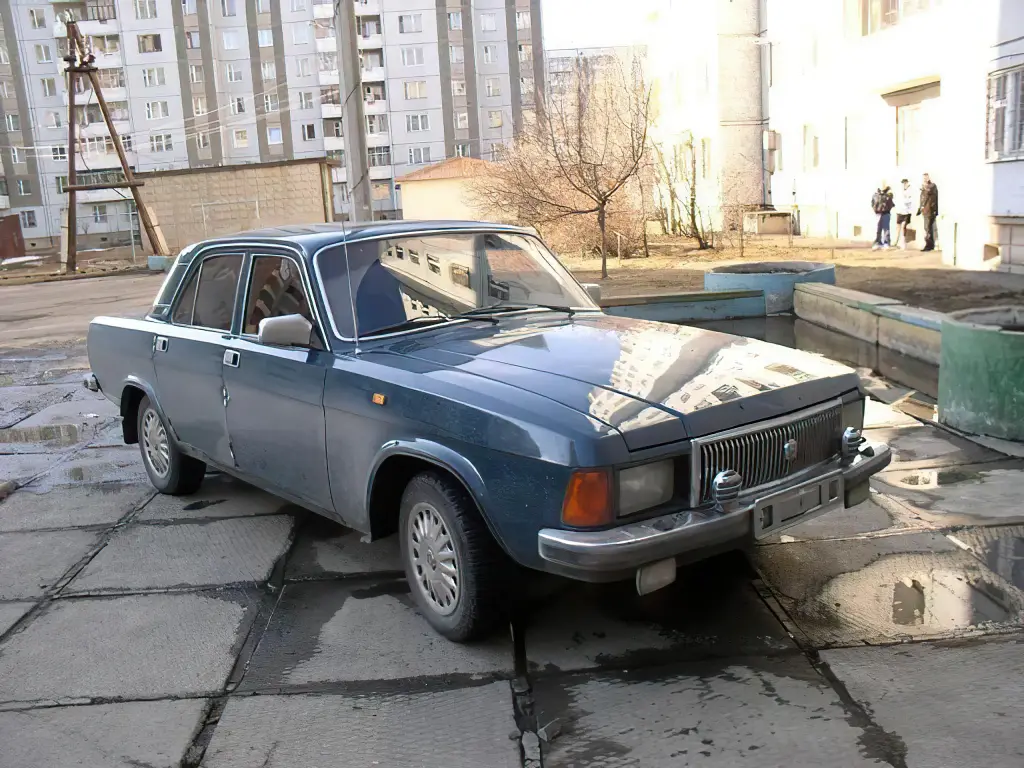
The GAZ-3102 Volga was a hand-built executive sedan made by the Gorky Automobile Plant (GAZ) from 1981–82 until 2008–09, a deep restyling of the GAZ-24 body with new front and rear ends. For its first decade it was sold only to state garages, not to private buyers. This page covers the key figures, the history, the engines and variants, and the answers to common questions.
GAZ-3102 Volga at a glance
| Manufacturer | Gorky Automobile Plant (GAZ) |
|---|---|
| Production years | 1981–2008 (Russian Wikipedia); 1982–2009 (English Wikipedia) |
| Units built | 155,850 hand-built cars (English Wikipedia), including 27 thousand of the first type with the ZMZ-4022 engine |
| Body | four-door sedan (an estate was only built as prototypes) |
| First engine | ZMZ-4022.10, four-cylinder with prechamber torch ignition |
| Power | 105 hp at 4,750 rpm |
| Fuel consumption | 8.5 L per 100 km |
| Performance | 0–100 km/h in 16.2 s, top speed 152 km/h |
| Gearbox | 4-speed manual at first; 5-speed on later cars |
| Brakes | front disc brakes, vacuum servo (Girling licence) |
The sources disagree on the production dates: Russian Wikipedia says the first cars were built on 13 February 1981 and the last in November 2008, English Wikipedia says hand assembly began in April 1982 and ended in early 2009. Performance figures are for the original 1980s car.
History of the Volga 3102
From the GAZ-3101 prototype to production
GAZ began work on a more modern Volga while the GAZ-24 was being prepared for production. The GAZ-3101 project kept the GAZ-24 body but changed the front and rear and added crumple zones, recessed door handles, headrests and a safer dashboard. Russian Wikipedia dates the first running prototype to 1973, English Wikipedia to 1976. The ministry would not pay for production, and the project stalled. A V8 and an automatic gearbox, planned for the GAZ-3101, did not reach production either: the engine plant could not build the V8 for a passenger car.
The production car became the GAZ-3102. It received a special four-cylinder ZMZ-4022.10 engine with a prechamber torch ignition system, which raised power by 10 hp to 105 hp and cut consumption to 8.5 litres per 100 km. The brakes were upgraded with front discs, the first on a Soviet car of this class according to Russian Wikipedia.
Hand assembly for officials
The GAZ-3102 was built by hand in a specialised unit of the plant, the one that built the Chaikas. In the Soviet period it was made at only two to three thousand cars a year and distributed to the garages of ministries and party committees, the military and the security services. A GAZ-3102 was officially not sold to private owners at that time.
The 1990s and the end of production
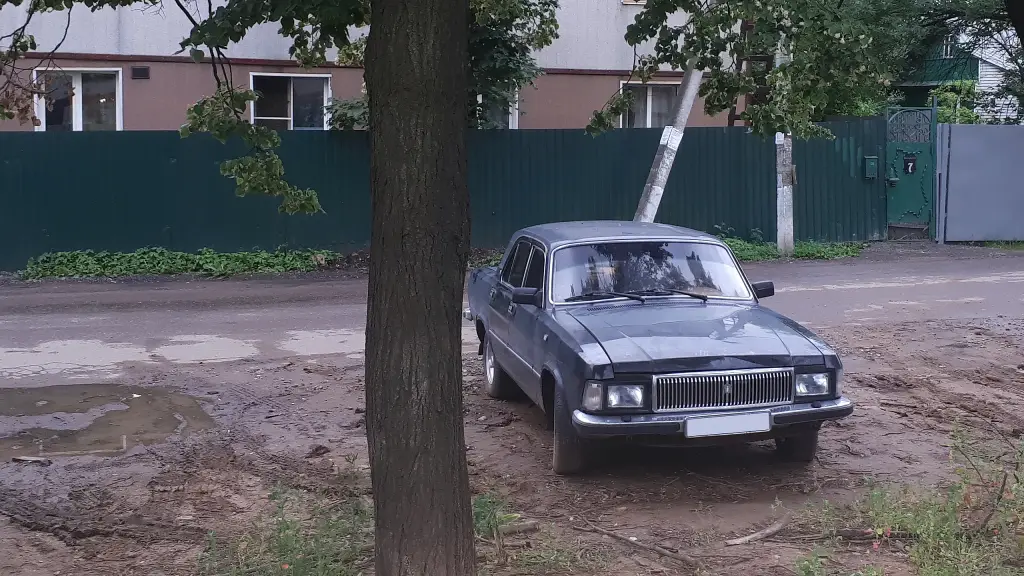
In 1992 the complex prechamber engine was dropped for the plain ZMZ-402 with 100 hp, and the GAZ-31029 appeared on the main conveyor, using the body stampings of the GAZ-3102. In 1993 GAZ began selling the GAZ-3102 to the public. Later cars received parts developed for the GAZ-3110: a 5-speed gearbox, the fuel-injected ZMZ-406 engine, disc brakes with ventilated discs and power steering. The last cars of the classic Volga family were taken off the line in November 2008 in the financial crisis, according to Russian Wikipedia.
Design and features
- Body: the GAZ-3102 kept the GAZ-24 side panels, doors, roof, boot lid and frame members, with a new front with rectangular headlights and a new rear with large tail lamps.
- Safety: the fuel tank sits behind the rear seat, not under the boot floor, and the spare wheel moved into the boot. Inertia seat belts and headrests were fitted.
- Interior: a polyurethane-foam dashboard with round instruments, steering-column stalks and a rear window heater.
- Brakes: a two-circuit vacuum servo brake system with front discs, built under licence from the British company Girling.
Variants
- GAZ-31029: the mass-produced Volga that, from 1992, was built on the main conveyor with the stampings of the GAZ-3102 (English Wikipedia).
- GAZ-31011: a V8 version for the security services. Russian Wikipedia gives a 4,254 cc engine of 160 hp, English Wikipedia a 195 hp ZMZ-503.10.
- GAZ-31013: a V8 version with the Chaika-derived ZMZ-505.10 engine, 200 hp according to Russian Wikipedia and 220 hp according to English Wikipedia; English Wikipedia says no more than 300 of these V8 cars were built.
- GAZ-31028: a version with a two-section VAZ-413 rotary engine of 140 hp and a top speed of 164 km/h (Russian Wikipedia).
- GAZ-31025: a 1983 prototype with a 2,112 cc diesel of 70 hp.
- 3102L: a prototype with a longer wheelbase, 1987.
More about the Volga family and the neighbouring models is in our GAZ collection, including the GAZ 21 Volga and GAZ 24. The same plant built the GAZ Chaika executive limousines.
GAZ-3102 Volga questions and answers
When was the GAZ-3102 built?
Russian Wikipedia gives 1981 to 2008, English Wikipedia 1982 to 2009. The first batch of cars appeared in 1980–81 and the last were built at the end of 2008.
How many GAZ-3102 were made?
English Wikipedia gives 155,850 cars, about 27 thousand of them with the original ZMZ-4022 engine.
Could ordinary people buy a GAZ-3102?
Not at first: it was distributed to official garages. English Wikipedia says GAZ made it available to the public in 1993.
What engine did the GAZ-3102 have?
The first cars had the four-cylinder ZMZ-4022.10 with 105 hp. Later cars used the ZMZ-402 and then the fuel-injected ZMZ-406, and a few special versions had V8 engines.
What is the difference between the GAZ-3102 and the GAZ-24?
The GAZ-3102 shares the basic body panels with the GAZ-24 but has a new front and rear, a safer interior, front disc brakes and a more modern engine.
Is there an estate version?
Only prototypes: both sources say an estate was developed but never built in series.
Sources
- ГАЗ-3102, Russian Wikipedia: history, design, engines, variants
- GAZ-3102, English Wikipedia: history, production figures, performance