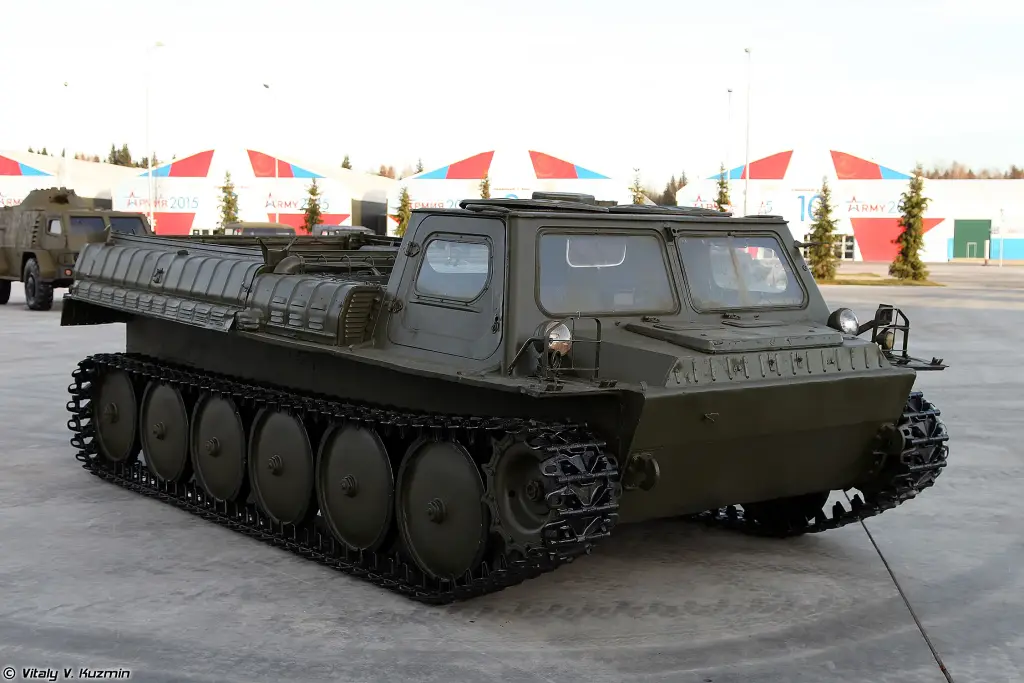
The GAZ-71, officially the GT-SM (Gusenichny Transporter-Snegobolotokhod Modernizirovanny), is a Soviet amphibious tracked all-terrain vehicle for people and cargo, designed at the Gorky Automobile Plant (GAZ) and built at the Zavolzhye tracked tractor plant from 1968. It worked in the far north, Siberia and the far east, and in the army. This page gives the key figures, the history, the variants (GAZ-73, GAZ-3403, GAZ-34039) and answers to common questions.
GAZ-71 (GT-SM) at a glance
| Type | amphibious tracked snow and swamp vehicle with the engine between the cab and the load area |
|---|---|
| Design | GAZ design department, chief designer V. P. Rogozhin |
| Production | 1968–1985 at the Zavolzhye tracked tractor plant |
| Engine | gasoline V8 of the ZMZ family, shared with the GAZ-66 |
| Transmission | 4-speed gearbox and 2-speed transfer case, 8 speeds in total |
| Payload | 1,000 kg (1,250 kg on later versions); towing up to 2,000 kg |
| Weight of later versions | 5.3 tonnes |
| Ground pressure | 0.17 (GAZ-71) rising to 0.21 on later versions |
| Successor | GAZ-3403 from 6 September 1985: top speed 60 km/h, range 600 km |
This page is based on one source, Russian Wikipedia, so some figures could not be cross-checked. Ground pressure is given there without units.
History of the GAZ-71
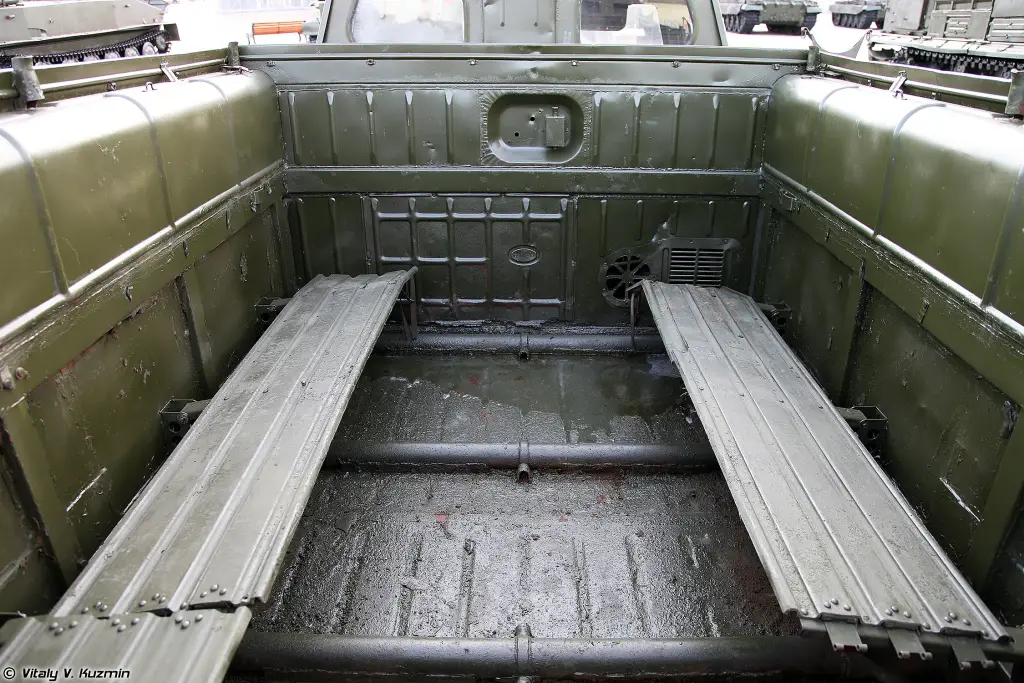
The GT-SM was a deep redesign of the earlier front-engined tracked transporter GT-S (GAZ-47), also designed at GAZ. Rogozhin moved the engine to the middle of the vehicle, between the cab and the load area, and turned it round. That made room for a more powerful V8 instead of the small engine from the GAZ-51, gave almost ideal weight distribution and made the vehicle lower and longer. Russian Wikipedia says the layout split the cab and the load area, but improved the running and amphibious qualities.
Tests took place on the Kola Peninsula, in the marshes of the Arkhangelsk region and in Central Asia. Production began in 1968 at the new plant in Zavolzhye. An armoured army version, the GT-MU (GAZ-73), followed for evacuating the wounded; it was smaller and had a five-roller track instead of the six-roller track of the GAZ-71. One unarmoured vehicle with a searchlight on the cab roof worked in Antarctica.
Design and features
- Hull: a welded, sealed, displacement hull with a flat smooth bottom and rubber-sealed cab doors; an electric pump removes water at 80 litres per minute.
- Drivetrain: the engine, clutch and gearbox are shared with the GAZ-66, which gives eight speeds with the two-speed transfer case.
- Steering: by clutches and band brakes on each side, operated by two levers.
- Use: carrying people and cargo, towing trailers up to 2,000 kg and evacuating the wounded.
GAZ-71 variants
- GAZ-73 (GT-MU): a lightly armoured medical version for the army.
- GMP (1982), GT-PS (1983), GT-SM-1 (1985): modifications for other tasks; the GT-PS was for finding and rescuing people, and the GT-SM-1 had more ground clearance.
- GAZ-3403 (from 1985): the modernised GAZ-71 with a quieter rubber-metal track good for 12,000 km instead of 5,000 km, a better torsion-bar suspension, a top speed of 60 km/h, a range of 600 km and a 25 % higher payload.
- GAZ-34039: the version still built today with a turbocharged D-245 diesel, a 5-speed gearbox and a payload of 1,500 kg.
Other vehicles from the same plant are in our GAZ collection, for example the GAZ 66 whose engine the GAZ-71 shares, and the GAZ 34039.
GAZ-71 questions and answers
What is the GAZ-71?
The civil name of the GT-SM, a Soviet amphibious tracked all-terrain transporter.
Can the GAZ-71 swim?
Yes, it has a sealed displacement hull and is described as amphibious.
Where was the GAZ-71 built?
At the Zavolzhye tracked tractor plant from 1968 to 1985, after which it was replaced by the GAZ-3403.
What engine does it have?
A gasoline V8 of the ZMZ family; the engine, clutch and gearbox are the same as on the GAZ-66.
How much can the GAZ-71 carry?
One tonne, and it can tow trailers up to 2,000 kg. Later versions carry 1,250 kg or more.
Sources
- ГТ-СМ, Russian Wikipedia: history, design, variants, successors