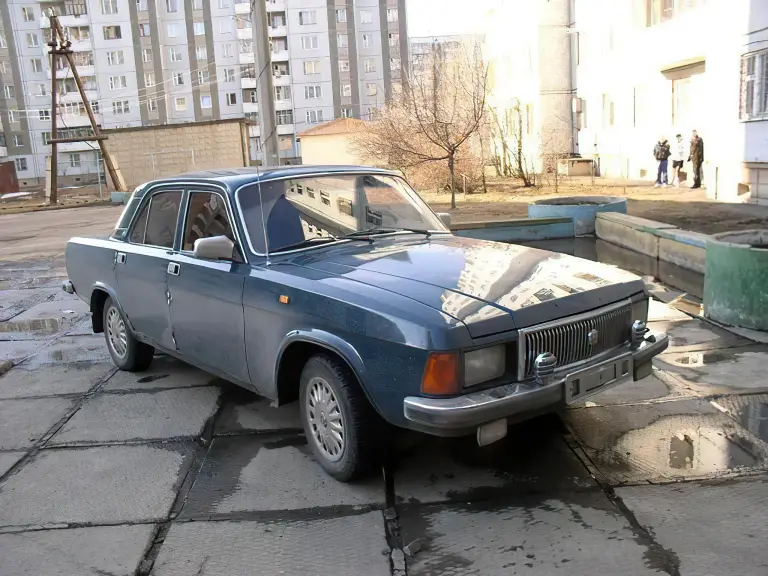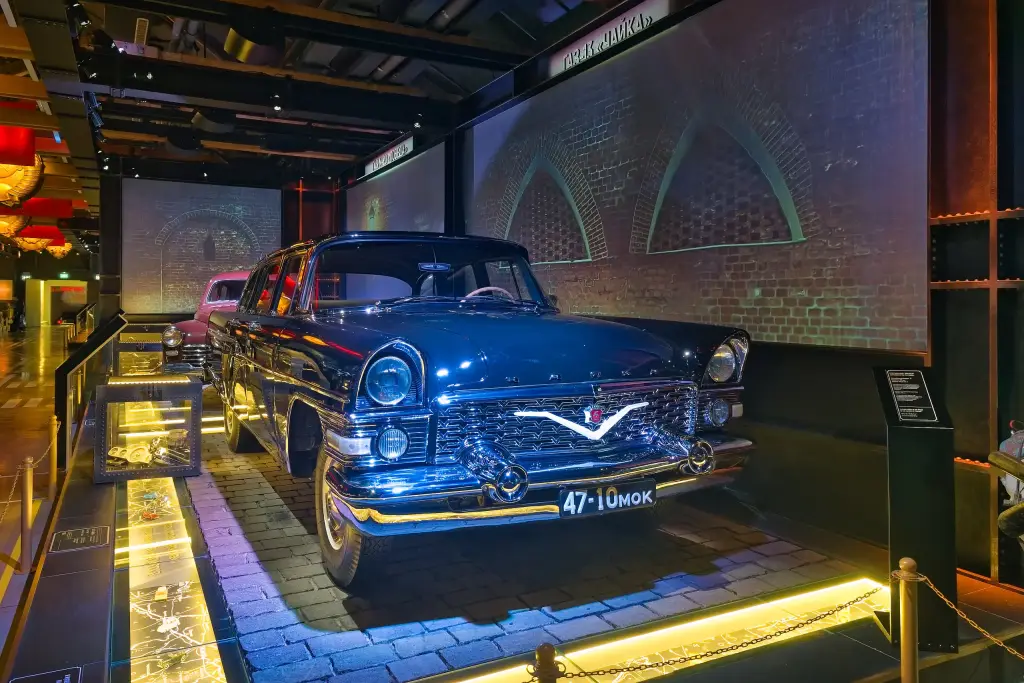
The Chaika (Russian for “seagull”) was the name of two large executive cars built by the Gorky Automobile Plant (GAZ) in the Soviet Union: the GAZ-13, produced from 1959 to 1981, and its successor the GAZ-14, built from 1977 to 1988. Neither was sold to private buyers. They carried ministers, party officials and foreign guests, both had a V8 and a three-speed automatic gearbox, and both were made in tiny numbers: about 3,180 GAZ-13 and 1,114 GAZ-14. This page puts the specifications, history and variants of both generations in one place.
GAZ Chaika at a glance
| GAZ-13 Chaika | GAZ-14 Chaika | |
|---|---|---|
| Production years | 1959–1981 | 1977–1988 |
| Replaced | ZIM (GAZ-12) | GAZ-13 |
| Engine | 5.5 L V8 (ZMZ-13), four-barrel carburettor | 5.5 L V8 (ZMZ-14), two carburettors |
| Power | about 195 hp (SAE gross) | 220 hp |
| Transmission | 3-speed automatic, push-button selector | 3-speed automatic |
| Wheelbase | 3,250 mm | 3,450 mm |
| Length | 5,600 mm | 6,114 mm |
| Width | 2,000 mm | 2,020 mm |
| Height | about 1,580–1,620 mm | 1,525 mm |
| Curb weight | about 2,050–2,190 kg | about 2,600–2,615 kg |
| Units built | about 3,180 | 1,114 |
| Seats | seven in the standard saloon | seven in the standard saloon |
Where the sources differ slightly (power, height, weight), the table shows a range or the rounded figure. See the sources at the bottom of the page.
History of the Chaika
GAZ-13: from ZIM to Chaika
The GAZ-13 began as a modernisation of the ZIM (GAZ-12) and grew into a new design under the working name ZIM-2. “Chaika” won over the alternative “Strela”. The exterior designer was Lev Eremeev. Two running prototypes with a 4.9-litre engine were built in 1957, and an experimental car won a Grand Prix diploma at Expo 58 in Brussels. The first cars left the line in autumn 1958, and series production began in 1959.
Chrome, tail fins and a wide grille echo American cars of the 1950s. English Wikipedia names the Packard Patrician as the inspiration, while Russian Wikipedia stresses that the Chaika was not a direct copy of any Packard.
Underneath, the GAZ-13 had a separate X-shaped frame with the body mounted on rubber blocks. Features that were new for GAZ included a four-barrel carburettor, hydraulic power steering, a vacuum brake booster, electric window lifts and a radio with automatic station search. Many of these solutions later reappeared in the GAZ 24 Volga.
GAZ-14: the last Chaika
Work on a successor began in 1967 with the aim of updating the looks, comfort, safety and performance of the GAZ-13 while keeping its X-shaped frame and most of its drivetrain. The first pre-series car was built in late 1976, reportedly as a gift for Leonid Brezhnev’s 70th birthday, and production started in October 1977. Every GAZ-14 was assembled by hand.
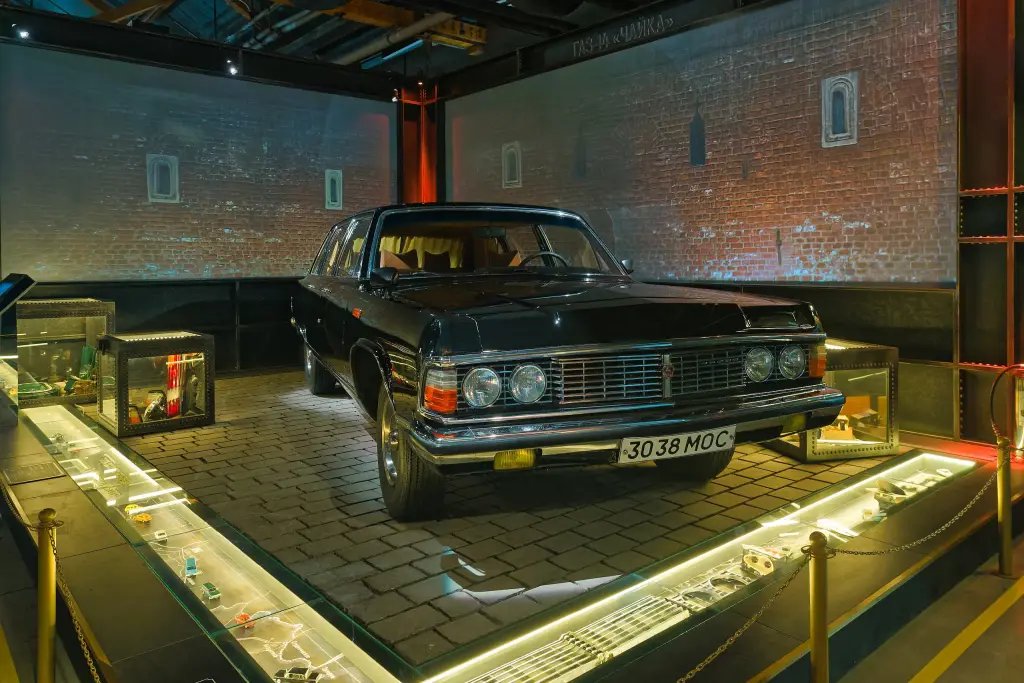
New in the GAZ-14 were front ventilated disc brakes, ball-joint front suspension (the GAZ-13 used kingpins), air conditioning, three-point seat belts and safety beams in the doors. Two fold-down seats for bodyguards explain why the rear doors have two handles each.
Production ended during perestroika. The last car was finished on 24 December 1988, and on Mikhail Gorbachev’s orders, as part of his campaign against official privileges, the documentation and tooling were destroyed.
Engines and transmission
- GAZ-13: ZMZ-13 V8 of 5,530 cm³ with an aluminium block and heads, about 195 hp, and a three-speed hydromechanical automatic with push buttons on the dashboard (N, D, T and reverse)
- GAZ-14: ZMZ-14 V8 of 5,526 cm³ with two carburettors and 220 hp at 4,200 rpm, derived from the GAZ-13 engine, with a three-speed automatic practically unchanged from the GAZ-13
Chaika variants
GAZ-13 variants
- GAZ-13: the four-door saloon, the most common version
- GAZ-13A: a limousine with a partition between the front and rear seats
- GAZ-13B: a four-door phaeton (open car) with an electro-hydraulic folding top, made in very small numbers for parades
- Estate and ambulance conversions built by the RAF plant in Riga, plus a few cars prepared for film crews
GAZ-14 variants
- GAZ-14-02: an update of 1985 with a revised cooling system, seats and some interior parts
- GAZ-14-03 and GAZ-14-04: versions for the security services, with different communications equipment
- GAZ-14-05: an open parade phaeton for the Ministry of Defence, about 15 built between 1981 and 1988 according to Russian Wikipedia
- GAZ-14-07: a prototype with a fuel-injected V8 and an improved automatic transmission that never entered production
Who used the Chaika
The GAZ-13 was never sold to the public. It served ministers and regional party secretaries, embassies, parades and foreign visitors, and some cars were given to foreign leaders such as Fidel Castro. Ordinary citizens could meet it only as a rented wedding car. The GAZ-14 was intended for ministers of the union republics, first secretaries of regional party committees, heads of large strategic enterprises and commanders of military districts.
More Soviet cars from the same plant are in our GAZ collection, including the GAZ 21 Volga, GAZ 24 and GAZ 3102.
GAZ Chaika questions and answers
What does Chaika mean?
Chaika is the Russian word for “seagull”.
When was the GAZ Chaika built?
The GAZ-13 was built from 1959 to 1981 and the GAZ-14 from 1977 to 1988, so the two overlapped for several years.
How many Chaikas were made?
About 3,180 GAZ-13 (English Wikipedia gives 3,179) and 1,114 GAZ-14.
Could ordinary people buy a Chaika?
No. Both models were official cars and had no retail price; the GAZ-13 was also used for wedding rentals.
Was the Chaika a copy of the Packard?
The styling clearly follows American cars of the 1950s, and the Packard is the model most often named. Russian Wikipedia says the Chaika was not a direct copy of any Packard.
What replaced the GAZ-14?
English Wikipedia lists the GAZ-3105 as the successor of the GAZ-14.
Video: GAZ Chaika drives for the first time in 30 years
Video by Practical Classics magazine on YouTube.
Sources
- ГАЗ-13 «Чайка», Russian Wikipedia: history, engines, dimensions, variants, users
- ГАЗ-14 «Чайка», Russian Wikipedia: development, engine, features, variants
- GAZ-13, English Wikipedia
- GAZ-14 Chaika, English Wikipedia