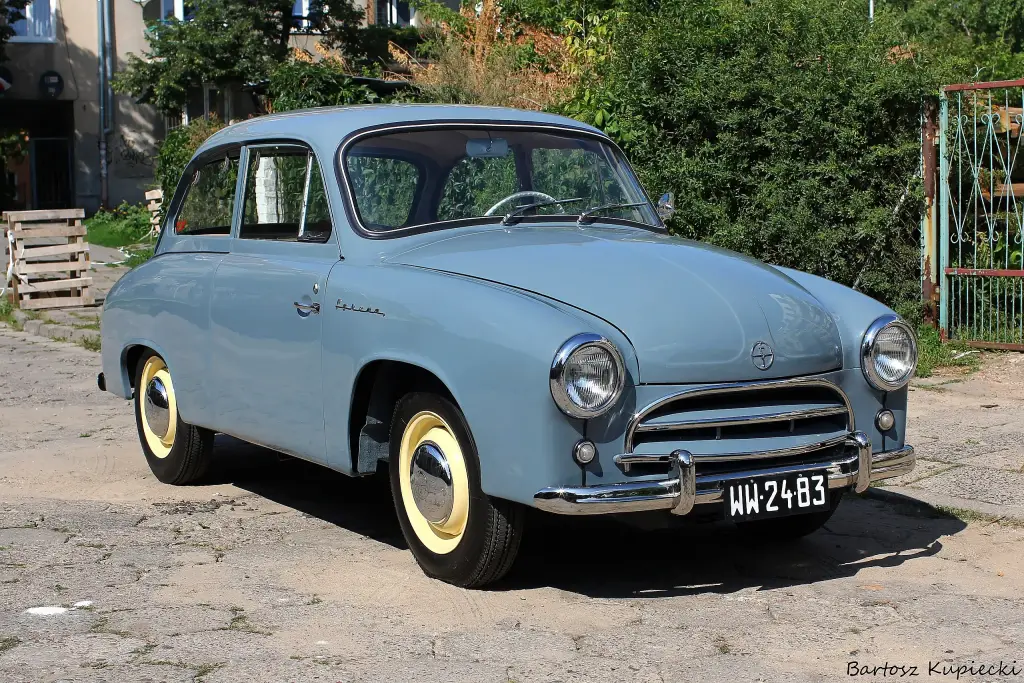
The FSO Syrena was Poland’s small car: a two-door, two-stroke saloon shown at the Poznań Fair in 1955 and built from 1957 to 1983. It changed remarkably little during 26 years, and 521,311 were made, first by FSO in Warsaw and then by FSM in Bielsko-Biała.
FSO Syrena at a glance
| Makers | FSO, Warsaw (1957–72); FSM, Bielsko-Biała (1972–83) |
|---|---|
| Production | 20 March 1957 – 30 April 1983 |
| Shown | 1955 Poznań Trade Fair |
| Engines | two-cylinder two-stroke; three-cylinder from 1965 |
| Layout | front-wheel drive, front-mounted engine |
| Body | two-door saloon |
| Models | 100, 101, 102, 103, 104, 105 |
| Built | 521,311 (177,234 FSO and 344,077 FSM) |
| Van | Bosto, about 135,000 built |
| Pickup | R-20 |
| Most popular | 105 (1972–1983) |
| Prototypes | Syrena Sport, Syrena 110 (1966), Laminat (1968) |
History of the FSO Syrena
A small car for Poland
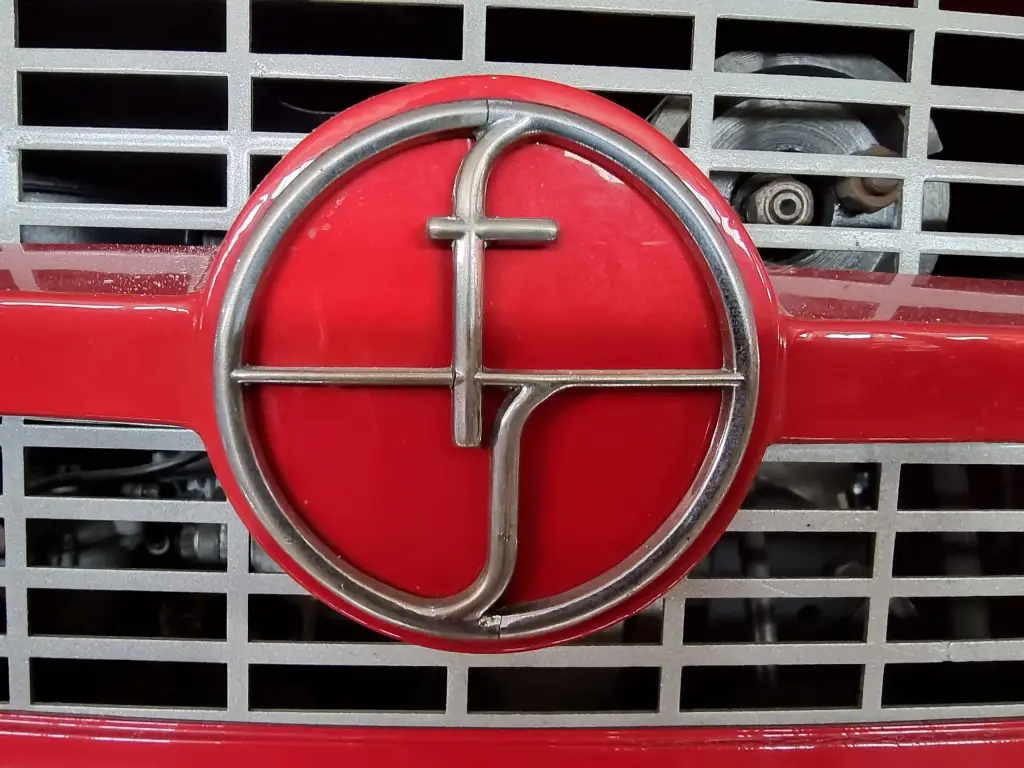
In May 1953 the government decided that Poland needed a small car to complement the larger Warszawa. The Syrena was designed by Stanisław Łukaszewicz, Stanisław Panczakiewicz and Fryderyk Bluemke, with a chassis and running gear copied from the DKW and a two-cylinder two-stroke engine of Bluemke’s design. The first two prototypes appeared in December 1953: one with a wooden frame by Panczakiewicz, one with a steel body by Łukaszewicz. The final design combined the first car’s shape with the second one’s steel body, though the roof stayed wooden. Five prototypes were ready by March 1955.
The car was shown in June 1955 at the 24th Poznań Trade Fair and drew so much interest that the government put it into production, at first planning 10,000 cars a year. In September 1955 the prototypes took part in a 5,600 km experimental rally; one, driven by Karol Pionnier, crashed and exposed the weak wooden roof, so steel replaced wood for that panel. Because money was short, the Syrena shared many parts with the much larger Warszawa, and as a result it was heavy for its size at 950 kg. Mass production began on 20 March 1957. The first bodies were beaten by hand over cement-and-asphalt forms, and only in the autumn of 1958 did pressed and spot-welded bodies arrive.
From 100 to 105
The first model only received the number 100 after the 101 appeared. The 101 of 1960 brought a pneumatic fuel pump, a different carburettor, twin windscreen wipers and a better suspension. The 102, built in 1962 and 1963, had slightly different body details; its 102S version shared an engine with the Wartburg 312, and about 150 were made. The 103 of 1963–66 had a restyled front and a different engine. The 104 lasted from 1966 to 1972 with a new three-cylinder engine, a synchronised gearbox and restyled tail lights. In 1965 the Syrena had already received the larger three-cylinder two-stroke.
The 105 was the final design, produced from 1972 to 1983 by FSM in Bielsko-Biała and badged accordingly. Unlike its predecessors it had regular front doors instead of the earlier rear-hinged ones. The Lux version of 1974 moved the gear lever and handbrake between the front seats. The 105 was also the basis for the R-20 pickup and the Bosto van.
Bosto, R-20 and one-offs
The Bosto panel van and its pickup sister, the R-20, were first introduced on the 104. The name is an acronym of Bielski Osobowo-Towarowy, passenger-cargo car of Bielsko. The first Bosto was revealed in December 1971 at the new FSM factory, and the last was built on 30 April 1983; about 135,000 were made. The 104B of 1972 came as a four-seater van with 200 kg of freight capacity or a two-seater cab with 350 kg. The 105B replaced it in 1976 with uprated semi-elliptical springs from the Warszawa, a larger fuel tank borrowed from the 125p and the handbrake in its standard position between the seats. As in the saloon, the three-cylinder two-stroke sat longitudinally ahead of the front axle and drove the front wheels.
Several prototypes never reached production: the Syrena Sport coupé, the Syrena 110 hatchback of 1966 and the Laminat of 1968.
Syrenka today
The name comes from the mermaid who, by legend, protects the Vistula and Warsaw and appears on the city’s coat of arms; Poles also call the car Syrenka, little siren. A 1983 FSM Syrena 105L in yellow appeared in the tenth series of the British programme Wheeler Dealers. Mike Brewer bought it in Poland for 7,000 złoty, about £1,400, and drove it back to Britain, where the repairs and upgrades brought the total cost to £5,454. The car was repainted red and white in homage to the Polish flag and later sold for £8,000 to the bubble car museum in Lincolnshire.
Design and features
- Two-stroke engines: small, simple and smoky, with a two-cylinder unit at first and a three-cylinder from 1965.
- Front-wheel drive: unusual for a small car of 1957, with the engine ahead of the front axle.
- Barely changed: the same basic design served for 26 years with only minor modernisations.
- Bosto and R-20: a van and a pickup that gave the little car a working life.
- Syrenka: the affectionate Polish nickname, from the Warsaw mermaid.
FSO Syrena versions
- 100 (1957): the original two-door saloon with a two-cylinder engine.
- 101 (1960): better suspension, twin wipers, new fuel pump.
- 102 and 102S (1962–63): revised body details; the S used a Wartburg 312 engine.
- 103 (1963–66): restyled front and a different engine.
- 104 (1966–72): three-cylinder engine, synchronised gearbox, new tail lights.
- 105 and 105L (1972–83): conventional front doors; Lux with floor gearchange.
- Bosto: panel van, about 135,000 built.
- R-20: pickup version of the 104 and 105.
The Syrena was the small companion to the Warszawa and was replaced in the FSO range by the 125p and Polonez. More cars are in the FSO collection.
Video: FSO Syrena 105 Ciechanów
Video on YouTube.
Sources
- FSO Syrena, English Wikipedia: models, engines, Bosto and R-20
- FSO Syrena, Polish Wikipedia: prototypes, production, technical details