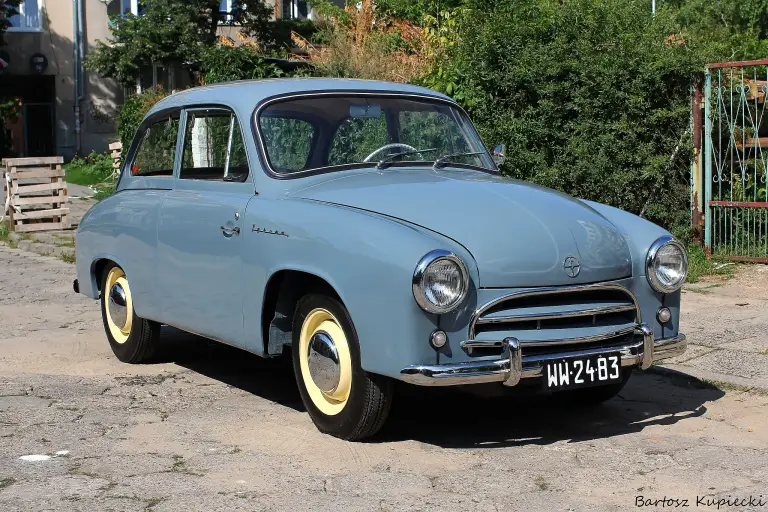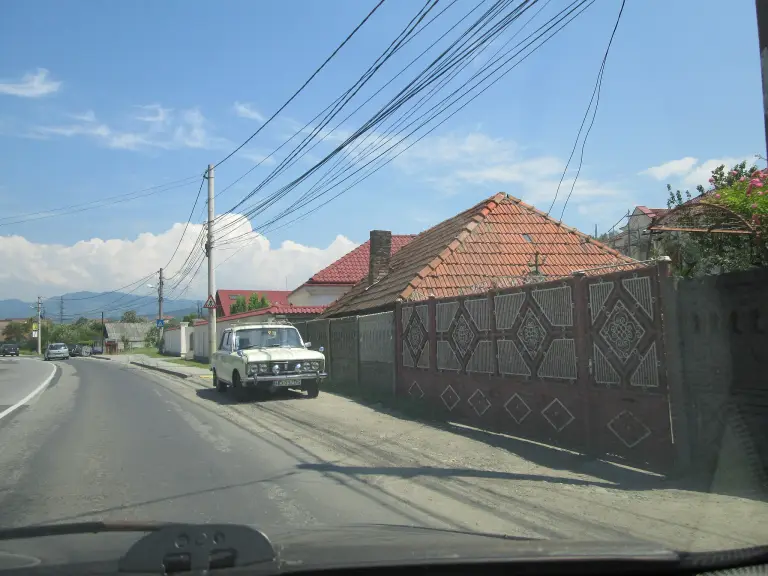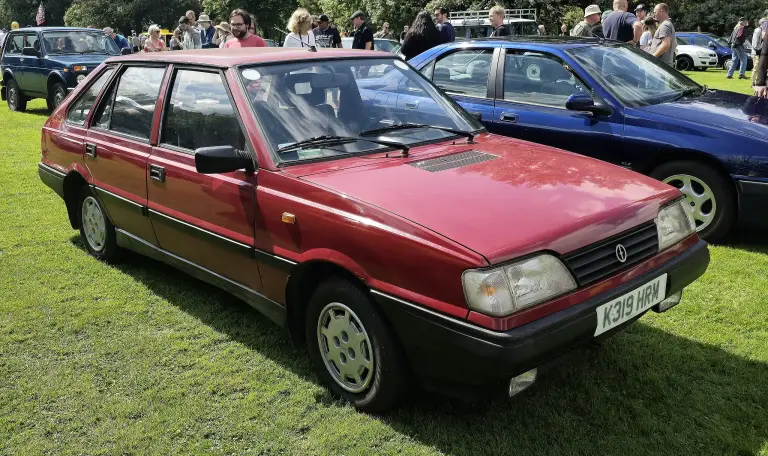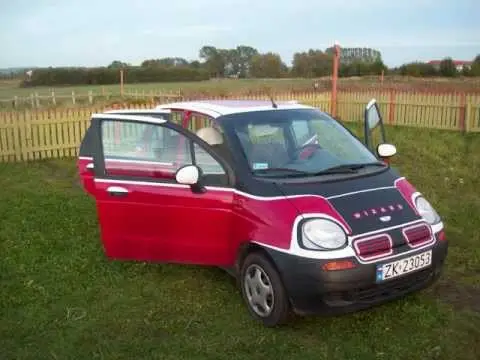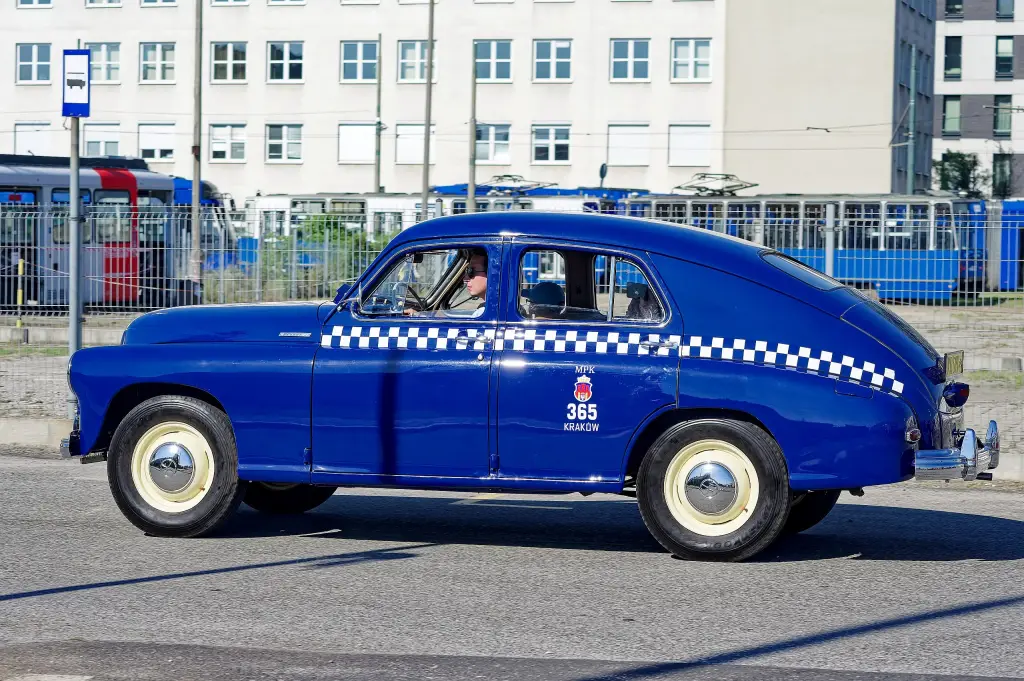
The FSO Warszawa was the first passenger car developed in Poland after the Second World War. Produced from 1951 to 1973 and based on the Soviet GAZ-M20 Pobeda, it carried Poland’s families, taxi drivers and state institutions for more than two decades, and 254,471 were built.
FSO Warszawa at a glance
| Maker | FSO, Warsaw |
|---|---|
| Production | 1951–1973 |
| Based on | GAZ-M20 Pobeda |
| First car | 6 November 1951 |
| Engine | 2,120 cc side-valve, 50 hp; OHV 70 hp from 1962 |
| Gearbox | three-speed; four-speed in small numbers from 1971 |
| Body styles | fastback saloon, ponton saloon (1964), estate (1965), pickup (1958), van |
| Models | M20, 200, 201, 202, 203/204, 223/224 |
| Built | 254,471 |
| Exported | 72,834 |
| Last car | 30 March 1973 |
| Successor | Polski Fiat 125p |
History of the FSO Warszawa
From the Pobeda to the Warszawa
The first plans for a Polish passenger car dated from 1946, and in 1947 Poland signed a trade agreement with Fiat for a factory to build the Fiat 1100. The works started in August 1948 but were stopped a few months later; the cooperation with Italy collapsed, and the country turned to the Soviet Union instead. The Soviet side supplied the documentation for the GAZ-M20 Pobeda, which Poland paid for with 130 million złoty, and the tooling for another 250 million. The planned output was 25,000 cars a year.
The first Warszawa M-20 was assembled from Soviet parts on 6 November 1951, and only 75 were built by the end of that year. Polish production grew stage by stage: the first engine assembled entirely from Polish parts on 19 September 1953, the first Polish-pressed body in March 1954, and the first car built only from Polish components in 1956. Exports began in 1954, first to China, Romania, Albania and Bulgaria. Until 1957 the Warszawa was identical to the Pobeda, which was built under a licence that GAZ granted at Joseph Stalin’s insistence. Power came from the same 2,120 cc side-valve four of 50 hp (37 kW), driving through a three-speed gearbox with an unsynchronised first gear.
200, 201 and 202
Work on a four-speed gearbox began in 1956 but failed in practice and was suspended. In the same year FSO started an overhead-valve engine, a copy of the Étendard unit used in the Renault Frégate, which reached the Warszawa in 1962. The first major modernisation came in 1957. The restyled car was called the Warszawa M20 model 57, soon renamed Warszawa 200, with a modified front, a compression ratio raised from 6.2:1 to 6.8:1 and power up to 52 hp (38 kW).
In 1960 a lightly modernised 201 arrived with 200 technical improvements: combined rear lights, a revised electrical system, 15-inch wheels instead of 16-inch, telescopic shock absorbers, orange front indicators and a new rear bumper. A Lux version added a roof rack and two-tone paint. From 1962 the new overhead-valve engine raised power to 70 hp (51 kW), and the car so equipped was called the Warszawa 202.
Ponton body and the end
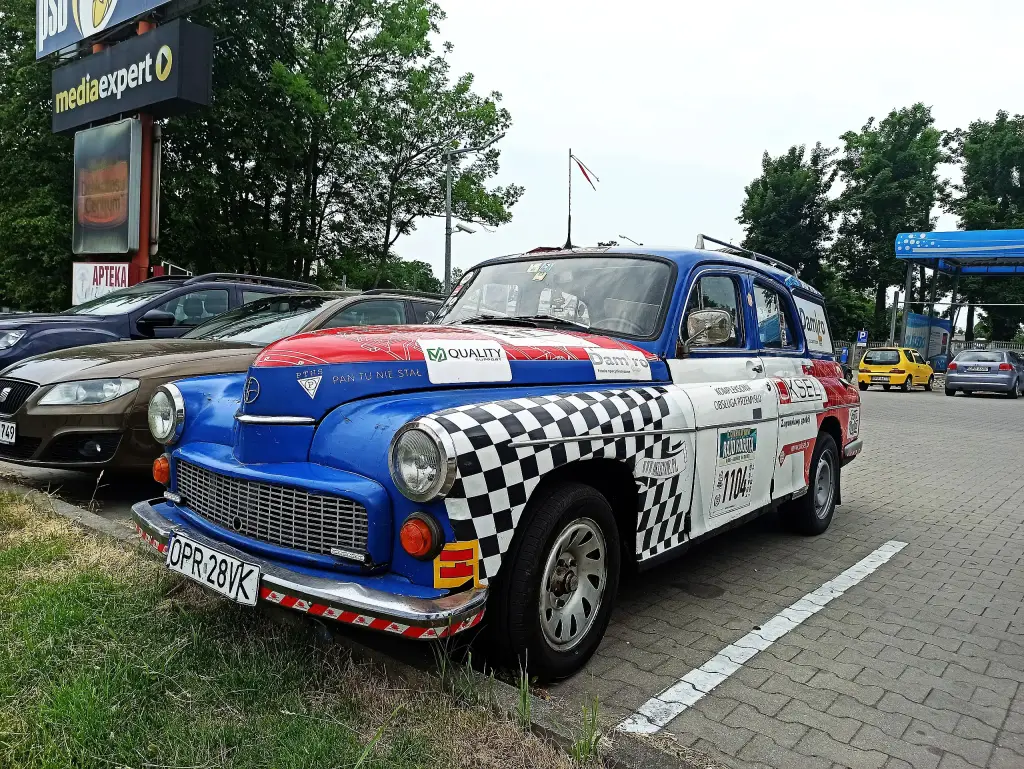
In 1964 the body was changed to a three-box ponton shape, then becoming mainstream in Europe. The designations became 203 for the overhead-valve car and 204 for the side-valve one. In 1968 Peugeot protested because it had protected three-digit names with a zero in the middle, and FSO changed the numbers to 223 and 224. In 1967 Perkins four-cylinder 1.76-litre diesel engines were announced for export Warszawas, due to appear at the Poznań International Fair in June that year.
By then the smaller Polski Fiat 125p, based on the Italian Fiat 125, had entered production, and the Warszawa faded away. The last car left the line on 30 March 1973, with the 125p as its successor. In all, 254,471 Warszawas were built and 72,834 of them were exported.
Pickups, vans and estates
A pickup, technically a coupe utility, was made from 1958. It carried two people and 500 kg of payload, mostly for state enterprises and institutions; the 223P version reached 120 km/h and the 224P 105 km/h. The load floor was made of pine boards and covered with a tarpaulin over a steel frame. A van called the 201F followed, with a 400 kg payload, the fuel tank under the driver’s seat and the spare wheel under the floor; the 203F and 204F replaced it in 1964, and vans were withdrawn in 1965 when the 203-K and 204-K estate arrived. The estate had been shown at the Poznań Fair in June 1965 and entered mass production at the end of that year. Police cars, ambulances and postal vans were built on the same basis, and the Warszawa’s components lived on in the Żuk, Nysa and Tarpan delivery vehicles.
Design and features
- Pobeda lineage: the Soviet car’s body and side-valve engine, adapted for Polish production.
- Taxi toughness: sturdy and rugged, but underpowered for its weight and thirsty.
- Overhead-valve engine from 1962: a copy of the Renault Frégate Étendard unit, 70 hp.
- Many bodies: saloon, estate, pickup, van and ambulance from one chassis.
- Basis for other vehicles: its components were used in the Żuk, Nysa and Tarpan.
FSO Warszawa versions
- M20 (1951–1957): identical to the Pobeda, 50 hp side-valve engine.
- 200 (1957): restyled front and higher compression.
- 201 (1960): 200 improvements, 15-inch wheels, telescopic dampers.
- 202 (1962): new overhead-valve 70 hp engine.
- 203/204 (1964): ponton body, renamed 223/224 in 1968.
- Pickup 223P/224P (from 1958): 500 kg payload.
- Estate 223K/224K (1965): five-door station wagon.
- Van 201F: 400 kg payload, later 203F and 204F.
The Warszawa was replaced by the FSO 125p, while the smaller Syrena served alongside it. More cars are in the FSO collection.
Video: FSO Warszawa
Video on YouTube.
Sources
- FSO Warszawa, English Wikipedia: models, engines, body versions
- FSO Warszawa, Polish Wikipedia: production dates, totals, early history