The Ford P100 was a coupe utility built by Ford from 1971 to 1995, at first in South Africa and later in Portugal. It was based on medium-sized Ford passenger cars — the Cortina and Taunus at first, the Sierra from 1988 — and it took the P100 name in 1982.
Ford P100 at a glance
| Maker | Ford, South Africa then Portugal |
|---|---|
| Production | 1971–1995 |
| Type | coupe utility (pickup) |
| First base | Ford Cortina Mk III / Taunus TC |
| First market | South Africa, 1971 |
| First name | Ford Cortina Pickup |
| P100 name | from 1982 |
| Second base | Ford Sierra, from late 1987 for 1988 |
| Later engines | 2.0 Pinto petrol, 1.8 turbo diesel |
| South African name | Ford 1-Tonner |
| Otosan version | Turkey, 1991–1996, on the Taunus TC |
This page is based on English Wikipedia only.
History of the Ford P100
A Cortina with a load tray
The P100 was introduced in South Africa in 1971 as a coupe utility based on the Ford Taunus TC and Cortina Mk III, and first sold as the Ford Cortina Pickup. Its body closely followed the Cortina, with the cab using the doors of the two-door sedan, which with a vertical rear window and B-pillar gave it a long, truncated look. The tray could be a wellside with the Cortina Mk III estate’s tail lights, or a flatdeck or purpose-built body, and a fibreglass canopy was optional. It sold well in South Africa, where it was also known as the Ford 1-Tonner, and in 1977 the bodywork was changed to match the Taunus TC2 and Cortina Mk IV, with a redesigned cab using the shorter front doors of the four-door models. A further change came in 1980 with the front sheet metal and grille of the Taunus TC3 and Cortina Mk V.
Exported to Europe
From 1982 the P100 name was used, and the model was exported from South Africa to Europe with a longer chassis and tray than the short-wheelbase version sold at home. It reached Europe in Mk V form just as the Cortina was being replaced by the Sierra. Ford considered selling a rebadged Mazda pickup, which would have been cheaper, but rejected it on political grounds given fears about Japanese imports, judging production in apartheid South Africa a smaller liability than production in Japan and achieving 35 per cent local parts content. The car continued in its Cortina Mk V form until 1988. In 1986 a “hi cap” version appeared with a taller roof, taller door tops and a more upright windscreen.
The Sierra-based P100
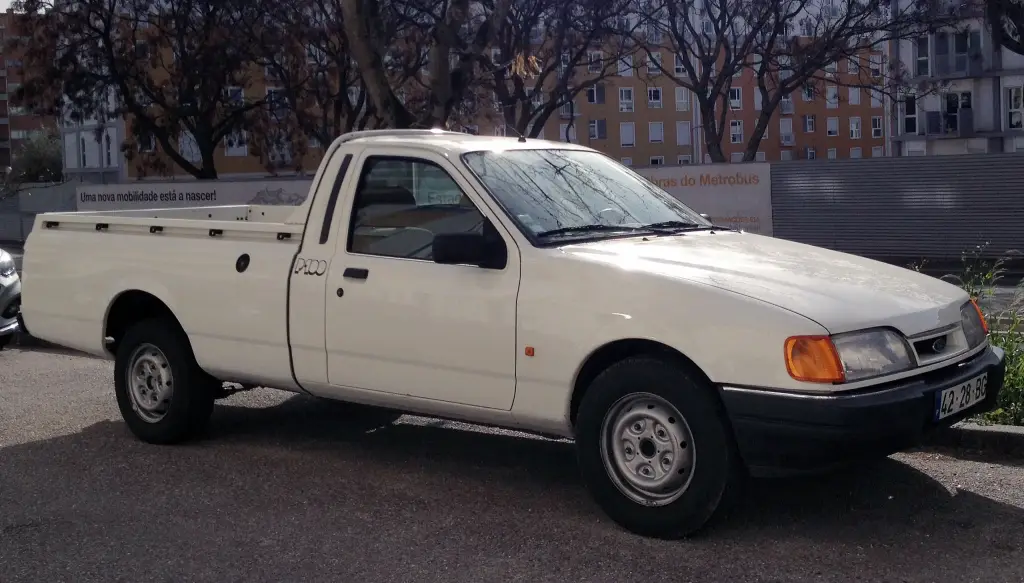
In late 1987, for the 1988 model year, the P100 was given a new cab based on the Sierra, and it was now built in Portugal for Europe to a design set out by Ford UK. Engines were the Sierra’s 2.0-litre Pinto petrol unit and, soon after, a 1.8-litre turbo diesel; the petrol engine was a low-compression version of the 205-block Pinto, the same block on which the turbocharged Cosworth engine was based, with a single-choke carburettor raising torque while lowering maximum power to 74 PS. It sold strongly, especially in Britain, and production ended in 1995. Turkey’s Otosan also built a P100 from 1991 to 1996 on the Taunus TC, with a separate bed and the shorter doors of the four-door sedan.
Design and features
- Passenger-car pickup: built on Cortina, Taunus and Sierra mechanicals.
- South African origin: built there from 1971 and exported to Europe from 1982.
- Portuguese production: the Sierra-based cars were made for the European market.
- Low-compression Pinto: more torque and 74 PS in the later petrol version.
Ford P100 versions
- Cortina Pickup (1971–1977): the original South African model.
- Taunus TC2-based P100 (1977): new cab with the four-door’s front doors.
- Mk V-based P100 (1980–1988): the last Cortina-shaped version.
- Hi cap (1986): taller roof and more upright windscreen.
- Sierra-based P100 (1988–1995): Portuguese-built, 2.0 petrol or 1.8 turbodiesel.
- Otosan P100: Turkish-built version on the Taunus TC.
The P100 was built on the Cortina and later the Sierra. More Ford vehicles are in the Ford collection.
Sources
- Ford P100, English Wikipedia: origins, changes, European export, Sierra version