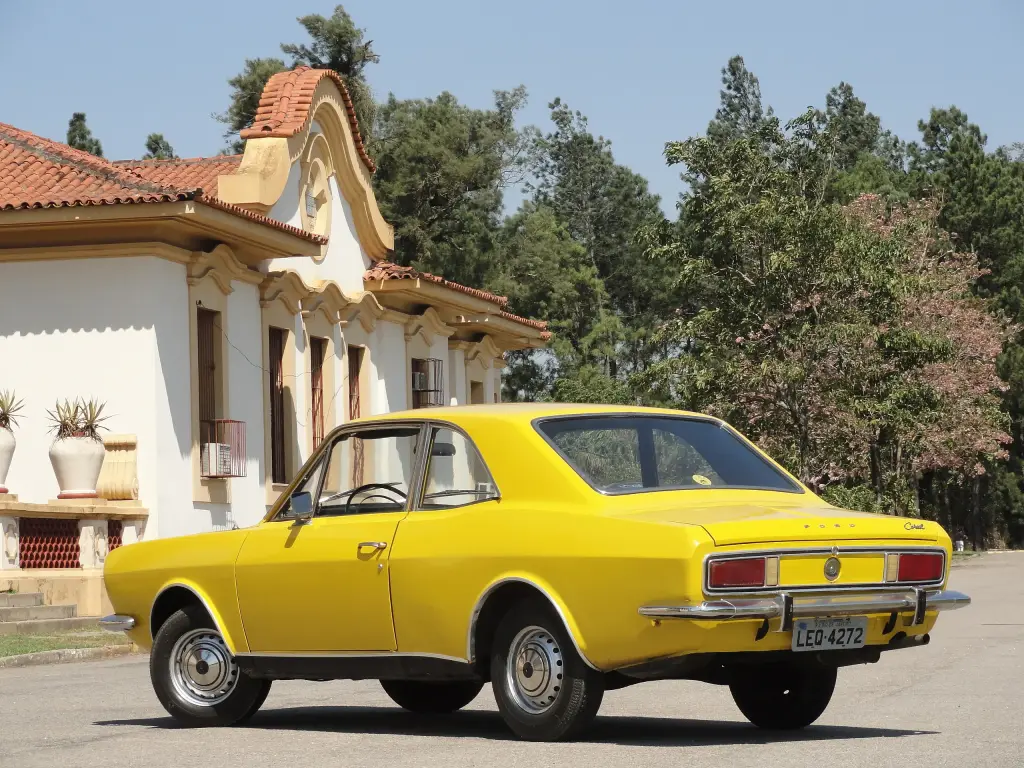
The Ford Corcel was a family car sold by Ford do Brasil in Brazil, Chile, Uruguay, Paraguay and Venezuela. Its engineering came from Renault, through the Willys operations that Ford bought in 1967, and it was the basis of the Belina estate, the Del Rey and the Pampa pickup.
Ford Corcel at a glance
| Maker | Ford do Brasil |
|---|---|
| Production | 1968 – early 1980s |
| Also sold in | Chile, Uruguay, Paraguay, Venezuela |
| Origin | Renault 12 project inherited from Willys do Brasil |
| First engine | 1,289 cc four, 68 hp |
| First body | four-door saloon, coupé from 1969 |
| Estate | Belina, from March 1970 |
| Sport version | Corcel GT, 80 hp |
| Second generation | Corcel II, for the 1978 model year |
| Derivatives | Del Rey (1981), Pampa pickup (1982) |
This page is based on English Wikipedia only.
History of the Ford Corcel
A Renault in Ford clothing
Willys-Overland’s Brazilian operation built the Renault Dauphine under licence and was planning a new car based on the upcoming Renault 12, internally called Project M. When Ford do Brasil bought Willys do Brasil in 1967 it inherited the project, which is why the Corcel reached the market almost two years before the Renault 12 itself. The first Brazilian-built Corcel appeared in 1968 as a four-door saloon, with a 1,289 cc overhead-valve “Cléon” engine of 68 hp and a compression ratio lowered to 8:1 so it could run on 70-octane petrol. A coupé followed in 1969 and quickly became the best-selling version, and the three-door Belina estate arrived in March 1970.
Recalls, GTs and rallies
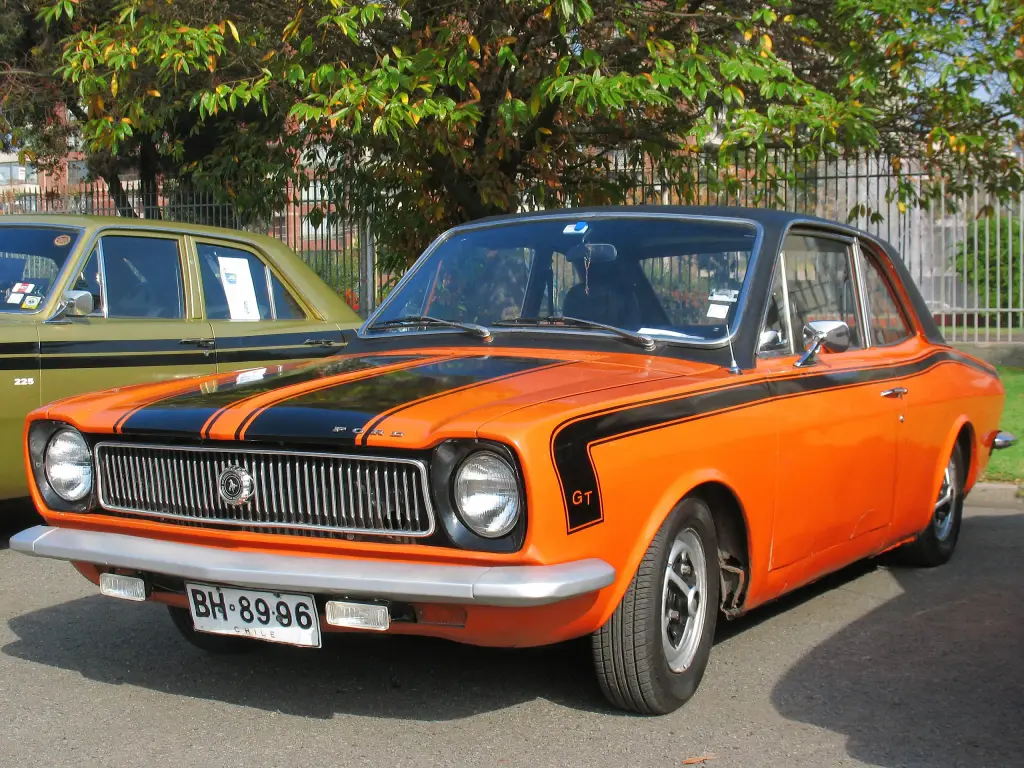
The early cars suffered serious quality problems and sales fell until a new head of Ford do Brasil, Joseph W. O’Neill, ordered improvements in 1970. In what was Brazil’s first automotive recall, 65,000 owners were contacted and repairs made free of charge, and the Corcel became Ford’s best seller again in 1971. The L and GT models were added that year, the GT using a twin-choke carburettor for 80 hp and 141 km/h. Facelifts came in 1973 and 1975, the later cars borrowing styling cues from the Maverick and gaining a 1.4-litre engine. Corcel GTs did well in Brazilian street-car championships at Tarumã, Interlagos and on the beaches, and the stress of racing exposed a weak front universal joint, which was replaced by constant-velocity joints in 1976.
The Corcel II and its family
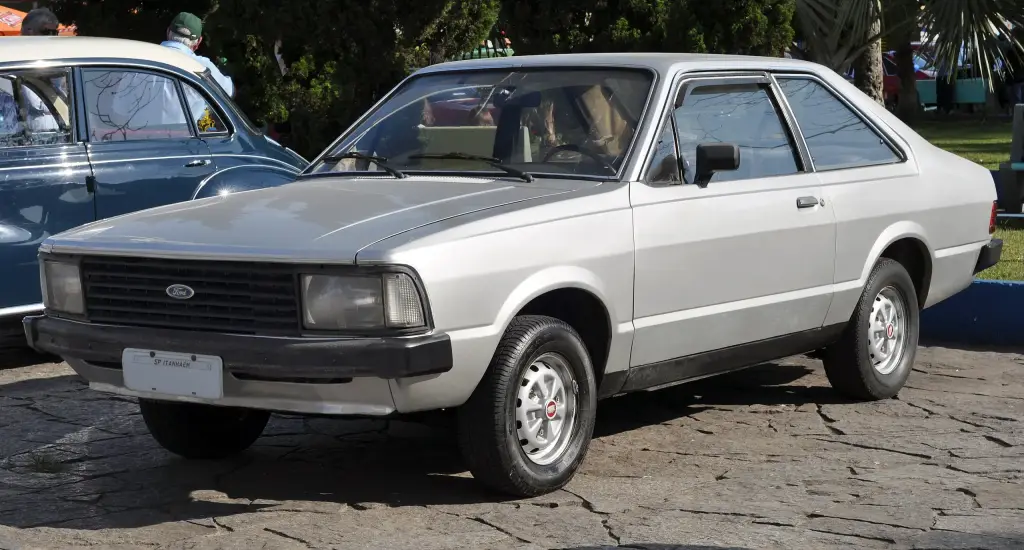
For the 1978 model year Ford launched the Corcel II with a completely new, straight-lined body in place of the pony-car styling of the original, while the Belina estate changed with it and the four-door saloon was dropped. The same platform produced the Del Rey of 1981, with a more upright roof and four doors, and in 1982 the Pampa pickup, which borrowed the shorter front doors of the four-door Del Rey. The Corcel was eventually replaced by the Del Rey, which had begun life as a better-equipped version of it.
Design and features
- Renault engineering: front-wheel drive and the Cléon engine from the Renault 12 project.
- Brazilian-only body: French-influenced styling unique to the market until 1977.
- Belina estate: the three-door wagon that outsold the saloon for years.
- Racing success: the GT was a regular winner in Brazilian street-car championships.
Ford Corcel versions
- Corcel saloon (1968): the original four-door.
- Corcel coupé (1969): the fastest-selling body style.
- Belina (1970): the three-door estate.
- Corcel GT (1971): twin-carburettor engine with 80 hp.
- Corcel II (1978): the second generation with straight lines.
- Del Rey and Pampa: later models built on the same platform.
The Corcel’s platform later produced the Pampa pickup, and its wagon was the Belina. More Ford vehicles are in the Ford collection.
Sources
- Ford Corcel, English Wikipedia: origins, models, engines, racing, successors