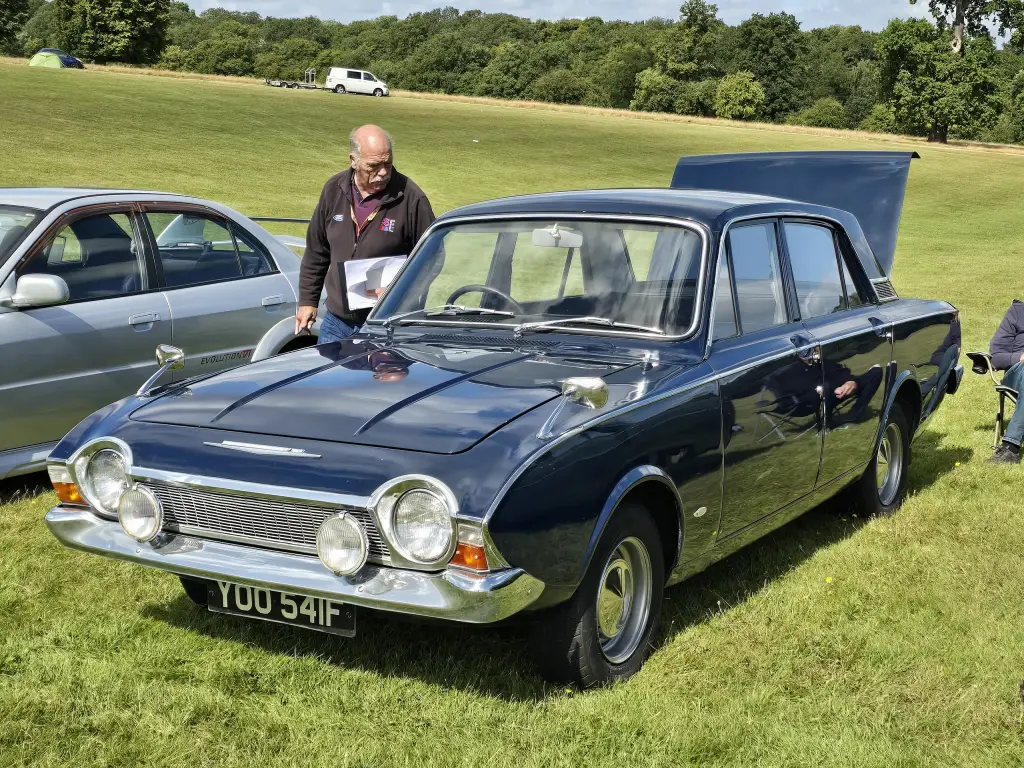
The Ford Corsair was a mid-sized car built by Ford of Britain between 1963 and 1970. Introduced as the Consul Corsair at the London Motor Show in October 1963, it was essentially a long-wheelbase Cortina with more soundproofing and better seats, and it replaced the Consul Classic range.
Ford Corsair at a glance
| Maker | Ford of Britain |
|---|---|
| Production | 1963–1970 |
| Debut | London Motor Show, October 1963 |
| Bodies | saloon, estate, and Crayford convertibles |
| Design team | Roy Brown Jr., styling by Charles Thompson, engineering by Fred Hart |
| First engines | 1.5 L Kent four, 60 or 78 bhp |
| From 1965 | 1.7 and 2.0 L Essex V4 |
| Top of range | 2000E from 1967, £1,008 |
| Estate | by Abbott, from March 1966 |
| Performance | 110 mph in the 2.0 L V4 |
| Total built | about 310,000 |
| Replaced by | Cortina Mk III |
This page is based on English Wikipedia only.
History of the Ford Corsair
A Cortina with a longer stride
The Corsair was designed by the same team as the Mk I Cortina: Roy Brown Jr. oversaw Charles Thompson’s styling and Fred Hart the engineering. It shared the Cortina’s windscreen, side windows, mechanical components and most internal panels, but had a longer wheelbase, extra soundproofing and more comfortable seating for fast long-distance driving. Its most striking feature was a sharp horizontal V-shaped crease across the nose with round headlights set into it, a shape that made the 1500 version faster than the equivalent Cortina despite being larger and heavier. At the rear, pointed vertical light clusters hinted at fins. The whole production run was a single Mark, with changes confined to the interior, engines and mechanicals.
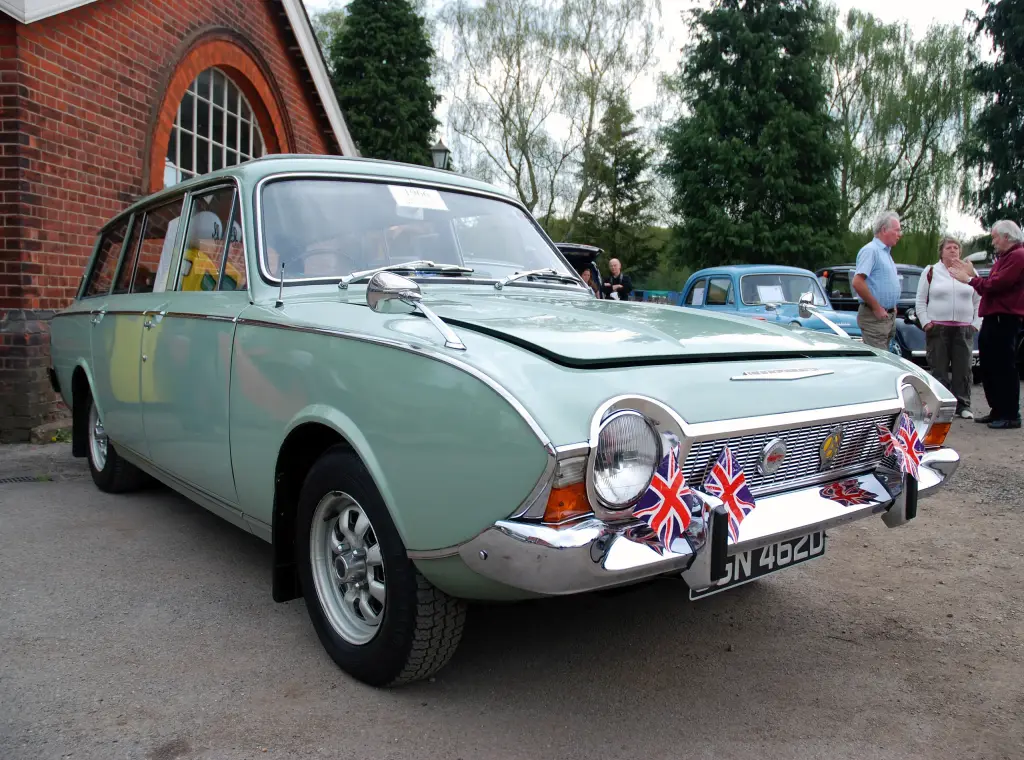
Four cylinders, then V4s
The Corsair Deluxe started with the 60 bhp 1.5-litre Kent engine and the GT with the 78 bhp unit from the Cortina GT. A 1500 GT also took 15 International class G world endurance records at Monza in 1964. In September 1965 the range was revised with a better dashboard and interior ventilation but also new Essex V4 engines, made in 1.7 litres for the V4 Deluxe and 2.0 litres for the V4 GT. The V4s were rough at idle and coarse on the road and sales began to fall; the advertising called the car “The Car That Is Seen But Not Heard”. A much improved 2.0-litre engine arrived in January 1967 and the V4 GT was replaced by the 2000E in April.
The 2000E and the end
The 2000E of 1967 had dechromed flanks, non-styled door handles, special wheel trims, reversing lights, a vinyl roof and a polished wood dashboard; at £1,008 it undercut the Rover 2000 and the Humber Sceptre. An Abbott estate had joined the range in March 1966, and Crayford Engineering built rare convertibles, including only 18 four-seat cabriolets using Karl Deutsch technology. The Corsair was replaced by the Mk III Cortina in 1970, once the enlarged Cortina had become Ford’s mid-sized car, with the Escort below it and the Capri taking over the sporting role. About 310,000 Corsairs were built in six years.
Design and features
- Distinctive nose: a V-shaped crease with inset round headlights.
- Cortina underneath: shared glass, mechanics and inner panels.
- Essex V4 engines: 1.7 and 2.0 litres from 1965.
- 2000E trim: the executive version with a wood dashboard and vinyl roof.
Ford Corsair versions
- Consul Corsair (1963–1965): 1.5-litre Kent engines, Deluxe and GT.
- Corsair V4 (1965–1970): 1.7 and 2.0 Essex V4 engines.
- 2000E (1967–1970): the executive model.
- Abbott estate (1966): the factory-approved wagon.
- Crayford convertibles: rare five-seat and four-seat cabriolet conversions.
The Corsair was a close relative of the Cortina and replaced the Consul Classic range. More Ford vehicles are in the Ford collection.
Sources
- Ford Corsair, English Wikipedia: design, engines, 2000E, production