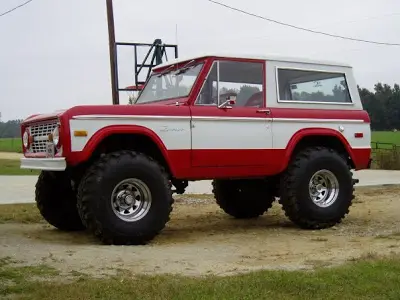
The Ford Bronco was the company’s first SUV, sold over five generations from 1966 to 1996 and revived in 2021 after a 25-year break. The original was a compact off-roader on its own chassis, aimed squarely at the Jeep CJ-5 and the International Scout.
Ford Bronco at a glance
| Maker | Ford, Michigan Truck Plant, Wayne, Michigan |
|---|---|
| Model years | 1966–1996, then from 2021 |
| Generations | five, 1966–1996; a sixth from 2021 |
| First-generation wheelbase | 92 in (2,337 mm) |
| Chassis | body-on-frame, built for the Bronco alone |
| Drive | four-wheel drive on every first-generation car |
| Launch engine | 170 cu in six, 105 hp |
| V8 option | 289 cu in, 200 hp, from March 1966 |
| Later V8 | 302 cu in from 1969 |
| Gearbox | three-speed manual, automatic from 1973 |
| First-year price | US$2,194 |
| Replaced by | Ford Expedition |
This page is based on English Wikipedia only.
History of the Ford Bronco
The idea and the first car
The Bronco began with Ford product manager Donald N. Frey, who had also conceived the Mustang, and was engineered by Paul G. Axelrad; Lee Iacocca approved it for production in February 1964 after the first clay models of mid-1963. It was developed as an off-road vehicle to fight the Jeep CJ-5, International Scout and Toyota Land Cruiser. The first-generation Bronco used a chassis developed only for it, with box-section body-on-frame construction on a 92-inch wheelbase, a Dana 20 transfer case and locking hubs, a Ford 9-inch rear axle and a coil-sprung front axle located by radius arms.
Simplicity first
At its launch in August 1965 the Bronco came with a 170 cu in six of 105 hp derived from the Falcon, and from March 1966 a 200 hp 289 cu in V8 was optional; for 1969 the V8 grew to 302 cu in. All cars had a three-speed column-shift manual until a three-speed automatic became an option in 1973. Styling was subordinated to simplicity: flat glass, straight C-section bumpers and symmetrical door skins. Three bodies were offered — a two-door wagon, a half-cab pickup and an open roadster — at a base price of US$2,194, with a long options list including a winch, snowplough and posthole digger.
Bigger and then gone
For 1978 Ford enlarged the Bronco into a short-wheelbase version of the F-Series, putting it against the Chevrolet K5 Blazer and Dodge Ramcharger. Demand for large two-door SUVs later fell, and the Bronco was dropped after 1996 and replaced by the four-door Expedition, with the larger Excursion following. The name returned in 2021 on a mid-size two-door and a longer four-door model aimed at the Jeep Wrangler.
Design and features
- Purpose-built chassis: the first Bronco shared its frame with no other Ford.
- Four-wheel drive as standard: every first-generation car had it.
- Three body styles: wagon, half-cab pickup and roadster.
- Long options list: from bucket seats to a power take-off and a snowplough.
Ford Bronco versions
- Wagon: the closed two-door that became the mainstay.
- Half-cab pickup: dropped after 1972.
- Roadster: the open body, withdrawn after 1968.
- Bronco Sport: a trim package from 1967, a stand-alone model from 1970.
- Full-size Bronco (1978–1996): built on a shortened F-Series chassis.
The Bronco was replaced by the Excursion in Ford’s range after the larger Expedition arrived, and it shared its later chassis with the F-Series. More Ford vehicles are in the Ford collection.
Sources
- Ford Bronco, English Wikipedia: generations, first-generation chassis and engines