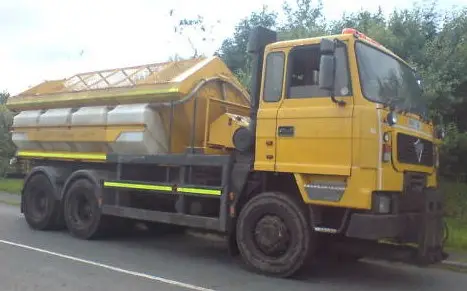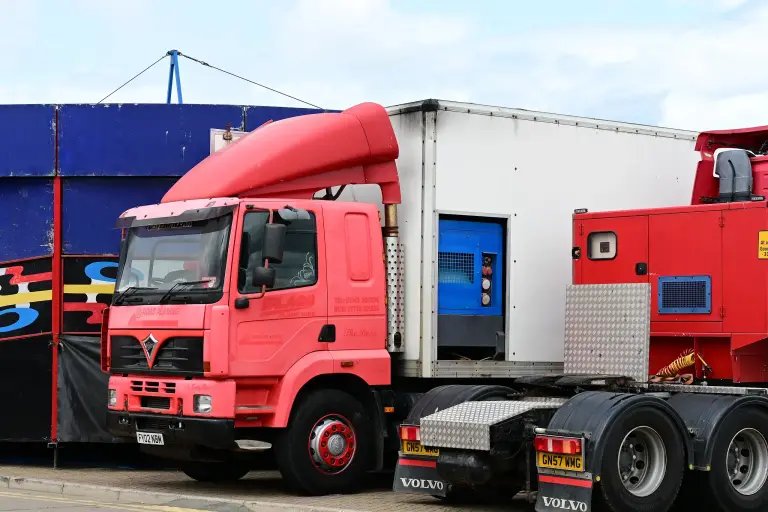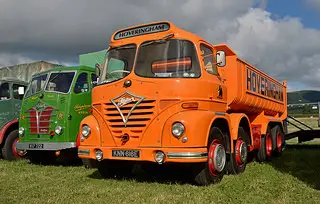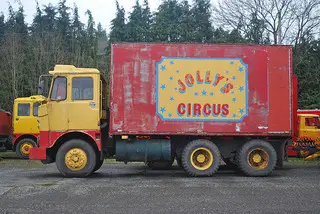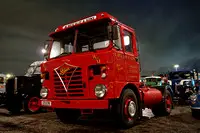
The Foden S80 was a heavy lorry of the company’s final independent years. Foden’s own two-stroke diesel, the FD6, remained standard in certain heavy models until 1977, when it was replaced in the range by the Fleetmaster and Haulmaster, the first Foden heavy lorries to rely on Cummins and Rolls-Royce engines.
Foden S80 at a glance
| Model | Foden S80 heavy lorry |
|---|---|
| Maker | Foden, Elworth near Sandbach, Cheshire, England |
| Own engine | Foden FD6 two-stroke diesel, 4.1 litres, 126 bhp |
| FD6 in service | standard in certain Foden heavy lorries until 1977 |
| New generation of 1977 | Fleetmaster with Cummins or Rolls-Royce engines |
| Haulmaster | offered with Cummins engines only |
| New factory | opened in 1974 |
| Workforce | over 2,100 in 1961 |
| Ownership | Paccar from 1980 |
| Marque | Foden, founded 1856; name dropped in 2006 |
based on one source: no dedicated page for the S80 exists; the article describes the heavy lorries of its years from the Foden company history.
History of the Foden S80
The two-stroke years
Foden began making its own engines in 1948, with the FD6 two-stroke diesel of 4.1 litres and 126 bhp. The two-stroke remained characteristic of the company’s lorries until production stopped in 1977, and in certain heavy models it was the standard engine right to the end. Foden had also become a leading maker of tipper bodies after a large order from the Steel Company of Wales in 1947, and by 1961 it employed more than 2,100 people.
The 1977 generation
Foden opened a new production site in 1974. In 1977 it introduced a new generation of heavy lorries: the Fleetmaster, with Cummins or Rolls-Royce engines, and the Haulmaster, sold with Cummins engines only. The company’s own two-stroke went out of production in the same year.
The collapse
Large investment and poor sales drove Foden into bankruptcy in 1979. The new factory, the development of the unsuccessful Foden NC double-decker bus and the launch of the 1977 range during the depression that followed the 1973 oil crisis all contributed, and the company needed state aid. It returned to profit in 1978–79 thanks to defence orders worth about £10 million placed in 1973. Paccar bought Foden in 1980.
Design and features
- Foden’s own diesel: the FD6 two-stroke, standard in certain heavy models until 1977.
- The last independent generation: the 1977 Fleetmaster and Haulmaster replaced it with bought-in engines.
- Engine choice: Cummins or Rolls-Royce in the Fleetmaster, Cummins only in the Haulmaster.
- A big works: a new production site opened in 1974, with more than 2,100 employees back in 1961.
Foden S80 versions
- FD6-engined heavy lorries: the two-stroke generation, built until 1977.
- Fleetmaster (1977): Cummins or Rolls-Royce engines.
- Haulmaster (1977): Cummins engines only.
- Tipper chassis: Foden’s large-capacity tippers, built after the 1947 Steel Company of Wales order.
The S80’s cab generation is described in Foden S83, and the earlier heavy eight-wheelers in Foden S39. More Foden lorries are in the Foden collection.
Video: FODEN S80 14 LITRE CUMMINS
Video on YouTube.
Sources
- Foden Trucks, English Wikipedia: FD6, Fleetmaster and Haulmaster
- Foden, German Wikipedia: FD6 output, 1974 factory, 1979 bankruptcy