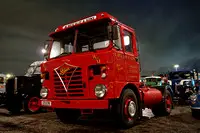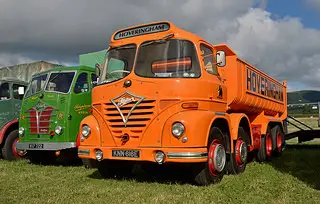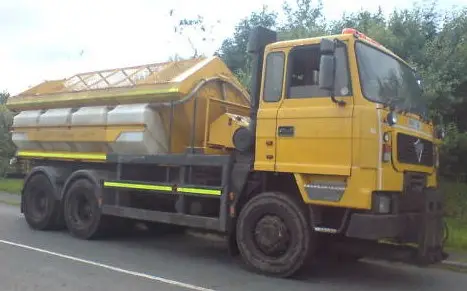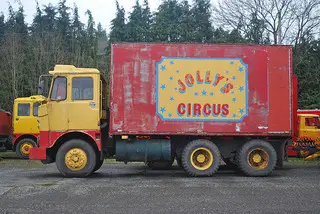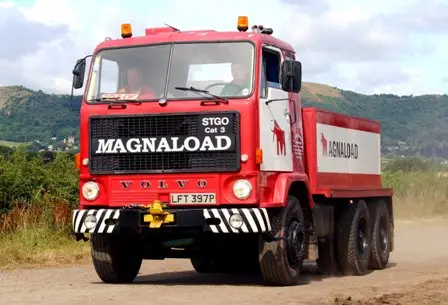
The Foden S20 was the company’s traditional metal-and-wood cab, introduced in 1956. In Foden’s naming the S number identified the cab rather than the engine or the weight class, and the S20 stayed in use long after the glass-reinforced plastic cabs that followed it.
Foden S20 at a glance
| Model | Foden S20 lorry |
|---|---|
| Maker | Foden, Elworth near Sandbach, Cheshire, England |
| Cab introduced | 1956 |
| Cab construction | metal and wood |
| In use on lorries | until at least 1963 |
| On special vehicles | until 1968 |
| Naming | the S number denotes the cab, not the engine or the weight |
| GRP cab that followed | S21, first Foden glass-reinforced plastic cab, 1958 |
| First British mass-produced tilt cab | Foden S24, 1962 |
| Marque | Foden, founded 1856; name dropped in 2006 |
based on one source: no dedicated page for the S20 exists, so the article is built on the Foden company history, which records the cab’s dates.
History of the Foden S20
The last of the traditional cabs
The S20 was introduced in 1956 and was built in the traditional way, from metal and wood. It was still fitted to many Foden lorries until at least 1963, and after that it continued on special vehicles until 1968 — a decade after a more modern cab had appeared in the range.
Plastic takes over
In 1958 Foden introduced glass-reinforced plastic into cab production. The first GRP cab was the distinctively styled S21, nicknamed “Spaceship” and “Sputnik” by the commercial vehicle press but better known as the “Mickey Mouse” cab. The GRP tilt cab that followed in 1962, designated S24, was the first British-built, mass-produced tilting cab; S21 production continued until 1969.
The company behind the cab
Foden’s origins were at Elworth near Sandbach in 1856, when Edwin Foden became an apprentice at the agricultural equipment maker Plant & Hancock; the business was renamed Edwin Foden Sons & Co. Ltd. in 1876. It built steam wagons from the 1890s, moved to diesel with the F1 of 1931, and after the Second World War introduced the FE and FG lorry ranges of 1948 together with its own FD6 two-stroke diesel. Paccar bought the company in 1980, and the Foden name was dropped in 2006.
Design and features
- Metal and wood: the S20 was built in the traditional materials, not in glass-reinforced plastic.
- A long life: still on many lorries in 1963 and on special vehicles until 1968.
- Cab-based naming: the S number told buyers which cab they were getting, not which engine.
- Two generations side by side: the S20 overlapped the GRP S21 of 1958 and the tilting S24 of 1962.
Foden S20 versions
- S20 cab (1956): the standard metal-and-wood cab.
- Special-vehicle S20s: the cab remained available for special vehicles until 1968.
- S21 cab (1958): the first Foden cab in glass-reinforced plastic, the “Mickey Mouse”.
- S24 cab (1962): the first British mass-produced tilting cab.
The cab that replaced it in the range was the S21 and the GRP generation, and the earlier cab-numbering system is described in the Foden S10 article. More Foden lorries are in the Foden collection.
Video: FODEN S20 – In Cab Ride – Top Gear Road Run 2014
Video on YouTube.
Sources
- Foden Trucks, English Wikipedia: the S20 and S21 cab dates, the S24 tilt cab
- Foden, German Wikipedia: company history, diesel and Paccar years