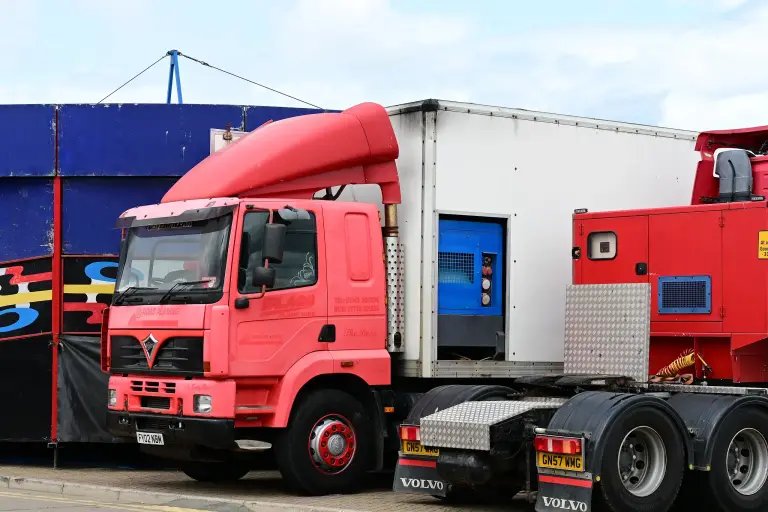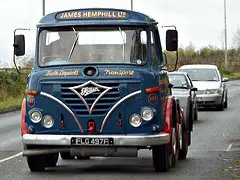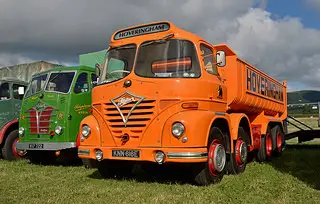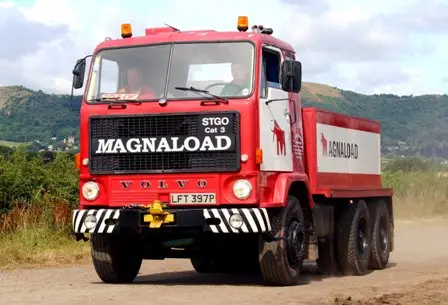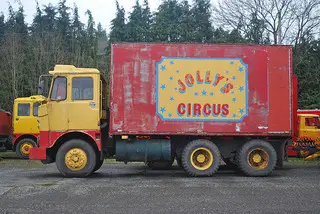
The Foden S83 dates from the years when Foden passed into American hands. The company went bankrupt in 1979, returned to profit with defence work, and was bought by Paccar in 1980; lorry production restarted in 1981 at a low level, concentrated on four-axle models, and the company took the name Foden Trucks in 1983.
Foden S83 at a glance
| Model | Foden S83 heavy lorry |
|---|---|
| Maker | Foden, Elworth near Sandbach, Cheshire, England |
| 1977 range | Fleetmaster with Cummins or Rolls-Royce, Haulmaster with Cummins |
| 1979 | bankruptcy after large investment and poor sales |
| Causes | new factory, the failed NC double-decker bus, the 1977 range in the post-oil-crisis slump |
| State aid | taken by the company before the takeover |
| Return to profit | 1978–79 on defence orders of about £10 million placed in 1973 |
| 1980 | bought by Paccar; company renamed Sandbach Engineering Company |
| 1981 | lorry production restarted at a low level, focused on four-axle models |
| 1983 | the company became Foden Trucks |
| Marque | name dropped in 2006 |
based on one source: no dedicated page for the S83 exists; the article describes the marque in its years from the Foden company history.
History of the Foden S83
Why Foden failed in 1979
Larger investment and poor sales took Foden into bankruptcy in 1979. The building of a new production site, the development of the ultimately unsuccessful Foden NC double-decker bus and the launch of the new lorry range in 1977, during the depression caused by the 1973 oil crisis, all pushed the company into difficulty. Foden had to take state aid. It was profitable again in 1978–79 thanks to defence orders worth about £10 million that had been won in 1973.
Paccar takes over
In 1980 Foden was acquired by Paccar and the company was renamed Sandbach Engineering Company. Lorry production restarted in 1981 at a low level, with attention concentrated on four-axle models. From 1983 the company was called Foden Trucks.
A reduced marque
The new owner kept the name alive but the volumes were small: 423 lorries were built in 1998 and 1,123 in 1999. Production at Foden ended in 1999; until 2006 Foden models were built at the Leyland plant, also part of Paccar, and by then they were badge-engineered DAF models. Low demand ended the Foden name in 2006.
Design and features
- The 1977 generation: the Fleetmaster and Haulmaster brought Cummins and Rolls-Royce power.
- A hard decade: the new factory, the NC bus and the oil-crisis slump combined against the company.
- American ownership: Paccar bought Foden in 1980 and renamed it Sandbach Engineering.
- Four-axle focus: when production restarted in 1981 it was concentrated on four-axle models.
Foden S83 versions
- Fleetmaster (1977): Cummins or Rolls-Royce engines.
- Haulmaster (1977): Cummins engines only.
- Four-axle models (from 1981): the focus of production under Paccar.
- Foden NC: the double-decker bus whose development contributed to the 1979 collapse.
The two-stroke generation that preceded it is described in Foden S80, and the marque’s last years in Foden Alpha. More Foden lorries are in the Foden collection.
Video: foden s83 Rolls 265
Video on YouTube.
Sources
- Foden Trucks, English Wikipedia: 1979 collapse, Paccar, 1981 restart
- Foden, German Wikipedia: Sandbach Engineering, 1998–99 output, Leyland and DAF years