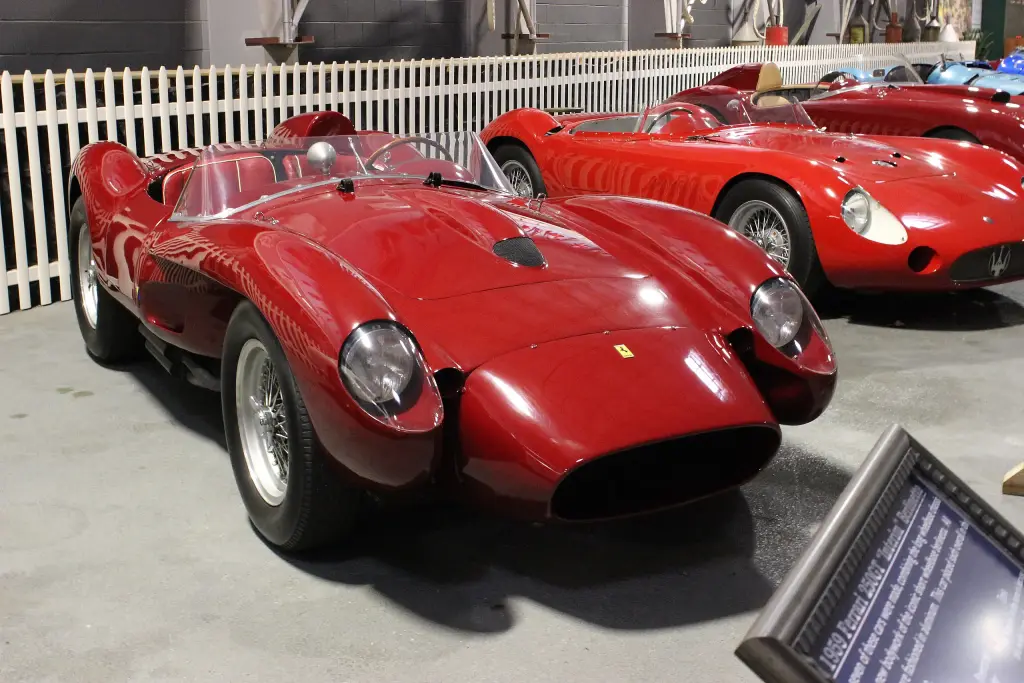
The Ferrari 250 Testa Rossa, or 250 TR, is a sports racing car built by Ferrari from 1957 to 1961. It was introduced at the end of the 1957 season in response to rules limiting engine displacement to three litres, and it won the 24 Hours of Le Mans three times.
Ferrari 250 Testa Rossa at a glance
| Production | 1957–1962 (racing through 1962) |
|---|---|
| Built | 33 of all types, including 19 customer cars |
| Engine | Tipo 128, 3.0 L (2,953 cc) Colombo V12 |
| Bore × stroke | 73 × 58.8 mm |
| Carburettors | six Weber 38 DCN |
| Power | 300 hp (220 kW) at 7,000 rpm |
| Specific output | 100 hp per litre |
| Gearbox | four-speed (to 1958), five-speed from 1959 |
| Chassis | tubular steel spaceframe |
| Wheelbase | 2.35 m, 10 cm longer than the 500 TR |
| Le Mans wins | 1958, 1960, 1961 |
| Sebring wins | 1958, 1959, 1961 |
based on one source (English Wikipedia).
History of the Ferrari 250 Testa Rossa
The 250 Testa Rossa was developed for the 1957 World Sportscar Championship in response to rule changes planned for 1958 that would cap engine displacement at three litres. The aim was to improve on the four-cylinder 2.0-litre 500 TR and 500 TRC Testa Rossa by fitting the more powerful Colombo-designed 3.0-litre V12 used in the 250 GT series, together with a better chassis and bodywork. Enzo Ferrari demanded absolute reliability, so the design was deliberately conservative and aimed at endurance rather than outright speed; chief designer Carlo Chiti’s continual experimentation balanced that conservatism and produced the revisions that kept the car competitive into 1962. Giotto Bizzarrini helped with aerodynamic improvements for 1961, and Andrea Fraschetti helped develop the first prototype before his death in a test drive in 1957.
The engine and the name
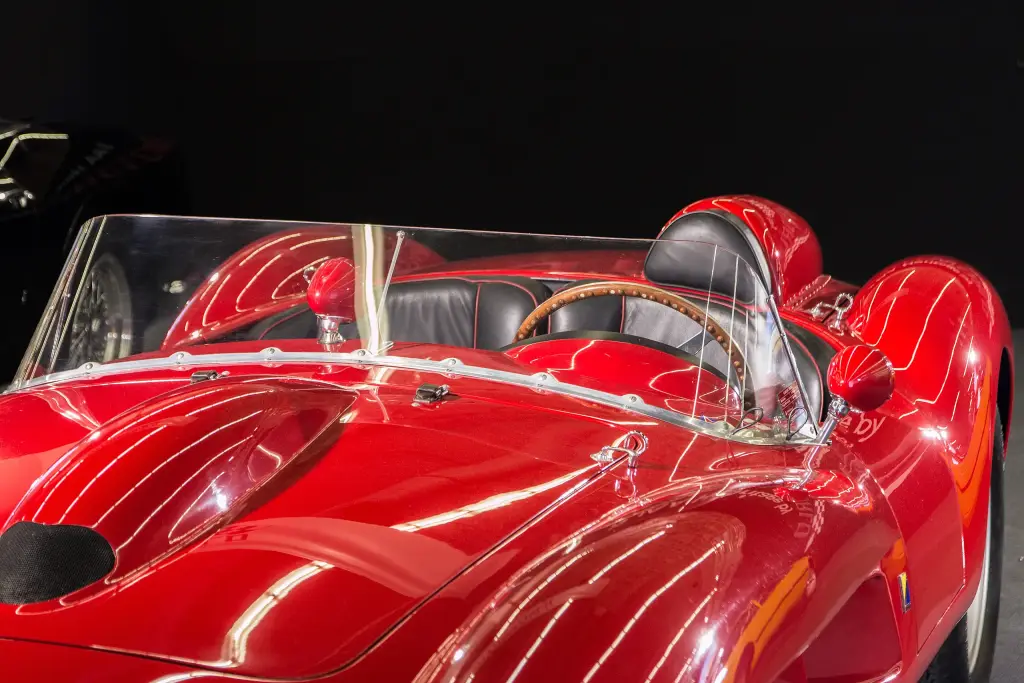
The engine began as the 1953-style 250 block of 2,953 cc with a 73 mm bore and 58.8 mm stroke, but gained six two-barrel Weber 38 DCN carburettors instead of the three typical of 250 GT engines. The cylinder heads used single overhead cams, two valves per cylinder and helical double-coil valve springs — a first for Ferrari. The smaller springs allowed stronger heads fastened with 24 studs instead of 18, improving head gasket sealing, and the spark plugs moved outside the vee between the exhaust ports for better combustion. Connecting rods were machined from steel billet rather than forged. The cam covers were painted bright red, which gave the car its name: Testa Rossa, literally “red head”, a tradition begun with the 500 TR. Designated Tipo 128, the engine produced 300 hp at 7,000 rpm, a specific output of 100 hp per litre of which Ferrari was particularly proud.
Chassis and running gear
The 250 TR used a tubular steel spaceframe similar to the 500 TR’s, with the wheelbase stretched by 10 cm to 2.35 metres, and earned a reputation for durability. All cars had independent front suspension with coil springs; customer cars had live rear axles, pre-1960 works cars used live or de Dion axles, and the 1960 250 TRI60 and 1961 250 TRI61 had independent rear suspension. The 1957 and 1958 cars had drum brakes all round because Enzo Ferrari believed they faded more predictably than the new disc brakes. Customer cars wore Scaglietti “pontoon fender” bodies and left-hand drive, and did not benefit from the works team’s continual improvements, although many privateers modified them or bought ex-Scuderia cars to stay competitive.
Racing record
The 250 TR and its variants won ten World Sports Car Championship races, including Le Mans in 1958, 1960 and 1961, Sebring in 1958, 1959 and 1961, the Targa Florio in 1958, the 1000 km Buenos Aires in 1958 and 1960 and the Pescara 4 Hours in 1961. Those results gave Ferrari the constructors’ title in 1958, 1960 and 1961. The same basic engine went on to win in the 250 GTO and 250 P well into the 1960s, long after the 250 TR chassis was obsolete.
Design and features
- Red cam covers: the painted heads that gave the car its name, a tradition started by the 500 TR.
- 100 hp per litre: 300 hp from three litres, a figure Ferrari used to show what it could do within a displacement limit.
- Endurance engineering: helical valve springs, 24-stud heads and billet con-rods built for reliability rather than peak power.
- Spaceframe chassis: a stiff tubular frame with a longer wheelbase than the 500 TR.
- Customer cars: 19 of the 33 built were sold to private teams with Scaglietti pontoon-fender bodies.
Ferrari 250 Testa Rossa versions
- 250 TR (1957–1958): the original drum-braked car with a four-speed gearbox.
- 250 TRI60 (1960): works car with independent rear suspension.
- 250 TRI61 (1961): further developed works car with revised aerodynamics.
- Customer 250 TR: 19 cars with Scaglietti bodies and live rear axles.
The Testa Rossa was part of the 250 series, and its engine went into the 250 GTO and the mid-engined 250 LM.
Sources
- Ferrari 250 Testa Rossa, English Wikipedia: engine, chassis, production, racing record