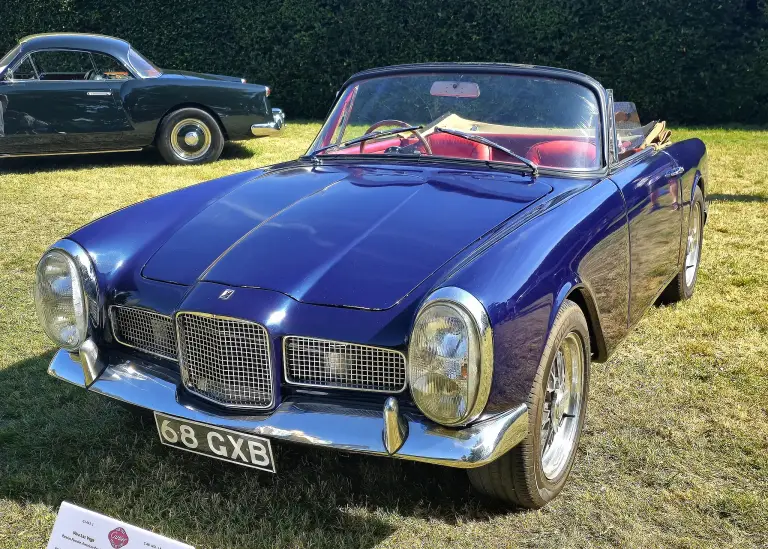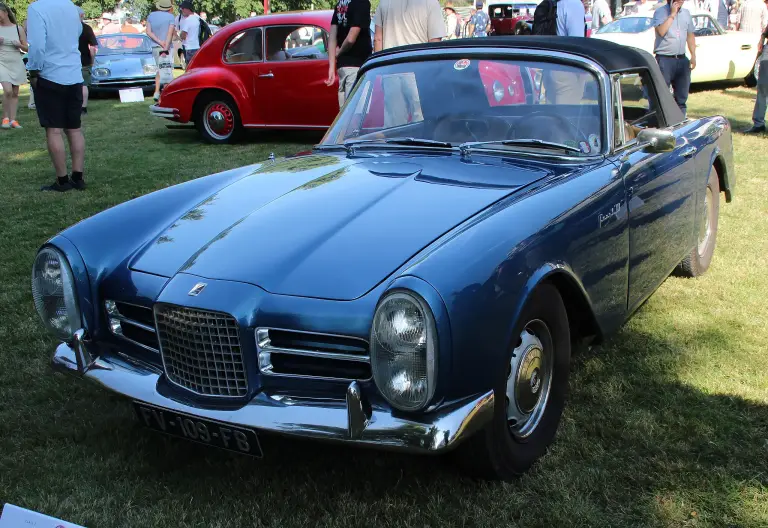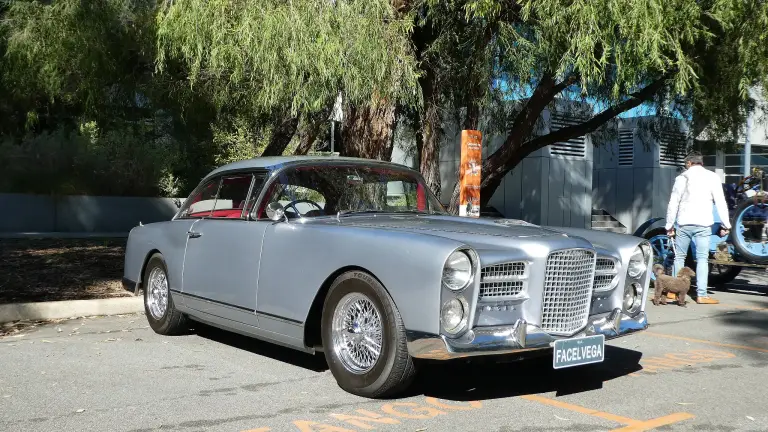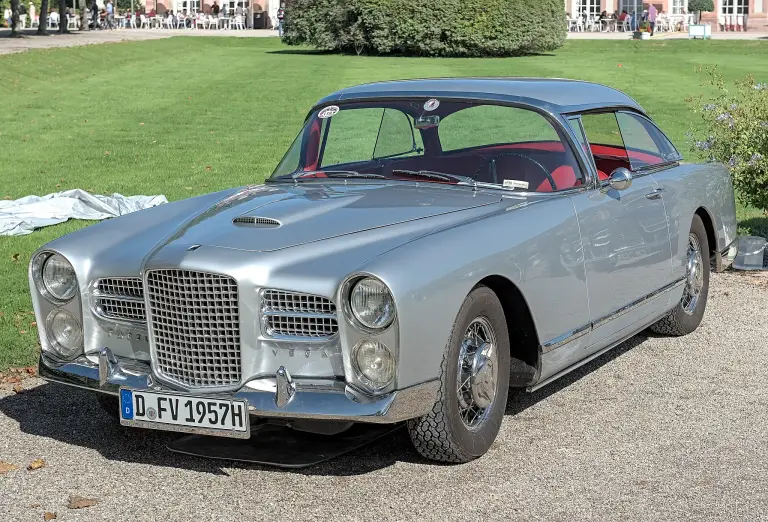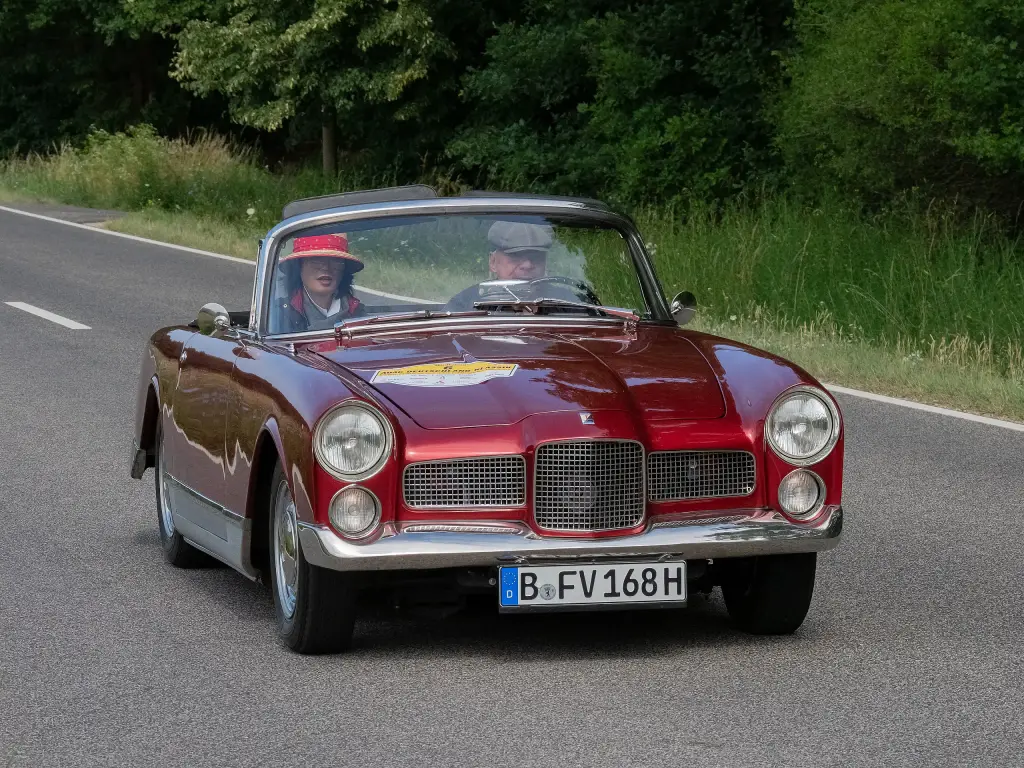
The Facel Vega Facellia was Jean Daninos’s attempt to build a smaller, more affordable sports car to compete with Alfa Romeo, Porsche and Triumph. Presented in September 1959 and homologated in March 1960, it used a 1.6-litre four-cylinder engine of Facel’s own design. Early cars suffered repeated engine failures, and the cost of honouring the warranties helped to bring the company down.
Facel Vega Facellia at a glance
| Maker | Facel S.A., Colombes |
|---|---|
| Production | 1960–1963 |
| Type | FA, later F2, F2B |
| Class | sports car |
| Engine | 1.6-litre four-cylinder, twin overhead camshafts |
| Power | 115 hp at 6,400 rpm; 105 hp from 1961; 126 hp in the F2S |
| Transmission | four-speed manual |
| Chassis | tubular frame with welded steel shell |
| Brakes | Dunlop discs |
| Body styles | cabriolet, four-seat coupé, 2+2 coupé |
| Top speed | 194 km/h in the F2S |
The English material is the general Facel Vega page; most detail comes from the dedicated French article.
History of the Facel Vega Facellia
Origins
Jean Daninos wanted a smaller model that could take on the Alfa Romeo, Porsche and Triumph sports cars that dominated the medium-capacity market. The project began in 1957, and the car was presented at the Musée Jacquemart-André in Paris in September 1959, with the British racing driver Stirling Moss, already a Facel customer, as its sponsor. It was one of the main novelties of the October 1959 Paris Salon. Homologation followed in March 1960 and the first deliveries in the summer. The first body style was the cabriolet, followed by a four-seat coupé and a 2+2 coupé whose handsome body looked like a cabriolet with a welded hardtop.
Engineering
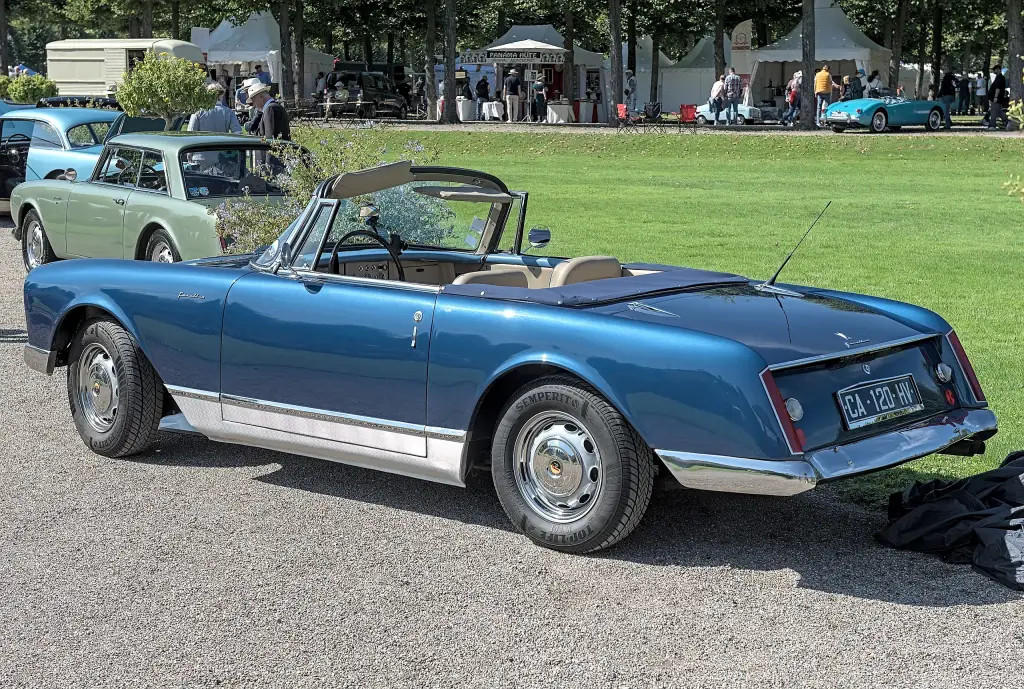
The Facellia followed the layout of the bigger V8 Facels: a tubular chassis, a welded steel shell, independent front suspension, a rigid rear axle and Dunlop disc brakes as standard. Its dimensions were more European than those of its sisters, and steering was by a Gemmer worm-and-roller box. The engine was the novelty. Unable to obtain an import licence for a foreign engine, Facel turned to Pont-à-Mousson, which already supplied gearboxes for the V8 cars and held the design of a 2.8-litre six-cylinder twin-cam engine by the Italian engineer Carlo Marchetti. From it was derived a 1.6-litre four with a cast-iron block and an aluminium twin-cam cylinder head, developing 115 hp at 6,400 rpm.
Engine trouble
The first cars delivered suffered from development problems and repeated engine failures. The factory replaced engines under warranty, a costly operation that strained its finances and damaged the marque’s reputation. A 105 hp version, introduced in September 1961 and made more reliable, could not save the model. In 1961 the Facellia F2 appeared with the engine completely revised by the company Le Moteur Moderne to improve reliability and cooling. Twin headlights were gradually replaced by Marchal Mégalux lamps like those of the Facel II, and the dashboard gained the faux-wood finish of the V8 models instead of leather.
F2B and F2S
At the 1961 Paris Salon came the final evolution, the F2B, with minor changes to the door handles and fuel filler, Marchal Mégalux headlights as standard and a lower compression ratio. The catalogue also mentioned a sharper F2S with two horizontal Weber carburettors, a 9.6:1 compression ratio, 126 hp and plexiglass headlamp covers, giving 194 km/h. Although it was announced to the press, it appears never to have been sold.
Racing, film and owners
The Facellia was the only Facel-Vega to race, and it took some class victories. Maurice Gatsonides and Louis Van Noordwijk drove one in the 1961 Monte Carlo Rally; in June the car led the over-1,600 cc class in the Rallye de Lorraine with Hazard and Loberteau and shortly afterwards in the 1961 Tour de France Automobile with Annie Soisbault and Michèle Cancre. In 1962 Poirot and Hazard finished second in their class in the Monte Carlo Rally. A blue F2B cabriolet appeared in the film OSS 117: Cairo, Nest of Spies, and an F2 coupé in the television series Les Petits Meurtres d’Agatha Christie. Among celebrity owners were Ava Gardner, who had three Facel Vegas, and Jean Marais, who had at least four.
Consequences
The Facellia had been introduced in 1959 in an under-developed state, and the losses caused by its warranty problems could not be recovered. Facel closed its factory in October 1964.
Design and features
- Smaller Facel: European dimensions and a 1.6-litre four instead of the Chrysler V8 of the big models.
- Twin-cam engine: a four-cylinder derived from Carlo Marchetti’s 2.8-litre six, with 115 hp.
- Three body styles: cabriolet first, then four-seat and 2+2 coupés.
- Dunlop disc brakes: fitted as standard, as on the larger Facels.
- Motor sport: class results in the Monte Carlo, Lorraine and Tour de France rallies.
Facel Vega Facellia versions
- Facellia FA (1960): 1.6-litre engine with 115 hp, cabriolet and coupé bodies.
- 105 hp version (1961): detuned and more reliable engine.
- F2 (1961): engine revised by Le Moteur Moderne, Marchal Mégalux headlights, faux-wood dashboard.
- F2B (1961–1963): minor trim changes, Mégalux lamps standard, lower compression.
- F2S: two Weber carburettors, 126 hp and 194 km/h; announced but probably never sold.
The Facellia was the smaller stablemate of the HK500 and the Facel II, and was developed into the Facel III. More cars are in the Facel Vega collection.
Video: 1961 Facel Vega Facellia Convertible – My Car Story with Lou Costabile
Video on YouTube.
Sources
- Facel Vega Facellia, French Wikipedia: origins, engineering, F2/F2B/F2S, racing, cinema, owners
- Facel Vega, English Wikipedia: company history, warranty losses, closure