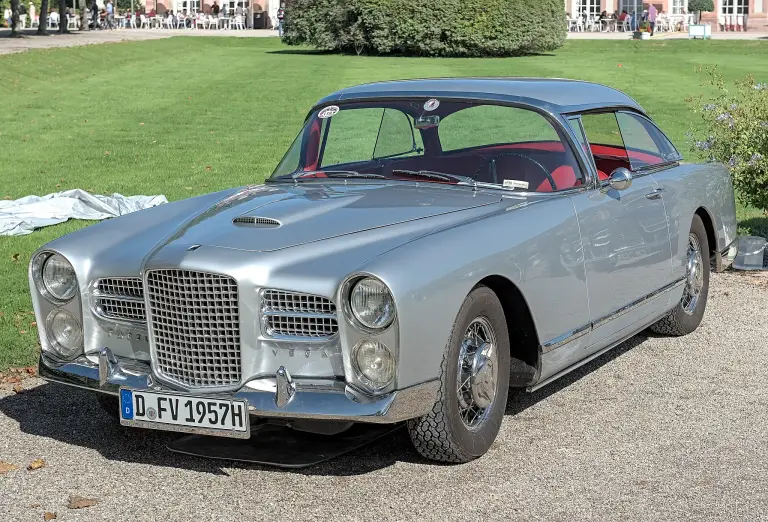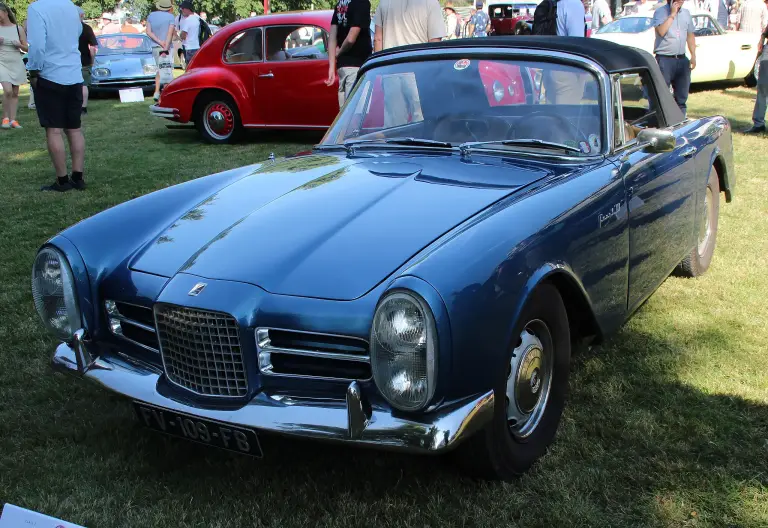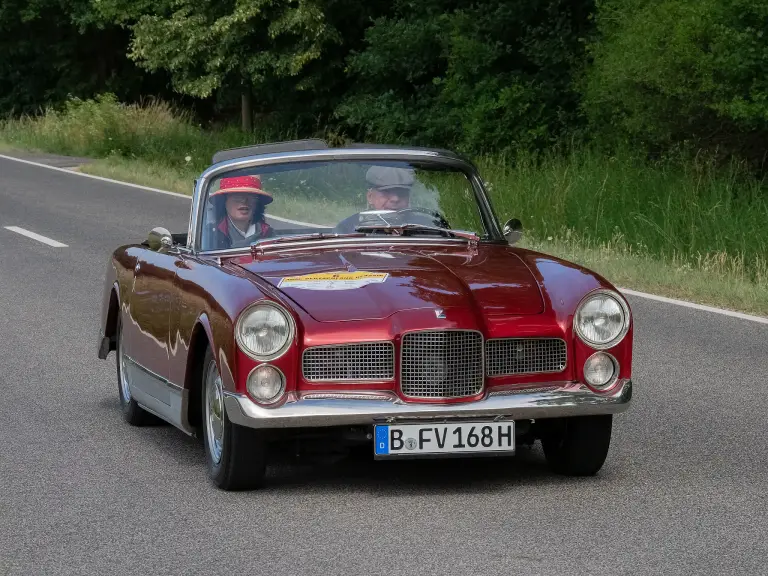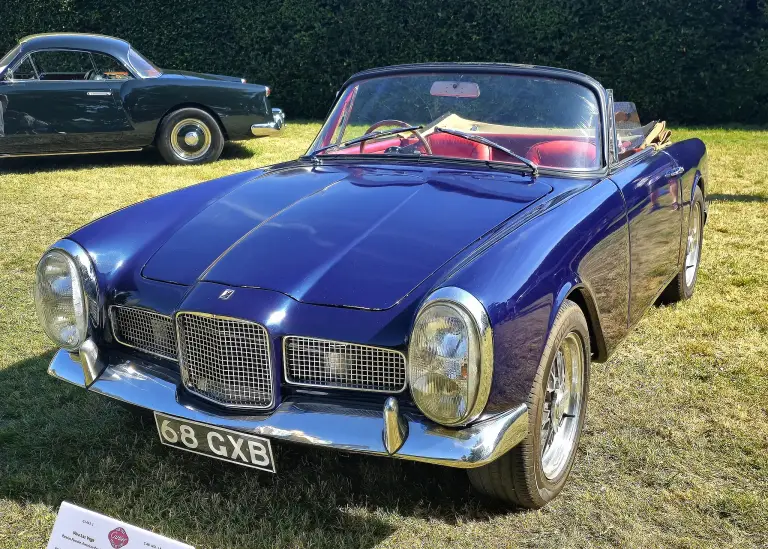
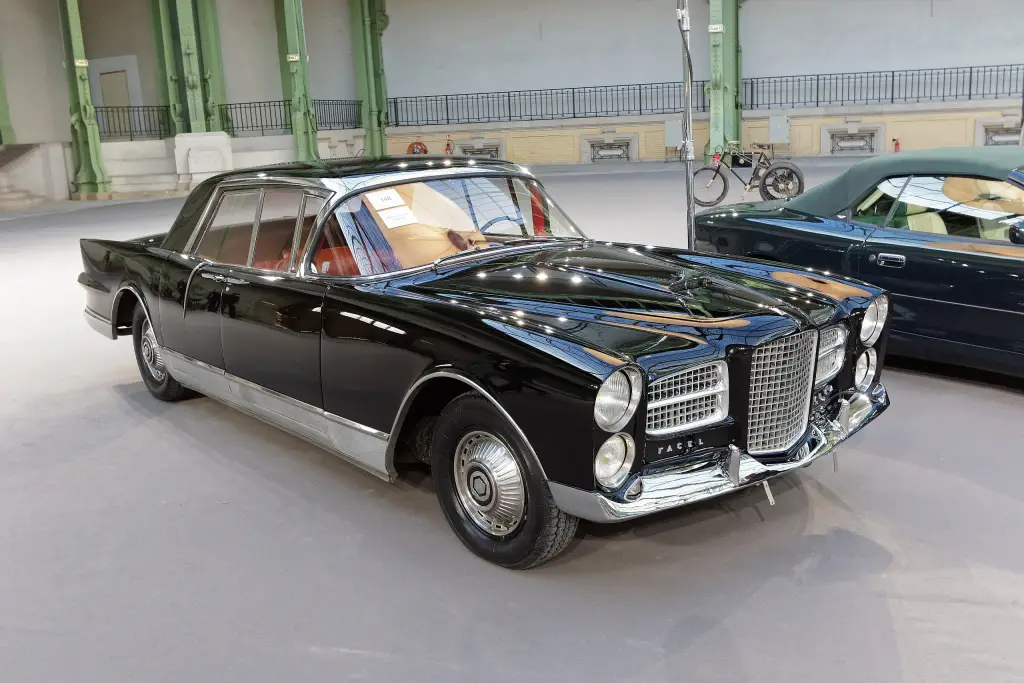
The Facel Vega Excellence was unveiled at the Paris Auto Show in October 1956 and built from 1958 to 1964. Based on a lengthened chassis from the Facel Vega FV coupé, it was the only four-door model the company ever made. Its combination of American V8 power, French coachwork and a very high price made it an alternative to the Rolls-Royce Silver Cloud and Mercedes-Benz 600.
Facel Vega Excellence at a glance
| Maker | Facel S.A., Colombes |
|---|---|
| Production | 1958–1964 |
| Types | EX, EX1, EX2 |
| Class | luxury four-door saloon |
| Engine | Chrysler V8: 6.4, 5.9 or 6.3 litres |
| Power | 355–390 hp, depending on engine and gearbox |
| Transmission | TorqueFlite automatic or Pont-à-Mousson four-speed manual |
| Doors | four, rear-hinged, without a centre pillar |
| Price when new | US$12,800, about four Citroën DS saloons |
| Built | 156 |
History of the Facel Vega Excellence
A four-door flagship
The Excellence was shown at the Paris Auto Show in October 1956 and went into production in May 1958. It used an elongated chassis from the Facel Vega FV coupé, and in France it was described as deriving from the FV3B. It was the only four-door car Facel ever built. At US$12,800 it cost about as much as four Citroën DS saloons and was an alternative to the Rolls-Royce Silver Cloud, Mercedes-Benz 600 and Lagonda Rapide. Only 156 were built, a figure explained by the price, which could be raised further by options such as power steering, power brakes, electric windows, Chrysler air conditioning and Kelsey-Hayes wire wheels.
Design
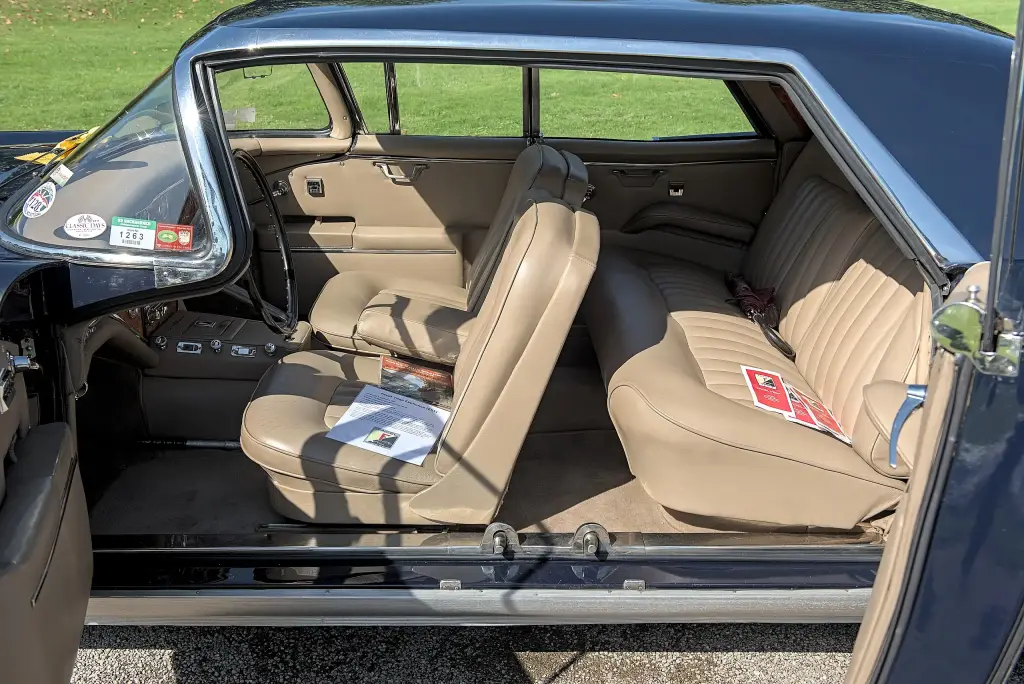
The Excellence mixed American styling cues – tail fins, a wraparound windscreen and a hardtop roof without B-pillars – with a design regarded as distinctly European, thanks to stacked quad headlights and a rakishly low profile. Its low beltline and comparatively high greenhouse anticipated the architecture that became mainstream in the late 1950s and lasted through the 1960s. The pillarless four-door layout allowed rear-hinged “suicide” rear doors that gave easier access; a large pin in the door sill let either front or rear door open independently, and when closed the doors added structural integrity. The same arrangement appeared on the limited-production Cadillac Eldorado Brougham and later on the 1961–1969 Lincoln Continental. Inside there were leather seats, a faux burled walnut dashboard with Jaeger-LeCoultre instruments, and a make-up kit in the centre armrest with a chrome-handled brush and comb and two perfume bottles, supplied empty by the factory.
EX: the Hemi-engined cars (1958)
The Paris show car of 1956 had a 331 cu in (5.4-litre) engine, but the first production Excellences used the 392 cu in (6.4-litre) Chrysler Hemi V8 of 360 hp, shared with the Facel Vega HK500 and Chrysler’s own Imperial. They could be ordered with the Pont-à-Mousson four-speed manual or the Chrysler TorqueFlite automatic, and road tests found them equal. These were genuine 140 mph cars and arguably the most powerful Excellences ever built. Only eleven EX-series cars were made, of which seven are known to survive; they can be recognised by a bonnet scoop absent on later models.
EX1 (1958–1961)
Chrysler discontinued the Hemi for 1958, and once stocks were used up Facel turned to the 361 cu in (5.9-litre) Chrysler “Wedge” V8, also rated at 360 hp. The French road tax system, based on engine displacement, is often cited as the reason Facel did not choose the larger 413. From late 1959 the Excellence could be ordered with power disc brakes at the front. This was the most numerous version, with 137 examples built according to the English source and 134 according to the French one; late cars incorporated nearly all the EX2 improvements, including the non-panoramic windscreen, chassis and steering upgrades and smaller fins.
EX2 (1961–1964)
The only significant facelift came in 1961, when the EX2 received a 383 cu in (6.3-litre) engine rated at 390 hp with the manual gearbox or 355 hp with the automatic. Contemporary tests found no significant gain in performance, and the Hemi cars remained the fastest. The EX2 lost its wraparound windscreen, the tail fins were downsized, and the chassis took on advances from the HK500 that reduced flex; door handles changed to turn-down units. Disc brakes, optional since late 1959, became standard. The EX2 is the rarest type, with eight examples built, the last finished in June 1964.
Design and features
- The only four-door Facel: a lengthened FV chassis with a pillarless body and rear-hinged rear doors.
- Chrysler V8 power: 6.4-litre Hemi, then 5.9-litre Wedge, then 6.3-litre engines, all around 360–390 hp.
- Luxury equipment: leather, Jaeger-LeCoultre instruments, air conditioning, wire wheels and a make-up kit.
- Distinctive styling: stacked quad headlights, tail fins and a wraparound windscreen on early cars.
- Rarity: 156 cars in total, including only eleven Hemi-engined EX models and eight EX2s.
Facel Vega Excellence versions
- EX (1958): 6.4-litre Hemi V8, 360 hp, bonnet scoop, eleven built.
- EX1 (1958–1961): 5.9-litre Wedge V8, 360 hp, optional front disc brakes from late 1959.
- EX2 (1961–1964): 6.3-litre V8, 355 or 390 hp, no wraparound windscreen, smaller fins, eight built.
The Excellence shared its chassis with the Facel Vega FV and its engine with the HK500. More cars are in the Facel Vega collection.
Video: Facel Vega Excellence (type EX2) 1964
Video on YouTube.
Sources
- Facel Vega Excellence, English Wikipedia: design, EX/EX1/EX2 engineering and production
- Facel Vega Excellence, French Wikipedia: production dates, types and numbers