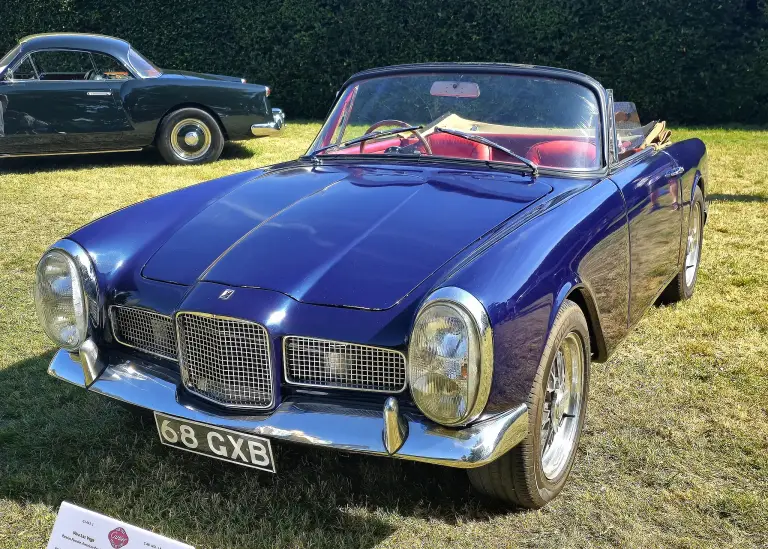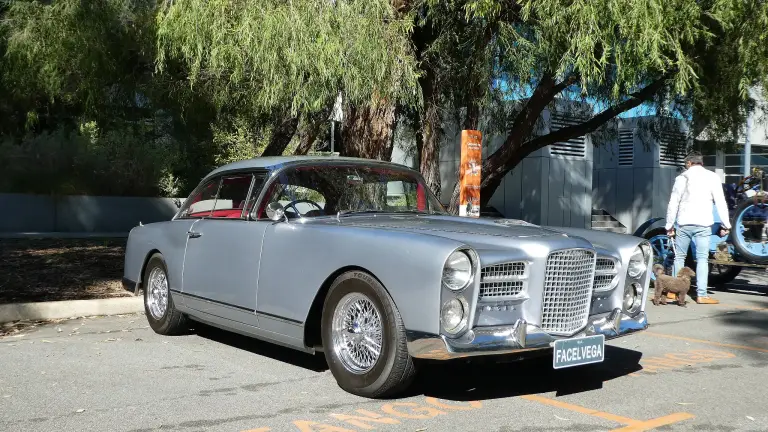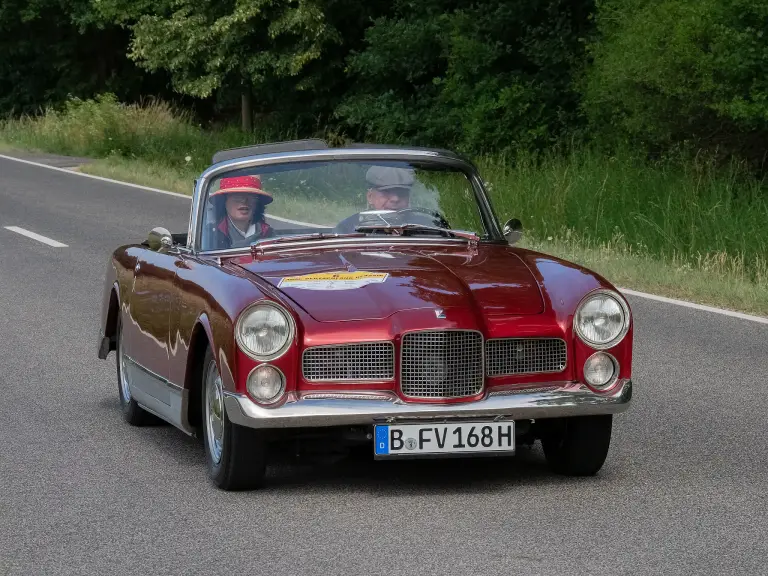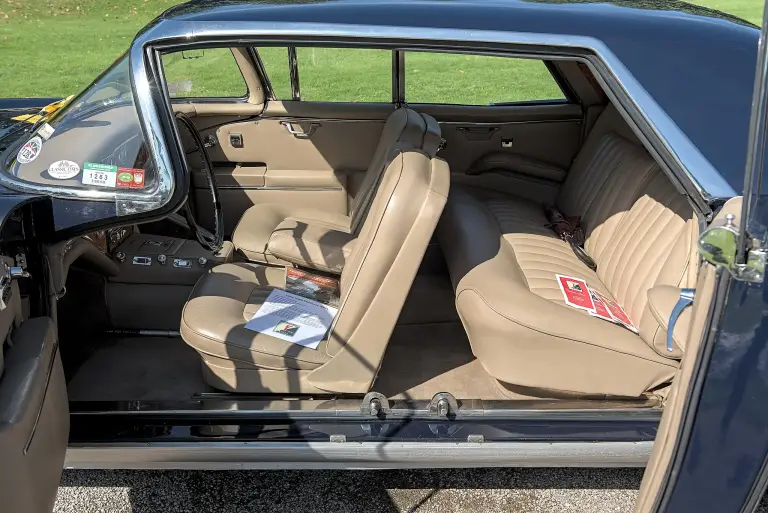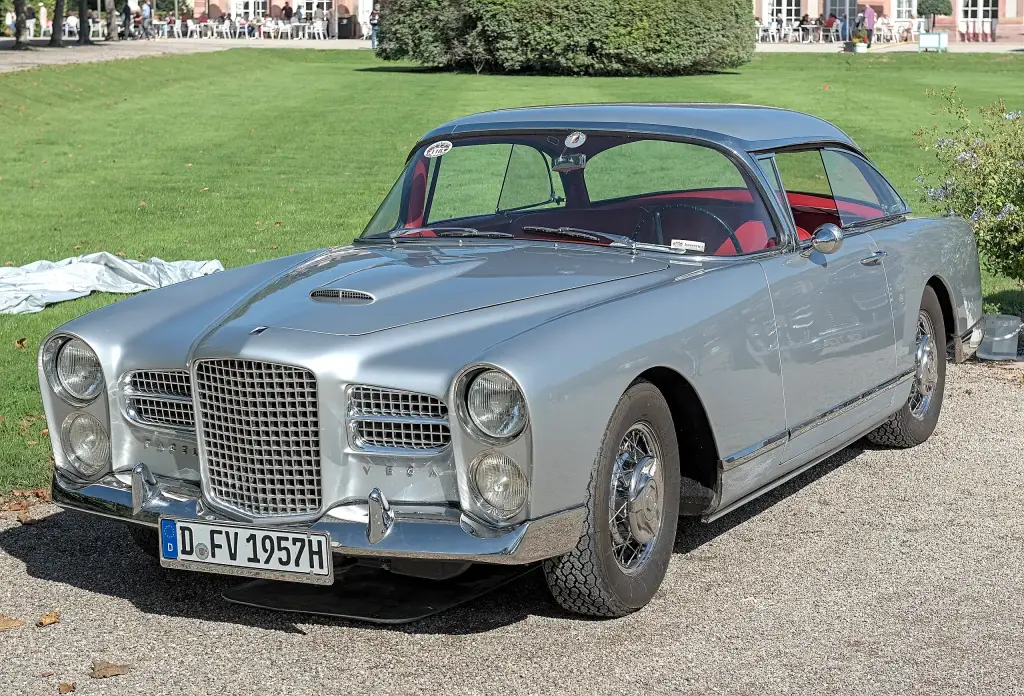
The Facel Vega FV was the first complete car built by Facel, a Paris coachbuilder that had made bodies for Simca, Ford and Panhard. Launched at the 1954 Paris Salon, it combined a stiff tubular chassis with American V8 power and French coachwork. Successive versions, the FV1, FV2, FV2B, FV3 and FV4, were built until 1959, when the model became the HK500.
Facel Vega FV at a glance
| Maker | Facel S.A., Paris and Colombes |
|---|---|
| Production | 1954–1959 |
| Also called | FVS in the United States |
| Engine | Chrysler V8, 4.5 to 5.8 litres |
| Power | 180 to 325 hp |
| Transmission | two- or three-speed automatic; four-speed manual Pont-à-Mousson |
| Chassis | tubular frame by Lance Macklin |
| Suspension | double wishbones and coil springs front, live axle on leaf springs rear |
| Top speed | 172–193 km/h in the first FV |
| Body | two-door pillarless coupé, a few convertibles |
| Built | 357 FVs and FVSs |
This page covers the whole FV series, from the FV of 1954 to the FV4 of 1958; the later HK500 has a separate page.
History of the Facel Vega FV
FV and FV1 (1954–1955)
The Facel “Vega” was shown at the 1954 Paris Salon, although the first prototype had been finished in October 1953. The model name was originally simply Vega; the letters FV, followed by a number for each iteration, came later. The 1954 car used a 4.5-litre DeSoto Firedome Hemi V8 of Chrysler origin, rated at 180 hp and driving through a two-speed Powerflite automatic or, at extra cost, a four-speed manual gearbox from Pont-à-Mousson. Depending on the rear axle ratio, the top speed was between 172 and 193 km/h. The chassis, designed by Lance Macklin, was a tubular frame with double wishbones and coil springs at the front and a leaf-sprung live rear axle.
The styling was by Jean Daninos himself. It looked American, with rudimentary tail fins, and the body was an enlarged version of the earlier Facel-bodied Simca/Ford Comète, trimmed with plenty of stainless steel. The dashboard was aircraft-inspired and was one of the first to have a centre console over the gearbox; on the FV and FV1 it was upholstered in leather. The rear seats folded flat to make a luggage platform and to give access to the boot. In 1955 the engine grew to 4.8 litres and 200 hp, and the car became the FV1, 12 cm longer than the original. Forty-seven of these early FVs were built in 1954 and 1955, seven of them convertibles; the open cars suffered from a lack of rigidity, and almost all the rest were pillarless coupés.
FV2 and FV2B (1955–1956)
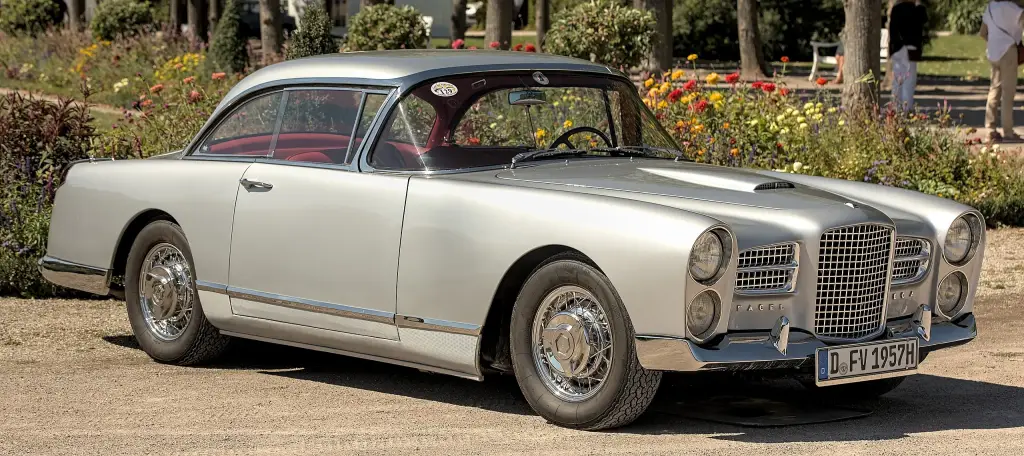
In October 1955 came the FV2, recognisable by its panoramic, wrap-around windscreen. The dashboard was now metal, hand-painted in trompe-l’il to look like burled wood by Marcel Bigot, the head of Facel’s paint department. The 4.8-litre engine was kept but now gave 250 hp. In March 1956 the FV2B arrived with a 5.4-litre engine of 285 hp and considerably more torque. The factory built one FV2 convertible, exhibited on the Facel stand at the 1955 Paris Salon, and two FV2B convertibles in 1956 for customers in the United States.
FV3, FV3B and FV4 (1956–1959)
The FV3 brought a reworked and more harmonious front end: what looked like twin stacked headlights was in fact a headlamp above an auxiliary lamp. Plymouth’s 4.5-litre Polyspheric “277 Power Pack” replaced the DeSoto Hemi and power fell to 200 hp; power steering and power brakes became standard in 1957. When Plymouth enlarged the engine to the 301 for 1957, Facel followed with the FV3B, which also received slightly longer and wider bodywork after the first twelve cars were completed in March 1957. For 1958 the engine grew to 5.8 litres and 325 hp in the FV4, although the 4.5- and 4.9-litre cars remained available and all three were built alongside each other.
The series ended in 1959 when the renamed and upgraded HK500 took over. In total 357 FVs and FVSs were built. The FV2 also has a sad place in history: on 4 January 1960 the publisher Michel Gallimard lost control of one near Villeblevin, and the crash killed him and his passenger, the Nobel laureate Albert Camus.
Design and features
- Chrysler V8 power: American engines gave the French body the performance French makers could not offer in the mid-1950s.
- Tubular chassis: Lance Macklin’s frame with double wishbones at the front was stiff and conventional in the American manner.
- Aircraft-style dashboard: a centre console over the gearbox and, on early cars, a leather-covered fascia.
- Panoramic windscreen: introduced on the FV2 in October 1955 and a hallmark of the series afterwards.
- Hand-painted dashboard: the FV2’s metal fascia was painted in trompe-l’il by Marcel Bigot to imitate burled wood.
Facel Vega FV versions
- FV (1954): 4.5-litre Hemi V8, 180 hp, two-speed automatic or four-speed manual.
- FV1 (1955): 4.8-litre engine, 200 hp, 12 cm longer than the original.
- FV2 (1955): panoramic windscreen, hand-painted dashboard, 250 hp.
- FV2B (1956): 5.4-litre engine, 285 hp and more torque.
- FV3 and FV3B (1956–1957): stacked headlights, Plymouth engines, from 1957 a longer and wider body.
- FV4 (1958): 5.8-litre engine, 325 hp, built alongside the smaller-engined versions.
The FV series was replaced by the Facel Vega HK500, and the four-door member of the family was the Facel Vega Excellence. More cars are in the Facel Vega collection.
Video: Le Mans Classic 2012 Facel Véga FV1
Video on YouTube.
Sources
- Facel Vega FV, English Wikipedia: history, engines, production, Camus crash
- Facel Vega FV2 et FV2B, French Wikipedia: FV2 and FV2B details, convertibles